
Current Issue
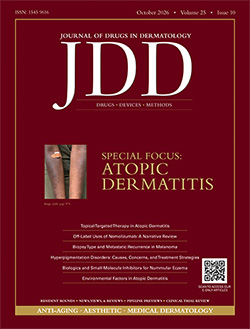
October 2026 | Volume 25 | Issue 10
Editorials
Association Between Sodium-Glucose Cotransporter-2 Inhibitors and Vulvar Pruritus Without Vulvovaginal Candidiasis: A TriNetX-Based Analysis
Differences in Atopic Dermatitis Comorbidity and Treatment Patterns by Race
Assessing the Variability of Dermatologic Needs in American Indian/Alaskan Native Populations: A Single-Center Retrospective Analysis
Original Articles
Nordic European Countries Atopic Dermatitis (NECAD) I: Importance of Concordance With Skincare for Atopic Dermatitis
Background: Atopic dermatitis (AD) is a chronic disease with a dysfunctional skin barrier, requiring continuous management to reduce symptoms and prevent flares. Topical treatment comprises the corner...
Read MoreThe Essential Role of Topical Targeted Therapy in Atopic Dermatitis
Background: Atopic dermatitis (AD) is a chronic inflammatory skin disorder marked by immune dysregulation, epidermal barrier dysfunction, microbiome imbalance, pruritus, and xerosis. Despite therapeut...
Read MoreA Narrative Review of Seven Off-Label Treatment Options for Seborrheic Dermatitis
Background: Seborrheic dermatitis (SD) is a chronic inflammatory skin condition driven by overactive sebaceous glands, Malassezia colonization, immune dysfunction, and epidermal barrier disruption. Wh...
Read MoreOff-Label Uses of Nemolizumab: A Narrative Review
Background: Nemolizumab, a humanized monoclonal antibody targeting interleukin-31 receptor α (IL-31Rα), is approved for atopic dermatitis (AD) and prurigo nodularis (PN) in adults and pedi...
Read MoreSAIGE III: The Role of Environmental Factors in the Development and Severity of Atopic Dermatitis in Young Children
Background: Atopic dermatitis (AD) often manifests in infancy or early childhood, with significant impacts on quality of life and potential persistence into adulthood. Environmental factors are key co...
Read MoreFundamentals of Hyperpigmentation Disorders: Causes, Concerns, and Treatment Strategies, Particularly in Skin of Color Patients
Background: Pigmentary disorders, including hyperpigmentation, are among the most common dermatologic diagnoses in individuals with skin of color (SOC), particularly individuals with African, Asian, o...
Read MoreInjectable NASHA Gel Skinbooster for Facial Skin Aging in Premenopausal and Postmenopausal Women With Estrogen Deficiency-Associated Not Receiving Hormone Therapy: A Case Series
Background: Estrogen deficiency contributes substantially to intrinsic skin aging by reducing dermal collagen, impairing hydration, decreasing elasticity, and compromising overall skin quality. Althou...
Read MoreHistological Analysis Shows That a Moisturizer Formulated for Dermatoporosis Increases Elastin Content and Improves Skin Elasticity
Background: Dermatoporosis involves age-related alterations in dermal structure and cellular function, including changes in collagen, elastin, and markers of skin senescence. Changes in skin biomarker...
Read MoreBiopsy Type and Metastatic Recurrence in Melanoma: A Cohort Study
Background: Melanoma is a dynamic health problem caused by deteriorating melanocytes that generate aberrant melanin that gives color to the skin. It remains the leading cause of death from skin cancer...
Read MoreContact Allergens Associated With Nummular Eczema: A Systematic Review
Background: Nummular eczema (NE) is a prevalent and chronic inflammatory dermatosis marked by pruritic, coin-shaped eczematous plaques. Contact allergen sensitization may play a role in NE etiology. ...
Read MoreBiologics and Small-Molecule Inhibitors for the Treatment of Nummular Eczema: A Systematic Review
Background: Nummular eczema (NE) is a chronic, pruritic dermatitis with substantial patient burden and no FDA-approved therapies. Emerging data suggest that biologics and small-molecule inhibitors may...
Read More
Features
Case Reports
Cicatricial Ectropion in the Setting of IL-13 Inhibition
Introduction: Interleukin (IL)-13 is a key mediator of type 2 inflammation and an important therapeutic target in atopic dermatitis (AD). Although IL-4/IL-13 and IL-13 inhibitors demonstrate favorable...
Read MorePulsed Dye Laser for Sensory Dysesthesias Associated With Chronic Radiation Dermatitis
Chronic radiation dermatitis (CRD) is a long-term complication of radiation therapy, typically manifesting as scarred atrophic plaques with telangiectasias. In some cases, patients report persistent s...
Read More
Departments
FULL SUPPLEMENT: Tildrakizumab In Everyday Dermatology: Clinical Insights From Challenging Psoriasis Cases
Tildrakizumab is a humanized immunoglobulin G1 (IgG1) monoclonal antibody that selectively binds the p19 subunit of interleukin-23 (IL-23), a key cytokine in the pathogenesis of psoriasis. In the pivo...
Read MoreFULL SUPPLEMENT: Ammonium Lactate for Xerotic Skin Conditions: Biomimetic Effects and Clinical Relevance
Xerosis is a common and clinically significant dermatologic concern, affecting patients across a broad spectrum of conditions, including atopic dermatitis, psoriasis, ichthyosis, and age- or environme...
Read More
Supplements
INDIVIDUAL ARTICLE: Tildrakizumab for Real-World Psoriasis Care: Clinical Lessons From Medically Complex and Underserved Patient Populations
Tildrakizumab, a humanized monoclonal antibody targeting the p19 subunit of interleukin-23, has demonstrated durable efficacy and a favorable long-term safety profile in moderate-to-severe plaque psor...
Read MoreINDIVIDUAL ARTICLE: Beyond Moisturization: Ammonium Lactate as a Biomimetic Regulator of Skin Barrier Function
The stratum corneum (SC) is essential for maintaining skin barrier integrity through coordinated interactions between corneocytes, intercellular lipids, and natural moisturizing factors (NMFs). Lactat...
Read MoreINDIVIDUAL ARTICLE: Ammonium Lactate in Clinical Practice: Optimizing Treatment of Xerotic and Hyperkeratotic Skin Conditions
Ammonium lactate is a well-established, time-tested dermatologic therapy with a substantial body of clinical evidence supporting its use in xerotic and hyperkeratotic skin conditions. Although its us...
Read More