

Psoriasis is a chronic disease that can affect many areas of the body. The use of topical corticosteroids (TCS) is a common treatment, although long-term safety of TCS remains a concern.
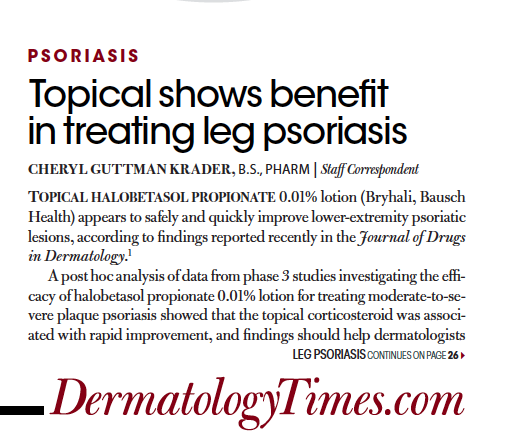
A recent article in Dermatology Times cites a Journal of Drugs in Dermatology study which examines how Topical Halobetsol Propionate 0.01% lotion appears to “safely and quickly improve lower-extremity psoriatic lesions,” over typical TCS treatments.
“A post hoc analysis of data from phase 3 studies investigating the e fficacy of halobetasol propionate 0.01% lotion for treating moderate-to-severe plaque psoriasis showed that the topical corticosteroid was associated with rapid improvement, and findings should help dermatologists with treatment decisions for patients with disease involving leg lesions, said Neal Bhatia, M.D., director of clinical dermatology at Therapeutics Clinical Research, San Diego, and the lead author of the paper.”
At the conclusion of the eight-week treatment, the rate of success was significantly higher for patients randomized to once-daily treatment with halobetasol 0.01% lotion compared with vehicle-treated controls (P<.001 for both comparisons).
View Article Now
You May Also Like
 ICYMI: Most Popular Articles From the Summer JDD
ICYMI: Most Popular Articles From the Summer JDD
Leaves are falling and nights are getting longer — fall is here. Even if summer felt like it went by in a blink, it's important not to miss developments in…
 JDD in the News: JDD in the News: Dermatology Clinician Perspectives on Sunscreen
JDD in the News: JDD in the News: Dermatology Clinician Perspectives on Sunscreen
The August issue of Dermatology Times featured an article written by dermatologist Darrell Rigel, MD, FAAD, about his 2025 Journal of Drugs in Dermatology study on dermatology clinician perspectives on…
 JDD in the News: UV Light as a Workplace Hazard
JDD in the News: UV Light as a Workplace Hazard
Healio featured two Journal of Drugs in Dermatology studies in recent articles, including an article on UV light as an underappreciated workplace hazard. The study, "Sun Exposure and Cancer Outcomes…