
New JDD Analysis Links Google Search Interest to Dermatologist Shortages by State
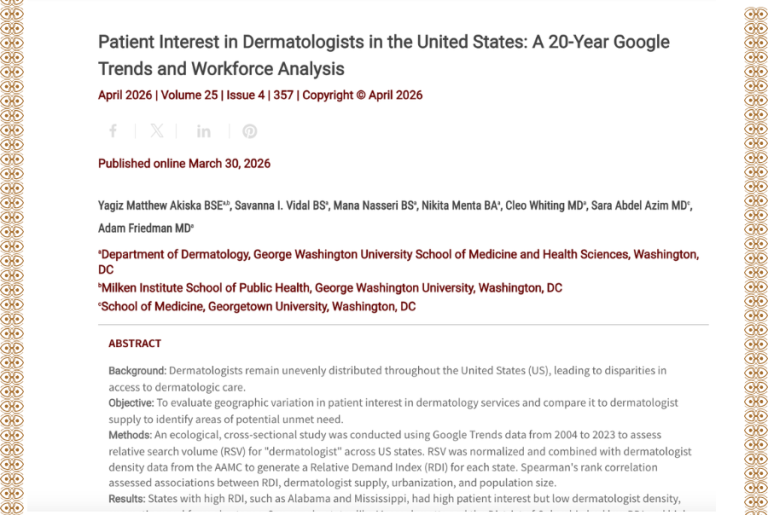
Have you read this article from the JDD? A recent paper examines geographic variation in patient interest for dermatology services across the United States and compares that interest to dermatologist supply, using Google Trends data and AAMC provider counts to identify potential pockets of unmet need.
The investigators calculated a Relative Demand Index that combines normalized search volume for the term dermatologist from 2004 to 2023 with state-level dermatologist density. States including Alabama and Mississippi showed high relative demand paired with low provider density, while Massachusetts and the District of Columbia demonstrated the opposite pattern. The study reports a strong inverse correlation between Relative Demand Index and dermatologist density, with Spearman correlation coefficient of minus 0.76 and a highly significant P value. Methods and state-level results are presented in the full article, alongside discussion of implications for workforce distribution and access to dermatologic care.
The authors note important limitations, specifically reliance on a single keyword and on Google search data, which assumes internet access and may miss local nuances at the county level. Despite these caveats, the findings highlight potential disparities in dermatology access that may inform workforce planning, teledermatology deployment, and health equity efforts.
Practicing dermatologists and dermatology healthcare professionals interested in workforce planning, clinic outreach, or regional access strategies will likely find the state-level metrics and methodological details relevant. For a closer look at how the Relative Demand Index was derived and which states might warrant targeted interventions, review the full JDD report to assess applicability to your practice or health system.
Blog write-up assisted by AI