
Issue Archive
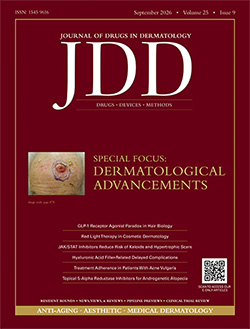
September 2026 | Volume 25 | Issue 9
Editorials
Postoperative Complication Risks in Melanoma in situ Treated With Mohs Surgery or Wide Local Excision
Differences in Keloid and Hypertrophic Scar Treatment Patterns by Race
Standardized Suture Tail Cutting Technique for Enhanced Cosmesis in Epidermal Closure
Application of Primary Closure in Nasal Reconstruction: A Case Series Research Letter
Original Articles
Red Light Therapy in Cosmetic Dermatology: Marketing Claims Backed by Evidence?
Background: Red light therapy (RLT) is a non-invasive modality that uses visible red wavelengths (approximately 620–700 nm) to modulate cellular activity. By stimulating mitochondrial cytochrome...
Read MoreBotulinum Toxin in Facial Paralysis: A Neuroaesthetic Framework for Functional, Therapeutic, and Aesthetic Correction
Background: Facial paralysis (FP) produces functional deficits and facial asymmetry that may include neuromuscular discoordination with synkinesis, painful muscle contractions, disturbing facial spasm...
Read MoreClinical Evidence of Skin Improvements With a Biologically Active Multimodal Topical Skin Treatment
Background: Antiaging skin treatments are continuously in development to meet the needs of an aging population and counteract cosmetic effects of glucagon-like peptide-1 receptor agonists. Peptide Fac...
Read MoreTopical Carboxytherapy as an Adjunct to Skin Recovery Post-CO2 Laser Fractional Resurfacing
Background: Topical carboxytherapy, a transcutaneous carbon dioxide (CO2) delivery system, may support skin repair and regeneration, yet its role as an adjunct to fractional laser treatment remains un...
Read MoreCardamonin Inhibits Keloid Fibroblast Activation and Extracellular Matrix Production Through Suppression of TGF-β1/Smad Signaling
Background: Keloids are pathological scars characterized by persistent fibroblast activation and excessive extracellular matrix (ECM) deposition. Cardamonin (CARD), a natural chalcone compound, has de...
Read MoreSafety and Tolerability of Facial Skincare in Children and Adolescents: Clinical Testing and Multigenerational Insights
Background: Pediatric and adolescent interest in facial skincare is increasing, often driven by social media and early exposure to adult-formulated products. Objective: To evaluate the safety of skin...
Read MoreA Novel Moisturizer Formulated With Micronized Centella asiatica and Mandelic Acid Improves Mature, Crepey Skin
Background: Dermatoporosis is a condition of fragile, aging skin that manifests as altered pH, wrinkles, laxity, easy bruising, and hyperpigmentation. This study evaluated efficacy, safety, and subjec...
Read MoreRisk Factors Associated With Hyaluronic Acid Filler-Related Delayed Complications: A Literature Review and Expert Consensus
Background: Delayed complications associated with hyaluronic acid (HA) fillers are a concern in aesthetic medicine. However, clinical strategies for mitigation remain inconsistent, and guidelines ofte...
Read MoreEyebrow Madarosis: An Updated Review of the Etiology and Management, Part II– Scarring Disorders
Background: Eyebrows play an essential role in facial symmetry, communication, and aesthetic identity. Scarring eyebrow alopecia results from inflammatory, autoimmune, infectious, genetic, traumatic, ...
Read MoreTreatment Adherence in Patients With Acne Vulgaris: A Narrative Review
Background: Acne vulgaris is a common dermatologic condition often requiring treatment using multiple mechanisms of action over a long time course to adequately clear symptoms. However, adherence to a...
Read MoreJAK/STAT Inhibitors Reduce Risk of New-Onset Keloids and Hypertrophic Scars: A Multi-Center Retrospective Cohort Study
Background: Keloids and hypertrophic scars are fibroproliferative skin disorders characterized by excessive collagen deposition and high recurrence rates despite existing therapies. Emerging evidence ...
Read MoreBody Contouring By Ultrasound-Induced Lipolysis
Background: The body contouring market has undergone a paradigm shift from invasive surgical procedures to advanced noninvasive treatments. Noninvasive fat-reducing devices based on nonfocused ultraso...
Read More
Features
Extracellular Matrix Remodeling as a Driver of Skin Tightening and Skin Quality: TriHex+ and Device-Assisted Delivery
GLP-1 Receptor Agonist Paradox in Hair Biology: A Biphasic dWAT–Follicle Signaling Hypothesis
Secondary Intention Healing Over Periosteum: Challenging the Reconstruction Algorithm for Supraperiosteal Defects
Current Considerations for Laser and Energy-Based Devices in Transgender Patient Care
Review of the Efficacy of Topical 5-Alpha Reductase Inhibitors for the Treatment of Androgenetic Alopecia
Case Reports
Systemic Corticosteroids in the Perioperative Setting for Prevention of Pyoderma Gangrenosum During Reconstructive Surgery
Pyoderma gangrenosum (PG) is classified as a neutrophilic dermatosis, often presenting as a rapidly enlarging ulcer and associated with inflammatory bowel disease, specifically ulcerative colitis and ...
Read MoreTopical Sirolimus for Refractory Cutis Marmorata Telangiectatica Congenita in Adulthood: A Case Report
Cutis marmorata telangiectatica congenita (CMTC) is a rare congenital vascular disorder characterized by persistent, violaceous, reticulated skin changes that may be complicated by painful ulcerations...
Read More
Departments
FULL SUPPLEMENT: The Role of IL 31 Inhibition in Atopic Dermatitis
Atopic dermatitis and prurigo nodularis represent the two most burdensome pruritic inflammatory skin diseases encountered in clinical dermatology. While distinct in morphology, chronicity, and epidemi...
Read MoreFULL SUPPLEMENT: Real-World Split-Face Case Series of a Phyto Polydeoxyribonucleotide (PDRN) Serum in Integrative Skincare
Inflammation and photodamage are largely considered the leading contributors to premature skin aging as they lead to decreased collagen content in the skin. Collagen, the most abundant protein in the ...
Read More
Supplements
INDIVIDUAL ARTICLE: Real-World Cases Using Phyto Polydeoxyribonucleotide (PDRN) Serum
Background: Integrative skincare refers to a clinician-directed regimen that combines aesthetic procedures with appropriate post-procedure skincare. The novel phyto polydeoxyribonucleotides (PDRN) for...
Read MoreINDIVIDUAL ARTICLE: Interleukin-31 in Atopic Dermatitis and Prurigo Nodularis: Pathophysiology, Neuroimmune Mechanisms, and Clinical Efficacy of Nemolizumab
Interleukin-31 (IL-31) is a central mediator in atopic dermatitis (AD) and prurigo nodularis (PN), functioning both as the principal pruritogenic cytokine, driving itch through direct neuronal activa...
Read More