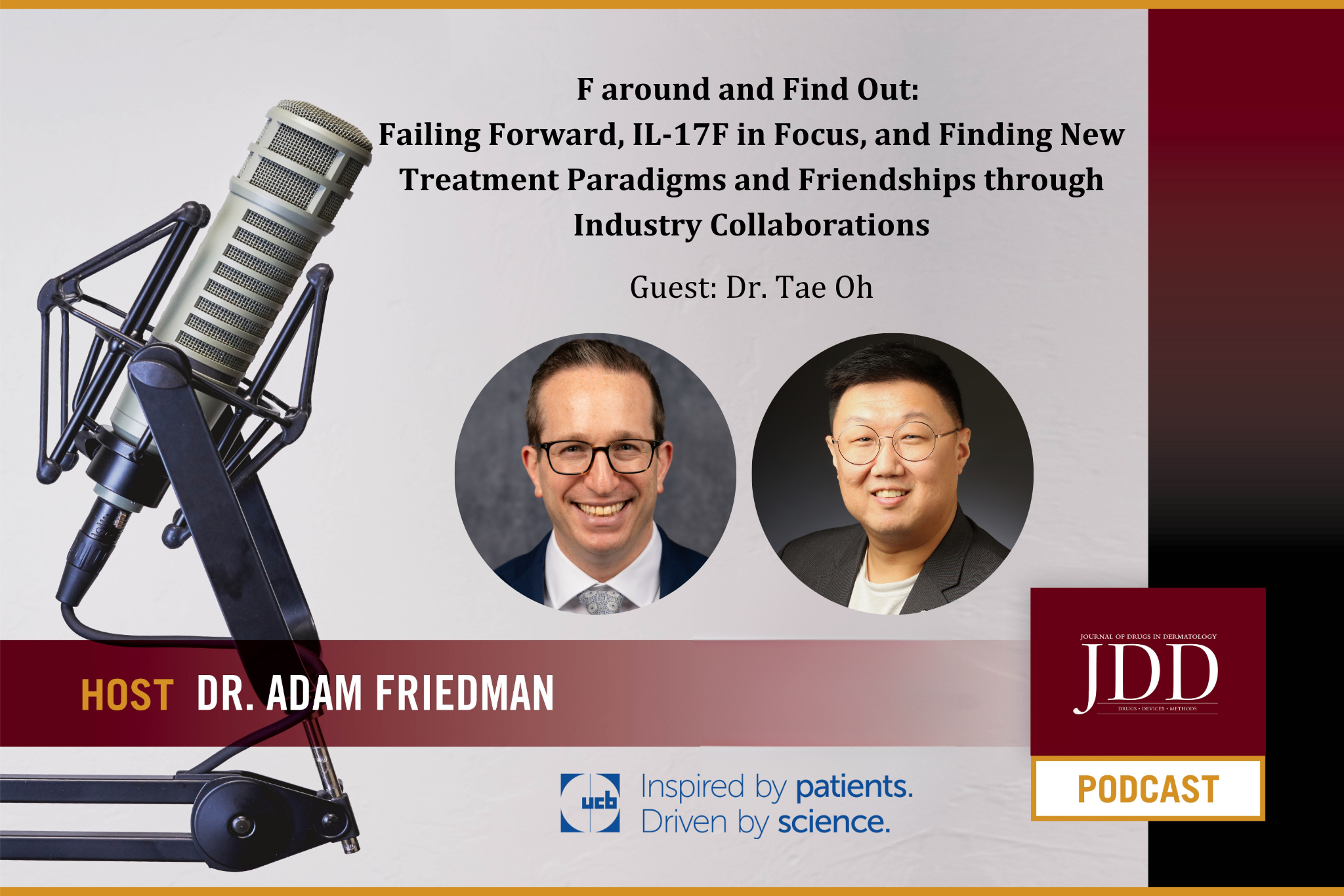
F around and Find Out: Failing Forward, IL-17F in Focus, and Finding New Treatment Paradigms and Friendships through Industry Collaborations
Guest: Dr. Tae Oh
For too long, the therapeutic ladder in hidradenitis suppurativa has often looked less like a ladder and more like an uneven mound: try this, fail that, wait, escalate, repeat. But while we are waiting, HS certainly isn’t. Inflammation marches on, tunnels form, scars accumulate, and what was potentially preventable disease becomes permanent architectural damage. So perhaps the better question isn’t when has the patient failed enough to earn advanced therapy, but rather when do we have enough evidence to justify waiting? JDD Podcast host Dr. Adam Friedman is joined by Dr. Tae Oh, Head of Medical Affairs for Dermatology in the US at UCB, to challenge the conventional “save it for later” mentality and examine how our evolving understanding of HS pathogenesis should reshape the treatment paradigm.
Tune in as they go beyond the bottle to explore industry’s role moving past the molecule. Can therapeutic development help expose the true prevalence and burden of an underrecognized disease? What responsibilities do industry partners have in disease awareness, education, evidence generation, patient identification, and ultimately defining not simply whether a therapy works, but when it should be used? Then it’s down to the follicular unit. Drs. Friedman and Oh dig into what our evolving understanding of HS initiation and propagation means at the bedside. If inflammation ultimately contributes to irreversible tunnels, scarring, pain, and disfigurement, is there a window of opportunity when earlier intervention could alter the trajectory before inflammatory disease becomes structural disease? And finally, the uncomfortable question…Are we making patients fail their way toward effective treatment? From therapeutic inertia and payer barriers to biologics, procedures, disease modification, and the consequences of undertreatment, this episode challenges one of medicine’s most persistent assumptions, that doing less first is inherently safer or smarter.
01:22 – Introduction
Dr. Adam Friedman: It is so great to have you here, Dr. Oh.
Dr. Tae Oh: Hey, Adam. So great to be here with you. Thanks for the opportunity.
02:00 – Industry Contributions Beyond Drug Development and Derm In Review
Dr. Adam Friedman:
Absolutely. All right, Tae, let’s dive in. I think there are a couple of different areas I want to hit on with you. But especially, you know, I think that there’s somewhat of a nebulous or unclear area with respect to a lot of what goes on behind the scenes in industry. And I think certainly when we talk about pharmaceutical innovation, we focus on the molecule, we focus on the drug, we focus on the pipeline. And my first question, but I’m going to preface this with something else first, but my first question really is going to be about ways industry is addressing unmet needs beyond simply developing another drug but before you answer it I do want to share something with our audience something that’s really important and this especially is for our residents and our recently graduated early career dermatologists. Many years ago, I’m not gonna say how many and it wasn’t that long ago, my friend here Tae and I were sitting at a lovely meal talking about just this very question. And one of the areas of need at that time was support for Derm In Review, which, as many of you listening know, is one of the largest and certainly multifaceted board of review programs that offers a binder or book, a guide, a mini guide, images, questions, the list goes kind of on and on. And of course, by bringing this up as self-serving as, you know, the JDD, Drugs in Dermatology is part of that universe. But at the time, it was unclear if this program, which I would argue probably every resident uses to pass their core or basic and even applied exams, would go on. And Tae stepped up to the plate. And while many will say, oh, yeah we’ll do this, we’ll take care of this and all that jazz, his words turned into action and it was actually Tae and UCB’s investment that led to the continuity and even expansion of this program so I think this question is almost answered by your actions so I wanted to give credit where credit is due given the important impact of that not just in the moment saying yeah we’re gonna take this on but actually following through which behind the scenes I know takes many many months and many sleepless nights. So I do want to appreciate that and make sure everyone is aware of that. But along those lines and in that kind of same context, how do you see industry addressing unmet needs whether it be for patients whether it be for our community? And I think you already have a very good footing in that area and certainly are appropriate to answer that.
Dr. Tae Oh:
Yeah, you’re so nice, Adam. I still remember that as well. That’s I think that’s the key it’s the partnership that we’re able to create and I think like you said, there’s this kind of misnomer a little bit about the pharmaceutical industry and how we’re only investing in kind of selling a drug, creating the drug, but really, it’s way beyond that, our kind of contributions to education, updated information especially in a world today where there’s so much misinformation in the world. It’s our duty, and we have the kind of scientific rigor, we have the right ethics and compliance behind it to make sure that people are well-educated on the very topics that we have an investment. And so I do want to acknowledge Derm In Review. I think it’s one of the greatest initiatives and greatest things that could be available to residents. You know what the greatest thing for me is? When I go to different institutions, I’m meeting with their residency directors or I go to your office and I see the Derm In Review book on their shelves.Like that is probably the coolest thing.
Dr. Adam Friedman:
Like I know that. I know that book!
05:27 – Direct-To-Consumer Campaigns and Disease State Awareness
Dr. Tae Oh:
Yeah, so we’re really happy to be able to partner and make sure that, you know, the education is given. But beyond that, it’s one of those things. The other part that I think people see industry put in a lot of dollars into is DTC, direct to consumer. advertisements right. But I think they only see that in one. kind of light and that’s, oh, they’re trying to sell their drug but sometimes it doesn’t get acknowledged that we’re actually doing direct-to-consumer on disease state awareness, right? And I talk about this all the time. Like, Adam, would tell me, like in the past few years, would you think that self-diagnosed or patients are coming more to you saying like, hey, I think I have HS. Can you check for me? Is that happening a lot now?
Dr. Adam Friedman
It is 100% happening. And I’m so glad you brought that up because I think the first time I had that kind of aha moment of how valuable that is was actually when the first FDA-approved topicals, more of a towelette than a topical, for hyperhidrosis, primary idiopathic hyperhidrosis came out. And that’s a disease where it’s like, is sweating really a disease? And there’s so, I mean, HS I think is a great example of a disease that’s misunderstood,hyperhidrosis even more so. And now you have all this direct-to-consumer marketing about a disease state. And it was the first time I ever saw patients come and say, I think I have this condition. or something. And I’m like, whoa, like, wow, this isn’t just about marketing a drug. Like this is actually helping patients get to where they need to be. And you are absolutely right. We have seen such a shift in patients, not just coming in, needing to be told from start to finish what this condition is. But also, and I think even more importantly, we’ll probably get into the you know window of opportunity, so to speak, they’re coming in earlier. They’re coming in at an earlier time point in their disease because of all that education that is hitting the airwaves. and i’d probably say This is one of the good places where social media is is actually an ad, you know, a value add to society versus a detractor. But you are absolutely right. I am seeing so much more of the positive influence of direct consumer marketing and that driving patients in earlier in their days, but also.Maybe a little bit at a… further along place that doesn’t require me starting with like the 101 mentality.
Dr. Tae Oh
Yeah. I’m so glad you said that because that’s where some of our investments go into. We’re hypervigilant about understanding a condition and the inflection points within a patient’s journey. So you kind of hit the nail on the head, right? Like patients are coming in earlier. And I’m going to kind of concentrate around HS just because that’s a lot of work that we did here at UCB around that. We know that when we started this journey several years ago, we saw that the misdiagnoses, the underdiagnoses, were leading to patients not understanding what they had for up to seven to 10 years, Which is… incredible, right? Like, I mean, if you’re a patient with this kind of condition, going to going into a healthcare system is daunting as it is, but to Walk out of it. and not know what you have is probably the scariest thing ever. Right. And so what we said was, OK, not only do we need to raise the awareness about what this condition is.But what do we do about it?And that’s that urge, right? We’re like, hey, we need to treat this earlier. You need to see the right specialists so that they can get you on appropriate medical management or surgical intervention as needed. So, you know, a lot of our investments going back to what I was saying about DTC, it’s not just about the drug, it’s about making sure that patients are aware. And here’s the biggest thing too: it’s not just the patients themselves, it’s caregivers, friends, your whole community, right? We have all of these rural communities where maybe not everybody has TV or that’s not their main source of information. And so we have to really partner with these different channels to get this information into their hands, maybe that’s radio and you brought it up, right, social influencers and things like that, so digital platform. So it’s really important for us to kind of invest in that way as well.
09:52 – Disease Burden vs. Drug Development Dynamics
Dr. Adam Friedman
So, yeah, and maybe you kind of hit on this already a little bit, but I’m thinking of almost like a chicken and egg type situation in that the question is, does recognizing disease burden, the unmet need, does that drive drug development, or is it more that drug development is actually helping us better recognize the true magnitude of disease burden and the gaps that ultimately that drug can help fill, let alone open the door for more opportunities in research innovation? And you kind of hit on that with where you start in looking at that number that unfortunately, at least as far as we know, has not changed, though it will take a long time to see that change, that delay in seven to 10 years from start to diagnosis. But yeah, what are your thoughts about that kind of, you know, dichotomy in that, does appreciating the burden first really drive drug development or is it something else? But I think, and don’t want to bias you, I think actually when we get new drugs, especially drugs that are very targeted towards the underpinnings of the disease, we actually learn a lot more about the disease.
Dr. Tae Oh
Yeah. I agree with you. I think it is kind of a chicken or an egg. And I think every great innovation in science we’ve had is not always deliberate,right, like sometimes we find these by accident and the good thing is that we’re invested in the research. And just to let you know, right, this just goes to history,we know that, like I’m once again concentrating on HS here a little bit, that if you looked at like the epidermal histology of psoriasis lesions and HS lesions, they’re very similar. So I don’t want to say it’s easier, but it’s definitely a recognition from… researchers and manufacturers say, okay, if we have medicines and research that are already deep with psoriasis, maybe this can contribute to HS. Now that was the thinking back then, but as we go down this endeavor of understanding HS more. Knowing that it’s oh my gosh there’s a huge unmet need and there’s a lot of different opportunities to kind of attack this condition from different ways that may have been how we started but it’s not where we are now. Now we’re deliberately saying, okay, there’s still other elements. where there’s unmet needs with this disease that we can attack if we use a different mechanism of action or a different delivery route or whatever it is that we’re trying to kind of solve for.
Dr. Adam Friedman: You know, it’s interesting in hearing you talk about, and it makes perfect sense from especially with the bimekizumab story from psoriasis to HS, it almost makes me think that there really is an opportunity for collaboration there because to your point of how diseases, while distinct, and we’re seeing this maybe in parallel talk about, you know, the kind of T2 spectrum of inflammatory diseases, distinct diseases. with shared biology or pathophysiology and in these cases can then lend itself to say well hey if they have similar underpinnings.then maybe targeting this here as well will be useful. So that’s kind of what I’m hearing in terms of maybe what lit the match. But then, of course, as you’re seeing the impact, you start learning more and more about the disease. And I think, for example, in the pathway from that lateral transition or the lateral expansion from the psoriasis, right, arthritis indication to hidradenitis suppurativa, I think we learned a lot about HS in what is,not necessarily there’s a direct linear correlation, but knowing that, well, interesting, we’re seeing that there’s more IL-17F versus A, not that we know what that necessarily translates into clinically, but correct me if I’m wrong, that wasn’t even part of the conversation until this pipeline began, correct?
Dr. Tae Oh: Yeah, exactly And we’re we’re so lucky because there’s so many researchers out there doing all of this work in advance, right? So even um how this actual conversation even started with HS was way before the clinical trials started, right? So about, you know, seven, eight years ago, when we already knew that we wanted to go into HS, we’re like, okay, let’s scour the internet. Let’s go through different literature. Let’s talk with experts and see what their thoughts are on targeting and modeling in this disease. And there’s like this one article, one study that we always refer back to, and this study probably started more in like 2016, 17, but they published their results in 2021. It’s out of Jim Krueger’s lab. And they’re actually the ones that kind of did all of this work to show about why you have this upregulation of genes that are related to psoriasis, but then things not related to psoriasis. And that’s how we found out like HS is a neutrophilic disease. And guess what? Like our mechanism of action has this big play in neutrophils, right? In neutrophil chemotaxis. So let’s, we’re going to dive right into it. And so that’s how we translate the theory or our hypothesis from kind of a uh bench to bedside matter because that’s how we then created the clinical trials right?
15:07 – Industry-Academic Collaboration and Medical Affairs
Dr. Adam Friedman: Yeah, you know you walked into where I was hoping you were headed so beautifully. In I think what you’ve could be the impetus for an entire clinical pipeline. And I think there’s often is a case that there there’s is this apparent or you know kind of perceived chasm between the early career dermatologist or the investigator and the massive organism that is industry, and it really doesn’t exist. And I think just putting your insight and your innovation out there could lead to exactly what you’re describing, not just enabling a pathway to accelerate your own program and research, but again, at the end of the day, the whole reason we’re all in it together is to help the patient’s condition. So I think that’s a very important point that a lot of this often starts with us, the dermatologists publishing or even speaking on a finding or an observation that then can escalate even further. And maybe the next question I have for you is, obviously, it’s a perfect situation when you guys happen to catch that on a PubMed search.
Yeah, you know you walked into where I was hoping you were headed so beautifully. In I think what you’ve clearly described is the opportunity for industry academic partnership and I think this is a a good kind of description for those who are listening and out there wondering, okay, how can my research move the needle? How, you know what is the importance of even publishing? You just said it. And I can relate to my own work. I’ll have folks reach out to me based on publications from five, six years ago, wanting to talk because that work, even though it’s not directly associated with what they’re doing, they could see the kind of connections, they can connect the dots there. And so that’s really a plug for, you know, getting your observations, getting your research out there, even a case report or a case series, could be the impetus for an entire clinical pipeline. And I think there’s often a case that there there’s is this apparent or you know kind of perceived chasm between the early career dermatologist or the investigator and the massive organism that is industry and it really doesn’t exist and Ii think just putting your insight and your innovation out there could lead to exactly what you’re describing not just enabling a pathway to accelerate your own program and research but again at the end of the day the whole reason we’re all in it together is to help the patient condition so I think that’s a very important point that a lot of this often starts with us the dermatologist is publishing or even speaking on a finding or an observation that then can escalate even further. And maybe you know the next question I have for you is, um obviously, it’s a perfect situation when you guys happen to catch that on a PubMed search. But for those who have ideas and they don’t know necessarily how to present them to the right people or where to go, um, maybe you could share some of your insight in terms of best practices for collaborating with industry.
Dr. Tae Oh: Yeah, there’s a lot of different great examples, right? I mean, you’re the perfect example of that, Adam, right? We have regular conversations and I think this is, I hope every listener kind of understands. Like we are truly your science partners. We want to be collaborators. And we too have the same level of scientific curiosity in how mechanisms of diseases work.and also the mechanism of action from the actual therapeutic side too. So what I see a lot of times is, exactly like you said, small case series or case reports that could be written up, but the resident or maybe a very busy practitioner, it’s like, hey, you know what? It’s good learning for me, but I don’t really want to put it out there, it’s just too much work. But that could then lead to all of your peers right being like hey you know whatIi had a similar case of this and I didn’t know what to do. Your case series helped me use the right therapy or at least try out something new that I haven’t done before. And a lot of times that get caught from the industry side, we’re like, oh my gosh, wait, can this become a therapeutic option for this kind of condition? And let’s try to match up and understand from the pathogenesis perspective, does it make sense to do that? I mean, there’s so many investigator-initiated studies, IIS. And that’s where the investigator themselves or the institution are the sponsors of this study, and pharma, like from my side, we’re investing in that study. We don’t tell you how to run it. We don’t do anything except funding. right And so I think people kind of forget. that aspect, but we’re not trying to intervene and tell you how to run your study. What we want to do is really fund and sponsor meaningful work that’s being done by dermatologists and and all other specialties as well. I mean, so many orphan indications and other indications for drugs came out because there was originally an IIS done with that drug in that particular kind of condition, right? HS is actually no different, right? And I believe I want to credit a lot of folks. I know that Dr. Gottlieb is actually one of the pioneers for this too, but doing that IIS or research collaboration in HS with one of the drugs, led people to believe that, oh my God, this could be a great therapy in HS. And so it kind of opened up a lot of doors to this. So I think that’s one way, Adam. I think there’s…Going back to your point about publishing, that’s huge. But seek us out. We have a lot of arms of pharma that that kind of you can interact with. One of the main ones, and I’ll just kind of put a plug, I’m part of the medical affairs organization. So we have field representatives called field medical science liaison. These are extremely smart individuals with terminal degrees. So they’re PhDs, PharmDs, MDs, and they’re there to be a scientific collaborator with you. So if you don’t know who that is in your region, just reach out to somebody. You can talk to anybody from a company and say, hey, I want to talk to the Medical Science Liaison. And that’s initially how a lot of these conversations start.Right. I’m curious, Adam, like you’re really great with your MSLs. How’s your relationship been and over time with your career, how have they kind of helped you in any way?
Dr. Adam Friedman
Yeah, no, I think that’s a great point. One of the struggles is knowing what the different acronyms actually stand for and what they do. I think knowing who to go to, that was kind of—and you already kind of hit on that, I’m glad you brought that up. I think that there are different departments and different roles that are involved in different pieces. So, for example, MSLs are involved in sharing data, sharing slides, facilitating grants, for example, or IITs, whereas on the commercial side, that might be more support for getting samples, getting coverage, or even support or sponsoring and supporting or exhibiting meetings. I think that there’s definitely a lexicon gap with respect to the alphabet soup. So the more I think we provide visibility to those different roles and know who to go to certainly helps. And I’ve learned a lot about that in my career. I think you’re right. I think especially earlier in your career, you’ve got to be willing to invest the time. This may be an unpopular statement, but coming out of residency, there is no real difference from your last day of third year to your first day as a now board-eligible, possibly faculty member. Yes, you are out of your training, but you are not automatically a key opinion leader. You need to earn that—another acronym which I personally don’t love so much, but that’s a conversation for another day. But you have to prove your worth. You are now at the table. And so in giving of your time. And I think one of the best places to do that are at meetings. Everyone knows we have way too many conferences these days. There are too many opportunities to do this. But when you’re thinking about signing up, registering for a meeting. Go in with intention and purpose months before. Look at, hey, what companies are going to be there? Who’s going to be there? Reach out in advance and set up meetings to have these very conversations. So that’s what I learned very early in my career when I started Einstein was it started I started local. I started having meetings in my lab with various members of industry. Um I went in with no expectations whatsoever. I’m like, hey, I just want to share my thoughts, my expertise, what limited it was at that point. And if there is a connection, if it makes sense to do more, then we do more. And then those meetings escalated to meetings with more senior individuals. And it kind of went on and on. That took a lot of time. That took years before I really was at 60 miles per hour. So I think it’s important to recognize it takes time to establish these relationships. But I mean, Tae, we’ve known each other, I don’t even know how long, man. I mean, and that’s another thing is, it’s not just about careers and business. It’s also fun. I hope you feel this way. I consider you a friend and that leads and lends itself to the best possible collaborations.
22:16.54
Dr. Tae Oh: Oh, absolutely, absolutely and that’s the thing that I think people also forget. It’s not a transaction. We don’t need a transactional relationship, we we are trying to build a long-term relationship right and that’s how it is you want to do research it doesn’t get done in one day or even one year a lot of the times right?
Dr. Adam Friedman
Right.
Dr. Tae Oh
It takes multiple years so having that relationship over time really helps and I think that’s what we were able to have with you and I’m fortunate enough to have known you for a really long time now, I think almost close to a decade.
Dr. Adam Friedman
Yep.
Dr. Tae Oh: And just seeing the amazing work and we’ve been able to collaborate on different things. And I’ve been able to invest and sponsor in things that you’re passionate about that I think helps your peers and up-and-coming dermatologists. Like a perfect example, Derm In Review, right? You trusted me to have that conversation to say, hey, I think this is a great opportunity for education. Would you be willing to sponsor it? And it was a conversation, right? You were kind of explaining your thoughts. I was explaining what may be my hurdles or the things that may be slowing this process down, but eventually we got there and now it’s a yearly endeavor .That we have with Derm In Review. So long-term partnerships is what I would advocate for.
24:14 – Evolving Treatment Paradigms in Hidradenitis Suppurativa
Dr. Adam Friedman
Yeah, absolutely. I mean, I feel like this love fest can go on for hours. I want to make sure, though, we do pivot a little and talk about some of the new challenges, and maybe even mentalities that have emerged in a rapidly evolving space, which we’ve talked a couple of months ago about hidradenitis suppurativa. You know, not even a decade ago, we had nothing. I remember when I was training at Einstein seeing tons of HS, and I feel very fortunate I trained there under Dr. Steve Cohen, who was the chief at the time, my mentor, still my mentor and friend, and really being creative with off-label approaches. Now we have three on-label options, three biologics approved for moderate-to-severe hidradenitis suppurativa. We have many more on the way. And with this kind of in the scheme of things, rapid expansion of our on-label therapeutics, certainly there are challenges in deciding, well, what do I do first? What do I save for last? Or should I be having that mentality of saving something after everything else fails? You know, I mean, our insurance has pushed this fail-first mentality. We certainly should not be engaging in that for many different reasons. What are you seeing now that we have these three options with respect to the ordering or tiering of which medications to use first, and what are some of the problems maybe with that evolution?
Dr. Tae Oh
Yeah. It’s a loaded question, Adam. I could probably…
Dr. Adam Friedman: Yeah.
Dr. Tae Oh: And the one thing I won’t talk about today because we could probably talk about it for hours is kind of the restrictions based off of formulary or payers or the PBM. So I’m going to leave that conversation out of it. But what we’re seeing is kind of this approach. Sometimes it seems like a step-up approach. And while that may be sometimes consistent or safe with the learnings and the didactic lectures that you may have received in training in different ways and for certain conditions that may make sense.But in something like hidradenitis suppurativa, where you’re actually the one who said this, I love this saying, “time is tissue,” you remember that?
Dr. Adam Friedman
Yeah. Yeah.
Dr. Tae Oh: It’s the fact that there’s an irreversible component to this disease. It shouldn’t be save your best for last. It should be understanding where are they today? Are they progressing? Or do I believe that they’re progressing because of X, Y, Z factors? Let me get them on the best drug so that they can have resolved symptomology, whether that’s the abscesses, nodules, or tunnels. And the hope is that that is then helping with preventing the progression of the disease. So I think we’re not quite there yet. That’s where we’d like to go. But Adam, I think the biggest thing about this is actually understanding the pathophysiology for HS because that has been evolving at such a really high rate now. I mean, it was just maybe about three, four years ago when it was like, oh yeah, we’re seeing these different cytokines in HS lesions and all of this, so we just need to make sure that we’re controlling those inflammatory cytokines. But it goes way beyond that. I think it’s a lot more complex and sometimes we bring this complexity down to a simple matter.But then that’s not really addressing the issue. And I worry about that because we need to understand that it is complex. Like, for example, my biggest thing about this is, you know, that one study that I was talking about earlier out of Jim Krueger’s lab, what they found was that in HS lesions, right, you have all these inflammatory cytokines that are extremely increased, you know, things like IL-17A, F, TNF-alpha, you have interferon-gamma, you have interleukin IL-1 beta in there, which is really highly controlled or highly associated with neutrophil chemotaxis. And so it’s like, what does that do? What’s crazy is what they found was that you have that in the HS lesion. And then when you go to perilesional skin, so about… two centimeters out from the end of the inflammatory lesion. So that. kind of whole circle, big circle around the lesion about two centimeters out. They are almost the same transcriptomics as the HS lesion. So I think we’re like, okay, I don’t see the lesion anymore, you’re good, you’re doing well.
But we don’t know that because what we have seen is that in perilesional skin, there’s a lot of these increases in inflammatory cytokines and that isn’t even touching the tunnels, right? We haven’t even talked a lot about the tunnels yet. I mean, that’s a whole untapped market, but lately there’s been a lot of progress in here. And I have to give a lot of credit to Professor Martorell out of Spain. I mean, since… I think 2023 he’s been on this mission, he’s like there is something about this tunnel and you know, he always talks about like, he’s put out different review articles and even done a prospective study, of using ultrasound in his patients in a prospective way to understand what’s happening with tunnels. And, you know, just to sum it all up very quickly. What he’s found is that just because a tunnel is no longer draining, doesn’t mean that it’s all good and dandy. It could actually still be active. It could actually be a huge contributor still to inflammation. and skin deterioration.So that is what’s kind of new in our world a little bit. We’re trying to understand how can we best resolve the symptoms that the patients are experiencing today, but then also help solve for the progression issue for the future. And we believe it has – this part is really dictated by a lot of what’s happening in the tunnels.
Dr. Adam Friedman
No, I have so many follow-up points and questions. That was a great overview. I mean, my first question, of course, is how often do you use the term good and dandy? Because I think our viewers and listeners need to know that that’s such a lovely euphemism.I’m gonna hold you to that moving forward, good and dandy. No, I think something you brought up, I think, is something that is evolving in many different disease states. This concept that normal-looking skin is not normal. And actually, one of the first places we saw that was in acne.And this was a study published in the JID, I think like 20, 30 years ago at this point, where they did biopsies of lesional and non-lesional skin in those who developed acne vulgaris and those who didn’t. And to your point, what you just brought up.It looked the same. Even in non-lesional skin, there was an inflammatory infiltrate in the pilosebaceous unit. We know that in atopic dermatitis, you biopsy normal-looking skin, there’s some spongiosis, there’s lymphocytic infiltrate.
In HS, getting to what you were bringing up, in perilesional skin and normal-looking skin, it is far from normal, and I think that point in that this is not a lesional disease, it’s a systemic disease, then argues for a systemic approach. And that’s part of the problem in that there’s still, I mean, it’s gotten a lot better, but that mindset that biologics are the last line of defense we need to move away from. And I think one of the ways to do that, and you hit on that when talking about the tunnels, and I love the work that you brought up, is really, are we thinking about, are we sufficiently discussing and considering the consequences of undertreatment when we think about the risks or benefits, or we talk about the risks and benefits of systemic agents or biologics? You know, the side effect of doing nothing or underdoing it or going below the bar, We spent so much time about, you know, like the the drug and what it could do, what things could go wrong. are we taking enough time to educate our patients and our peers about not going for gold, not really treating this as a systemic disease.
Dr. Tae Oh
Yeah. I think that’s actually huge, right? What you’re doing by under treating is huge. I mean, we… There’s been so many analysis with drugs about that, especially in HS. It’s it’s actually true with a lot of different conditions. but we would compare people who had a certain duration of this condition to those who had more.years of the condition and we found that the drug effects are different. ah Like, it seems intuitive, right? Hey, if you’ve only suffered from this condition for only two to three years, you’ll probably do better on this drug. That’s what our data is saying compared to when you’ve had this condition for over 10 years. right So it’s like intuitively that makes sense. But I think, once again, there’s probably some you know logistical barriers and in making sure the right treatment gets to these patients. But I think that’s what we’re trying to do the most, right? Advocate that you need to get into the systemic treatments, especially in this kind of disease where time is tissue, right? And it’s irreversible after certain points.
Dr. Adam Friedman
And maybe along those lines, where do you think industry plays a role? What responsibility does industry have to generate the evidence needed to answer, for example, the sequencing question, like what do you start with first or how should you go up the therapeutic ladder if there even should be a ladder? Or hitting home that point that time is tissue, that undertreatment has its own bag of side effects, so to speak. Where do you see? in your role but that industry overall playing in a important part in changing that narrative and an approach to patient care.
Dr. Tae Oh
Yeah, and you know, we’re so invested in creating the data that’s needed for you right as the dermatologist, as a practitioner who are treating these patients so that you can make the best possible choice in the right moments at the right time with the right patients, right? So it’s really us trying to procure this data whether it’s, okay, we’ll run this analysis for you so that you have it or this new study that will show X, Y, and Z. I think that’s really important. But here’s another way that I’ve seen industry do a lot of, and I’ve done this in my past as well, is we’re not the ones with the seat at the table, but if you wanted to gather 10 experts together and say hey we want to do a delphi consensus on when to use biologics or when to use biology as its first line in HS. We would sponsor, we can help sponsor and invest in that endeavor. and And we’re not a part of the conversation, but we know how important that is. Right. And in fact, actually. It’s almost like you were leading me to this. um The European HS Foundation actually did this they actually got together like I think like 50 some hs experts around a room um maybe not all in a room but some virtually as well to get to a delphi consensus of when to have first line use of biologics and small molecules.
We’ve seen this happen all the time, too. There’s Delphi consensus all the time, right? Recently, there was one with the NPF for on-treatment remission, and then there’s more coming. And those are things that pharma can get involved with in terms of the sponsorship or investment. But once again, we’re not the ones with a seat at the table and we don’t want to be, right? You, I’m talking to you as a practitioner, you are treating the patients. We want you to have the best information possible to make those decisions.
Dr. Adam Friedman
So in thinking about, obviously, we’ve talked about time is tissue, early intervention, that there are ways to move that needle by partnering with industry to support, for example, Delphi consensus projects, getting to the underpinnings of disease with translational research. But at the end of the day, if earlier advanced therapy makes biological sense from your perspective, what’s preventing us from doing it today? Because that still is an issue. I mean, I know you guys definitely have that data. We talk about it on the podium all the time. What is getting in the way? Is it the evidence, guidelines, payer restrictions, clinician comfort, patient concerns, just therapeutic inertia, or just not seeing the forest from the trees? Because I have my own thoughts on it, but I’d love to hear the perspective coming from industry of why is this still a problem?
Dr. Tae Oh
Yeah, I think for the broad general public, it’s multifactorial. Like you said, there’s a lot of payer involvement in that. There’s hesitancy with utilizing advanced systemics like biologics. I mean, we know that one stat that came out a few years ago that said over 80% of biologics are written by only 40 to 50% of dermatologists. And I get that. I understand that there’s some hesitation to use this without all the long-term data, but at what point are we causing more harm than not by not using these kind of systemic agents. And some of it is on us too, I will admit, like maybe we could do a better job of informing and putting out the data to the public and getting more publications out there. I think once again, it goes back to my point earlier that I made that sometimes we want these concepts of diseases to be very simple.Right? But HS, like for example, HS is extremely complex, right? The pathogenesis is complex. So that’s why we can’t just say, oh, targeting this one cytokine will resolve all your issues you need to understand what’s happening in the pathogenesis you need to understand that in hs lesional skin this X, Y, and Z thing is happening, but in the tunnels, this X, Y, Z thing is happening that’s a little bit different, right? And I think um everybody, every human being is a little bit unique. And so that’s the other part. People feel like they can just apply. all the kind of learnings to every single patient but that’s why long-term clinical trials are made that’s why we kind of run these studies with thousands of patients so you can make generalized conclusions based off of this. So I think some of it is once again going back to the point that the question of, you know, what’s preventing this. Some of it is maybe the lack of information readily being available to everybody who’s treating HS.
Some of it, like I said, the payer restrictions, comfortability with these kind of treatments. I’d be curious for you, like I also think some of it may be kind of the background that you came from, and you’re better equipped to talk about this than I am, but not every residency program is created equal. Some are really concentrated on certain areas while others aren’t, and while you learn the whole broad spectrum of dermatology, you may have gone to a residency program that used a lot of biologics. So your comfort coming out of residency is much higher than somebody else who didn’t, right?
42:00 – Tunnels and the Future of Hidradenitis Suppurativa Care
Dr. Adam Friedman
Yeah, no, you’re absolutely right. I think there’s a lot that goes into that. I mean I think where are you training the location patient population can certainly feed into that, even restrictions or policies of the overarching institution. You know, I think that we’re never going to have equal footing across all the amazing programs out there. I think that’s where certainly unique educational resources, whether it be potentially augmented reality, virtual reality, hands-on sessions, I don’t want to give a huge shout out to Steve Dave Louie, Hadar Lev-Tov, and even locally, one of my faculty, Emily Murphy, who had the great foresight to include this in our resident boot camp. But Steve and Hadar do a session at ODAC, which is a hands-on deroofing session using various food sources from candy to white bread to at least give residents some comfort with performing a punch deroofing. But I think that and to the point about how industry can support helping with that educational gap, I think technology might be a great. way to level that playing field to get people more comfortable recognizing disease. It’s not just about the discussion with the patient, the history will be defining, but also being able to see in three dimensions what a disease can look like in different locations, different skin tones, different genders, many different demographic features that can influence the appearance of disease. But you’re right, it’s not going to be the same even in one region of the country, let alone across the country. So I think that we need to be thoughtful about how we change our format or vehicle for education to meet everyone where they are, regardless of how comfortable or how little comfort they have managing, to your point, a very complex disease like hidradenitis suppurativa.
You know, for my final question for you, actually, I’m going to do two because I can’t decide which one I really want to do. So, you know what? I’m going to be greedy and I’ll do two. So first, five years from now, HS management and wonder? Huh. Why did we wait so long to change that?
Dr. Tae Oh
It’s gotta be about to, I, I promise the viewers I did not have this question in advance.
Dr. Adam Friedman
No, this is 100 % Friedman. We had no prep whatsoever. like I literally just showed up after a meeting. I’m like, oh, this is who I’m interviewing. Cool.
Dr. Tae Oh:
It’s an answer for you. And it’s about tunnels and progression of disease. And part of disease, the reason why I say that is because I look at something like psoriasis, psoriatic arthritis, and how many times are you as a practitioner seeing arthritis mutilans now?
Dr. Adam Friedman:
Never.
Dr. Tae Oh: Almost never. And that’s because that from a certain point when we found a therapeutic kind of option that is helping prevent the progression to that kind of level of severity it’s being adopted everywhere and then eventually with time it no longer shows up. I bet you if you go back 20 years, there were still plenty of dermatologists who were seeing psoriasis plus also the mutilans, right? I guarantee that was happening. But with the invention of great drugs, with great education about the inhibition of progression, that kind of dissipated.
And that’s why I’m hoping in five years, because research right now is progressing so quickly about tunnels. I hope that in five years that we’re seeing less and less of patients that are coming into ah ERs needing, you know, wide excision surgeries that take them out for months because they have 10 different interconnected tunnels. because they weren’t able to be started on an advanced systemic. That’s a huge part of why I’m passionate about what I do, because that’s what I want to help avoid for the future.
Dr. Adam Friedman
I love it. And I guess maybe this already was answered, but my final question is, what’s the one thing you hope our audience walks away with? And I think you kind of already said it: it’s tunnels, tunnels, and no more tunnels, right?
Dr. Tae Oh
Yeah. Hey. Absolutely. Can I, you know how I kept talking about the science and how I said, you know, we can’t make it that simple. Can I add one thing about the tunnels? That’s, that’s really interesting.
Dr. Adam Friedman
You can have an addendum. Yes, absolutely.
Dr. Tae Oh
Nice. All right. The thing with tunnels that’s really incredible is that there’s two elements of information that’s coming from the tunnels. And it’s actually only been recently identified, like they gave it a name. You talked about alphabet soup earlier. There is the little—what I hear a lot of clinicians call it something different, but when you do the deroofing, there’s kind of that gunk there.
Dr. Adam Friedman
Yep.
Dr. Tae Oh
They identified that as IPGM, immunoinfiltrative proliferative gelatinous mass. Now that’s not from UCB, that’s actually from the publication from these dermatologists out of Spain. And what they found was that that is also just a huge giant mass of different inflammatory cells. And so you have that, and you have the tunnels, and that’s causing a lot of inflammation as well. And what we’re seeing is this extreme increase in the different inflammatory cytokines that I was talking about earlier, things like IL-17A and F. And what’s interesting is I always get asked the question, why does F matter so much, especially in HS. And it’s because we found that when you do like these different biopsies, that there are cells that are only expressing IL-17F. In fact, there’s actually a study that shows that um about 62 % of the cells that they found in that area were only expressing ,14% were expressing just A. And the rest, about 27%, 24 % was expressing ANF. So once again this was a scientific innovation discovery where it’s like okay this is why inhibiting F along with A is actually working well for tunnels. Righ?. And so we just need to keep advancing this element because we think, and Professor Martorell I think would agree as well because he kind of talks about this, that these draining tunnels, even though they’re not draining anymore, they can be active. We need to get those tunnels to a more quiescent state. And we’ve been actually seeing that with at least an IL-17A and F inhibitor. So I’m really big on the tunnels part with HS right now. And I also know that that’s one of the biggest complaints that our patients are suffering with, right? The appearance of tunnels and the pain that’s caused by tunnels. So I’m on my soapbox a little bit about this one.
Dr. Adam Friedman
No, honestly, it’s fascinating. and And what I’m taking away from it is… F around and find out is kind of the situation. If you ignore… F and disregard what we are learning and again it goes back to Uh…We learn so much when we have targeted therapies or even any investment whatsoever. You know, research in HS 10, 15 years ago was non-existent. And I remember Jeanette Okoye years ago was giving a Grand Rounds at GW about HS. And she showed an image, a screenshot from PubMed showing the number of papers per year on the subject of HS. And it was like, you could barely see it on the X axis. And then all of a sudden, boom, it exploded. It’s been exponential. And so that interest and focus from researchers, from industry absolutely plays a a very ah very big role in our and ah ultimately our understanding and innovation in that understanding. So so this is a great example about you know understanding what is driving the sustainability of those tunnels or Those tunnels are, there they are inflammatory machines. They’re not just scars. They actually have a life of their own, which certainly needs to be prevented and ultimately addressed.
Dr. Adam Friedman
Dr. Oh, thank you so much for your time, your expertise, your insight, and even maybe pulling behind the curtain a little bit about how our audience can engage with industry, how it’s not an all-or-none, like you don’t have to be a part of a multi-center phase three study to do good work. You could have an idea for a case series. You can have an observation that could lead to bigger things. It’s all about allowing yourself to be open to setting up those relationships, set up those meetings, utilizing your time efficiently to ultimately create those longstanding relationships that can lead to amazing things.
Dr. Tae Oh: Yeah. No, I appreciate the opportunity, Dr. Friedman, and I’ll see you soon. This was really great. I appreciate the time.
Dr. Adam Friedman: Absolutely. And thank you all for joining us for this final part of this three-part series. Stay tuned for the next and future episode of the JDD Podcast.
Podcast: Play in new window | Download
Subscribe: RSS