Photodistributed Hyperpigmentation Associated With COVID-19 Vaccination
January 2026 | Volume 25 | Issue 1 | 93 | Copyright © January 2026
Published online December 22, 2025
Rebecca Gibons BSa, Tanner Harding MDb, Erica Ginsburg MDb, Jessica Houpe MDb, Austinn Miller MDb, Imara Scott MDb, Michael Bernhardt MDb
aFlorida State University College of Medicine, FL
bUniversity of Central Florida/ HCA Florida Healthcare GME Consortium, FL
Abstract
Background: Although drugs are a common cause of hyperpigmentation, the pathogenesis is unclear and varies based on the offending agent. Classic medications associated with hyperpigmentation secondary to increased melanin deposition include tetracyclines, prostaglandins, nicotine, and antimalarial medications. We report the case of a 70-year-old female who developed photodistributed hyperpigmentation due to increased melanin deposition following COVID-19 vaccination.
Case Report: A 70-year-old female presented with a one-year history of diffuse blue-grey hyperpigmentation in a photodistributed pattern. Eight months prior to onset, she received her third COVID-19 booster vaccine. The patient had never undergone therapy with medications classically implicated in the condition. A punch biopsy of the left cheek demonstrated brown pigment deposition with both superficial perivascular and deep focal interstitial and perivascular distribution. Fontana-Masson stain positivity in the setting of Prussian blue negativity was suggestive of increased melanin pigment deposition as the cause of her hyperpigmentation. Extensive laboratory workup was unremarkable.
Discussion: While the COVID-19 vaccine has been associated with a variety of cutaneous reactions, there is little evidence describing drug-induced hyperpigmentation after vaccination. Although we cannot definitively establish a causal relationship between the patient's COVID-19 vaccination and the development of her photoinduced hyperpigmentation, an in-office literature review suggested the correlation of these two events. The timing of the vaccine relative to the onset of pigmentary changes and the absence of other identifiable metabolic triggers elevate COVID-19 vaccination as a plausible offending agent. This report is intended to raise awareness of a rare but cosmetically disfiguring potential complication of COVID-19 vaccination.
INTRODUCTION
Up to twenty percent of all cases of acquired hyperpigmentation are postulated to be drug-induced. The incidence and pathogenesis of drug-induced hyperpigmentation are unclear and vary based on the offending medication.1 Mechanisms postulated in the literature include drug-induced formation of special pigments, iron deposition through leakage of damaged dermal vessels, drug-induced melanin deposition, and the accumulation of the inciting medication with subsequent pigmentation secondary to chemical reaction induced by sun exposure.1
Classic medications associated with hyperpigmentation secondary to increased melanin deposition include tetracyclines, prostaglandins, phenothiazines, nicotine, amiodarone, cytotoxic agents, and antimalarial medications.1,2 Many cutaneous reactions (including urticarial eruptions, eczematous dermatitides, and papulovesicular eruptions) have been associated with COVID-19 vaccination. We report the unique case of a 70-year-old female who developed photodistributed hyperpigmentation following COVID-19 vaccination.
CASE REPORT
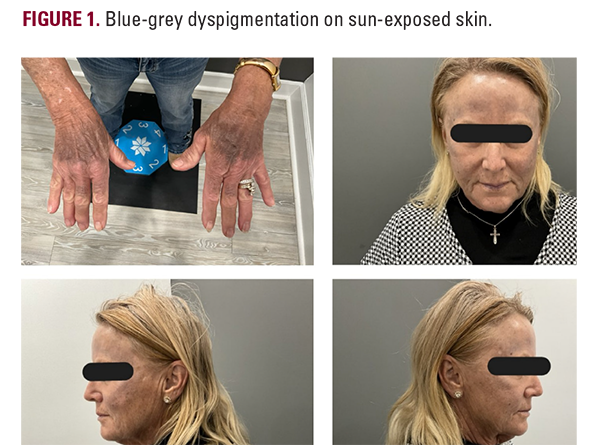
A 70-year-old female presented to our clinic with a one-year history of diffuse blue-grey hyperpigmentation in a photodistributed pattern on the face, hands, and dorsal forearms (Figure 1).