INTRODUCTION
LGBTQ+ individuals seek both invasive and non-invasive dermatological procedures, such as Botox and fillers, at high rates.1 Some theories attempt to explain the disproportionately higher rates of procedure seeking in the LGBTQ+ community compared to those who do not identify as LGBTQ+, but no studies to date have explored motivation or preferences regarding the reasons for this finding. While some hypotheses suggest additional factors, such as poor self-esteem, may play a role in the pursuit of these procedures,1,2 they are largely depicted as being sought out for purely "cosmetic" or superficial reasons. Thus, in our study, we sought to evaluate additional factors playing a role in LGBTQ+ peoples' decision to seek out dermatological procedures.
An IRB-approved survey (NCR235235) was emailed via SurveyMonkey to participants in the platform's Contribute and Rewards Panels. ANOVA was used for statistical analysis and frequency distribution calculations. The survey was sent to a total of 2,880 participants, yielding a response rate of 79%, of which 516 reported receiving cosmetic procedures. Of these, 141 identified as heterosexual, while 375 identified as LGBTQ+.
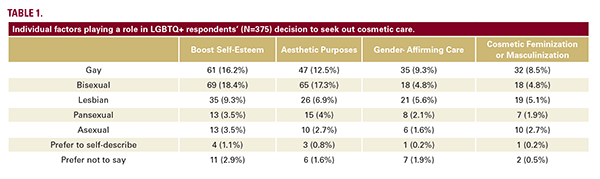
The most common individual factors influencing LGBTQ+ respondents' (N=375) decision to seek out cosmetic care include boosting self-esteem, aesthetic purposes, gender-affirming care, and cosmetic feminization or masculinization (Table 1). Of the LGBTQ+ respondents, gay and bisexual respondents
An IRB-approved survey (NCR235235) was emailed via SurveyMonkey to participants in the platform's Contribute and Rewards Panels. ANOVA was used for statistical analysis and frequency distribution calculations. The survey was sent to a total of 2,880 participants, yielding a response rate of 79%, of which 516 reported receiving cosmetic procedures. Of these, 141 identified as heterosexual, while 375 identified as LGBTQ+.
The most common individual factors influencing LGBTQ+ respondents' (N=375) decision to seek out cosmetic care include boosting self-esteem, aesthetic purposes, gender-affirming care, and cosmetic feminization or masculinization (Table 1). Of the LGBTQ+ respondents, gay and bisexual respondents