Dear Editor,
Benzoyl peroxide (BPO) is a widely used agent in the treatment of acne vulgaris (AV). Recently, concerns have emerged regarding the safety of BPO products, as they have been reported to degrade into benzene, particularly when exposed to elevated temperatures (37°C). Benzene exposure has been associated with an increased risk of several malignancies, particularly hematologic malignancies and internal malignancies, especially lung cancer.1,2 Given the critical role of BPO in acne management and the potential safety concerns, we conducted a systematic review and meta-analysis to evaluate the association between BPO use for acne and the risk of developing malignancies.
A systematic search was conducted in PubMed, Embase, and Web of Science following PRISMA guidelines.3 Inclusion criteria were: (1) Human participants with a diagnosis of AV or who were using BPO; (2) A clearly defined comparator group not exposed to BPO (eg, acne patients without BPO use, or nonacne controls). The search strategy was ('Benzoyl peroxide' OR BPO) AND ('hematologic malignancies' OR 'hematologic malignancy' OR 'blood cancer' OR leukemia OR lymphoma OR 'multiple myeloma' OR 'myelodysplastic syndrome' OR 'lung cancer'). Statistical analyses were performed using R version 4.3.2. A random-effects model was performed to determine the proportion with a 95% confidence interval (CI). Heterogeneity was assessed using the I² statistic.
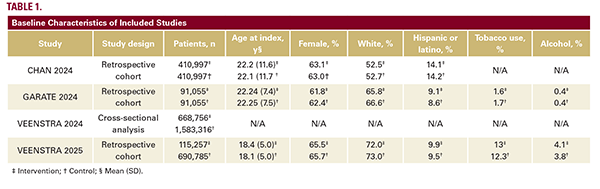
Four studies were included (1, 2, 4, 5), encompassing a total of 4,062,218 patients. Three of these studies reported baseline characteristics; among them, the mean age was 20.3 years, 64.1% were female, and 63.0% were White. Additional baseline characteristics are presented in Table 1. Risk of leukemia was reported in all studies, and the pooled analysis (Figure 1A) showed no statistically significant association between patients using BPO and those who were not (RR 0.91; 95% CI 0.68, 1.21; P=0.5; I² = 69.7%). Three studies specifically reported on the risk of acute myeloid leukemia (AML), and the pooled analysis (Figure 1B) also did not demonstrate a statistically significant difference between the two groups (RR 0.98; 95% CI 0.67, 1.43; P=0.9; I² = 77.3%). Two studies reported on the risk of lymphoma (Figure 1C) and any hematologic malignancy (Figure 1D); neither analysis showed a statistically significant increase in risk, lymphoma (RR 0.99; 95% CI 0.70, 1.41; P=0.9; I²=79.0%) and any hematologic malignancy (RR 0.99; 95% CI 0.92, 1.06; P=0.7; I² = 0%). Internal malignancy was reported by one study, which also found no significant difference in risk between BPO users and non-users. One study reported the risk of lung cancer, likewise finding no statistically significant difference.
Our pooled analyses of more than four million patients consistently demonstrated no statistically significant association between BPO use and the risk of leukemia, acute myeloid leukemia, lymphoma, or any hematologic malignancies. These results suggest no significant association between BPO use and malignancy risk.
Benzoyl peroxide (BPO) is a widely used agent in the treatment of acne vulgaris (AV). Recently, concerns have emerged regarding the safety of BPO products, as they have been reported to degrade into benzene, particularly when exposed to elevated temperatures (37°C). Benzene exposure has been associated with an increased risk of several malignancies, particularly hematologic malignancies and internal malignancies, especially lung cancer.1,2 Given the critical role of BPO in acne management and the potential safety concerns, we conducted a systematic review and meta-analysis to evaluate the association between BPO use for acne and the risk of developing malignancies.
A systematic search was conducted in PubMed, Embase, and Web of Science following PRISMA guidelines.3 Inclusion criteria were: (1) Human participants with a diagnosis of AV or who were using BPO; (2) A clearly defined comparator group not exposed to BPO (eg, acne patients without BPO use, or nonacne controls). The search strategy was ('Benzoyl peroxide' OR BPO) AND ('hematologic malignancies' OR 'hematologic malignancy' OR 'blood cancer' OR leukemia OR lymphoma OR 'multiple myeloma' OR 'myelodysplastic syndrome' OR 'lung cancer'). Statistical analyses were performed using R version 4.3.2. A random-effects model was performed to determine the proportion with a 95% confidence interval (CI). Heterogeneity was assessed using the I² statistic.
Four studies were included (1, 2, 4, 5), encompassing a total of 4,062,218 patients. Three of these studies reported baseline characteristics; among them, the mean age was 20.3 years, 64.1% were female, and 63.0% were White. Additional baseline characteristics are presented in Table 1. Risk of leukemia was reported in all studies, and the pooled analysis (Figure 1A) showed no statistically significant association between patients using BPO and those who were not (RR 0.91; 95% CI 0.68, 1.21; P=0.5; I² = 69.7%). Three studies specifically reported on the risk of acute myeloid leukemia (AML), and the pooled analysis (Figure 1B) also did not demonstrate a statistically significant difference between the two groups (RR 0.98; 95% CI 0.67, 1.43; P=0.9; I² = 77.3%). Two studies reported on the risk of lymphoma (Figure 1C) and any hematologic malignancy (Figure 1D); neither analysis showed a statistically significant increase in risk, lymphoma (RR 0.99; 95% CI 0.70, 1.41; P=0.9; I²=79.0%) and any hematologic malignancy (RR 0.99; 95% CI 0.92, 1.06; P=0.7; I² = 0%). Internal malignancy was reported by one study, which also found no significant difference in risk between BPO users and non-users. One study reported the risk of lung cancer, likewise finding no statistically significant difference.
Our pooled analyses of more than four million patients consistently demonstrated no statistically significant association between BPO use and the risk of leukemia, acute myeloid leukemia, lymphoma, or any hematologic malignancies. These results suggest no significant association between BPO use and malignancy risk.