INTRODUCTION
Skin aging involves the gradual breakdown of the ECM's structure and function, including collagen fragmentation, elastin disorganization, and loss of ground substances like hyaluronic acid.1,3–5 These changes lead to decreased tensile strength, reduced elastic recoil, and increased tissue laxity.1,3–4 Elastin plays a key role in skin elasticity, but the idea that boosting elastin alone directly causes skin tightening lacks strong biomechanical evidence.1–2,6 It's important to distinguish elasticity from tightening when evaluating regenerative topical treatments and device-based rejuvenation results, especially with new ECM-related technologies like TriHex+.8,10,13–15
MATERIALS AND METHODS
This manuscript synthesizes biomechanical principles, histologic observations, and clinical literature to construct a conceptual model of ECM-driven skin tightening.1–3,8,10
Biomechanical Discussion
Biomechanical roles of ECM components
Collagen provides tensile strength and dominates the higher-stiffness part of the stress–strain response, making it the main contributor to structural tightening when fibers contract or the dermis densifies.3–4,8,11–12 Elastin mainly functions in the low-stiffness region, allowing recoil and resistance to permanent deformation (creep).1–2 Ground substance, especially hyaluronic acid, adds hydration, viscoelasticity, and turgor, while the DEJ supports anchoring and reduces interlayer shear. 3–4,7
Elastin in Aging and Regeneration
Aging and photodamage cause elastin fragmentation, solar elastosis, and disruption of fibrillin microfibrils, which together impair recoil and promote microfolding and crepiness.1–2,6 Restoring organized elastic fiber architecture is therefore expected to improve recovery after deformation and reduce creep.1–2,6
Why does elastin alone not tighten skin?
True clinical tightening usually requires one or more of the following: collagen contraction caused by radiofrequency, ultrasound, or laser energy; dermal densification through new collagen growth; structural repositioning or volume redistribution.8–12 Elastin improves recoil and resilience but does not generate the force needed for lifting or visible contraction.1–2
Integrated ECM model
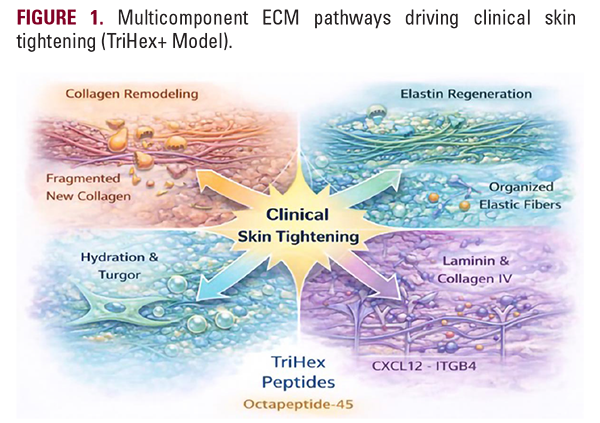
Clinical tightening is best understood as an emergent biomechanical result caused by collagen remodeling, elastin regeneration, increased hydration/turgor, and DEJ reinforcement acting together rather than as a single isolated pathway.1,3–4,8,13
Additional biological layers include basement membrane reconstruction (laminin, collagen IV), keratinocyte and fibroblast activation, stem cell recruitment (e.g., CXCL12), and anti-senescent signaling, leading to improved biomechanical performance without directly generating contractile force.19,23
Biomechanical Discussion
Biomechanical roles of ECM components
Collagen provides tensile strength and dominates the higher-stiffness part of the stress–strain response, making it the main contributor to structural tightening when fibers contract or the dermis densifies.3–4,8,11–12 Elastin mainly functions in the low-stiffness region, allowing recoil and resistance to permanent deformation (creep).1–2 Ground substance, especially hyaluronic acid, adds hydration, viscoelasticity, and turgor, while the DEJ supports anchoring and reduces interlayer shear. 3–4,7
Elastin in Aging and Regeneration
Aging and photodamage cause elastin fragmentation, solar elastosis, and disruption of fibrillin microfibrils, which together impair recoil and promote microfolding and crepiness.1–2,6 Restoring organized elastic fiber architecture is therefore expected to improve recovery after deformation and reduce creep.1–2,6
Why does elastin alone not tighten skin?
True clinical tightening usually requires one or more of the following: collagen contraction caused by radiofrequency, ultrasound, or laser energy; dermal densification through new collagen growth; structural repositioning or volume redistribution.8–12 Elastin improves recoil and resilience but does not generate the force needed for lifting or visible contraction.1–2
Integrated ECM model
Clinical tightening is best understood as an emergent biomechanical result caused by collagen remodeling, elastin regeneration, increased hydration/turgor, and DEJ reinforcement acting together rather than as a single isolated pathway.1,3–4,8,13
Additional biological layers include basement membrane reconstruction (laminin, collagen IV), keratinocyte and fibroblast activation, stem cell recruitment (e.g., CXCL12), and anti-senescent signaling, leading to improved biomechanical performance without directly generating contractile force.19,23