
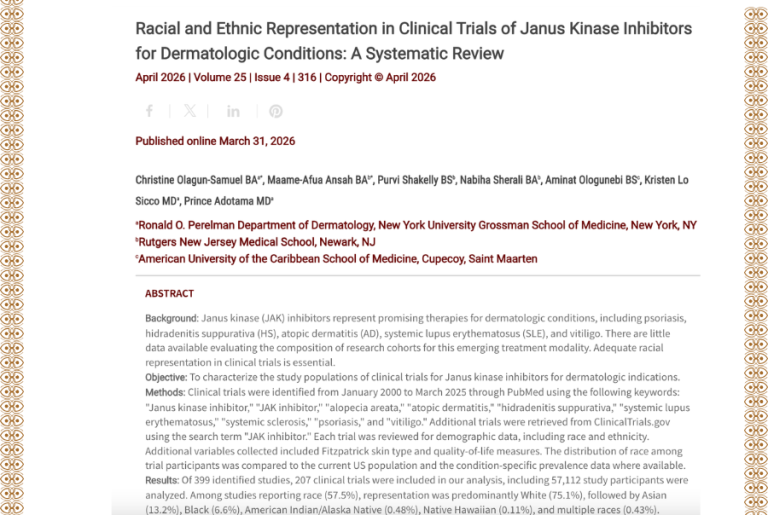
JDD analysis highlights racial gaps in JAK inhibitor dermatology trials
Have you caught this new JDD, analysis on JAK inhibitor trials? Dermatologists and clinical investigators will likely find this review relevant to ongoing discussions about trial diversity and generalizability for emerging therapies in psoriasis, atopic dermatitis, vitiligo, hidradenitis suppurativa, and systemic lupus erythematosus.
The authors screened 399 studies and analyzed 207 clinical trials encompassing 57,112 participants. Race was reported in 57.5 percent of trials, with study populations predominantly White at 75.1 percent, Asian at 13.2 percent, and Black at 6.6 percent. Notable condition specific findings included very low Black representation in psoriasis studies at 1.3 percent and in systemic lupus erythematosus at 1.0 percent, while hidradenitis suppurativa trials showed higher Black enrollment at 27.9 percent. Representation differed significantly from US disease prevalence for vitiligo with P = 0.012 and for atopic dermatitis with P = 0.00088. Less than 30 percent of trials reported quality of life measures, and reporting on Fitzpatrick skin type was uncommon.
Adherence to rigorous demographic reporting and inclusion of patient centered outcomes are emphasized by the authors as key gaps. The review notes limitations that affect interpretation, including variable reporting, short follow up for many studies, and heterogeneity in trial design. Potential conflicts of interest across the literature are flagged as an additional consideration.
For clinicians evaluating JAK inhibitors in practice or designing trials, this article provides a concise evidence map on participant demographics and reporting practices. Consult the full JDD paper to inspect trial level tables, understand the methodology, and consider actionable steps for improving recruitment and outcome reporting in future dermatology research.
Blog write-up assisted by AI