Featured Poster Abstract

The following is a selected scientific poster abstract from the 2019 Skin of Color Update.
"Impact of High Coverage Make-up Coverage against Visible Light Exposure"
Authors: Hawasatu Dumbuya, PhD & Janet Wangari-Talbot, PhD
The following is a selected scientific poster abstract from the 2019 Skin of Color Update.
Historically, photo-protection studies have focused on UVB (280-320 nm) and UVA (320-400 nm) protection. However, it is now evident that visible light (400-700 nm) causes skin darkening and contribute to worsening of dyschromia, particularly in individuals with Fitzpatrick phototype III and higher.
Currently, few sunscreens provide protection against visible light. Due to their capabilities in absorbing and reflecting visible light, topical products containing pigments and/or metal oxides (i.e. iron oxide, zinc oxide, and titanium dioxide), can provide additional protection against harmful effects of that spectrum.
Here, we demonstrate that lightly or darkly tinted high coverage pigmented foundation containing iron oxides or a combination of iron oxide and titanium dioxide significantly protected against visible light-induced pigmentation when compared to a mineral SPF50+ sunscreen in Fitzpatrick IV individuals when assessed by visual grading and by chromameter.
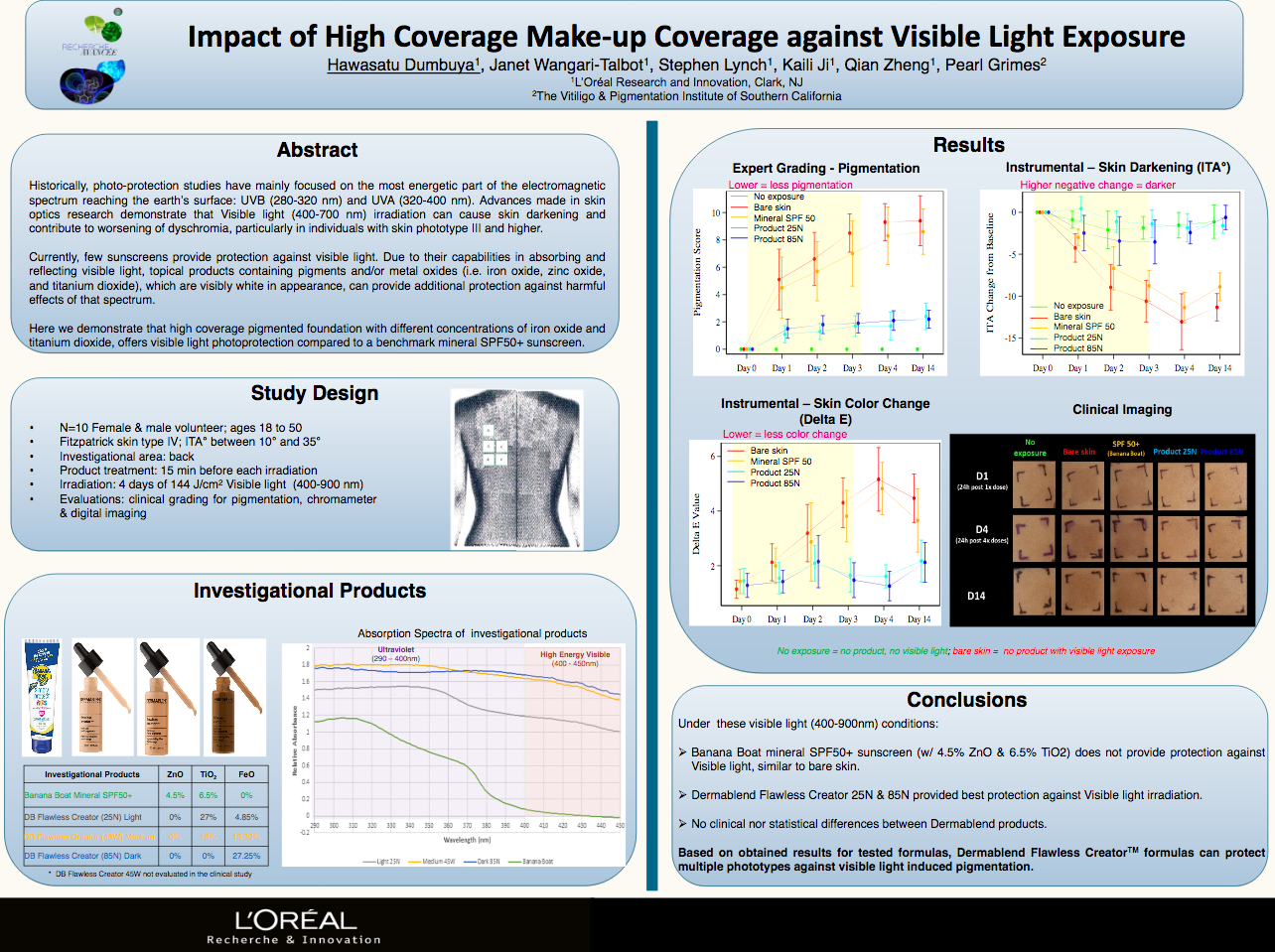
Our results show the benefits of high coverage pigmented foundation, containing different concentrations of iron oxide and titanium dioxide, in offering visible light photoprotection. Depending on the metal oxides concentrations, these formulations have the potential to extend protection beyond UV for multiple skin phototypes.
Skin of Color Scientific Poster Abstracts
View a curated selection of scientific poster abstracts from the Skin of Color Update conference below.
Explore More
Skin of Color Update Virtual

The Experts’ Forum for Multicultural Dermatology
The US population is growing and evolving and the clinical profile of the average patient presenting to the dermatologist is changing. One in three Americans self-identify as member of a non-caucasian racial or ethnic group. Data shows as of 2020, individuals of non-Caucasian, multi-racial descent will comprise more than 50% of the population.
Skin of Color Update Virtual 2020 Topics
- Hair Loss
- Acne
- Rosacea
- Skin Care with Cosmeceuticals
- PRP
- Psoriasis
- Scalp Psoriasis
- Skin Cancer
- and more!
You May Also Like