INTRODUCTION
Over-the-counter (OTC) products are often used as firstline or adjunctive treatments for many dermatologic conditions.1,2 Topical formulations consist of one or more active ingredients combined with a vehicle, which influences stability, ability to permeate the skin barrier, and optical and physical properties of the product.3 Topical vehicles (TVs), including ointments, creams, gels, and foams, differ in their pharmacological properties and consequently influence tolerability, patient adherence, and overall treatment success.3-5 Thus, it is crucial that clinicians, especially dermatologists, are adequately trained on TV formulations. This study sought to quantify TV training in dermatology residency and to evaluate the impact of a targeted educational intervention on residents' overall knowledge and their confidence in recommending and discussing TV formulations and OTC products.
MATERIALS AND METHODS
An IRB-approved, anonymous survey (IRB#NCR256476) was distributed to dermatology residents from three training programs in Washington, DC, who attended the inaugural "Lab-to-Label: Science and Clinical Application in Sunscreen and Cosmeceutical Vehicles" conference. The educational intervention included didactic lectures, multidisciplinary panel discussions, and hands-on tactile product evaluation. Conference content addressed skin structure and function, TV chemical science, OTC product categories and ingredients, FDA regulations, formulation considerations for acne and sunscreen therapies, and navigation of skincare trends and the influence of social media on patient education.
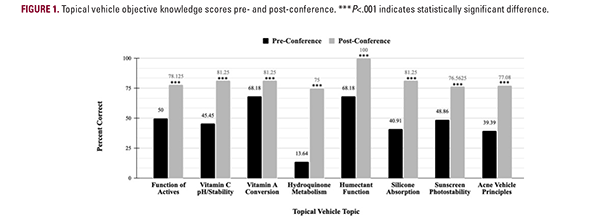
Participants completed pre- and post-conference surveys assessing prior exposure to TV education, comfort discussing TV formulations, confidence recommending OTC products based on TV type, and formulation knowledge. Objective questions evaluated resident knowledge of actives, vitamin C, vitamin A derivatives, hydroquinone, humectants, silicones, sunscreen, and acne topicals. Pre- and post-intervention objective knowledge scores were compared using a paired-samples t-test in SPSS version 31 (α=.05).
Participants completed pre- and post-conference surveys assessing prior exposure to TV education, comfort discussing TV formulations, confidence recommending OTC products based on TV type, and formulation knowledge. Objective questions evaluated resident knowledge of actives, vitamin C, vitamin A derivatives, hydroquinone, humectants, silicones, sunscreen, and acne topicals. Pre- and post-intervention objective knowledge scores were compared using a paired-samples t-test in SPSS version 31 (α=.05).
RESULTS
Of the 22 dermatology residents present, 17 participated in the pre- and post-surveys (77% response rate). Most respondents (81.8%) reported no formal training in cosmetic chemistry or TV formulation. Pre-survey responses indicated that only 13.6% felt "very comfortable" and 31.8% felt "somewhat comfortable"