INTRODUCTION
Ultraviolet (UV) radiation from sun exposure causes photosensitivity, photoaging, and photocarcinogenesis.1 While dermatologists routinely recommend sunscreen as a preventative measure, sun protection methods have diversified tremendously, offering options that cater to various physical abilities, financial budgets, and time constraints. In this review, we assess a novel mode of sun protection, sun patches, and discuss their supporting evidence as well as real-world practicalities.
Sun Patches
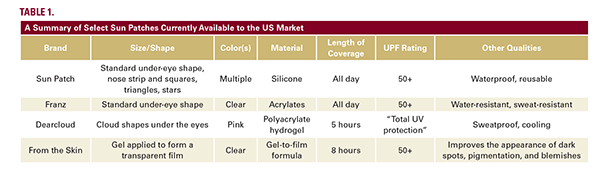
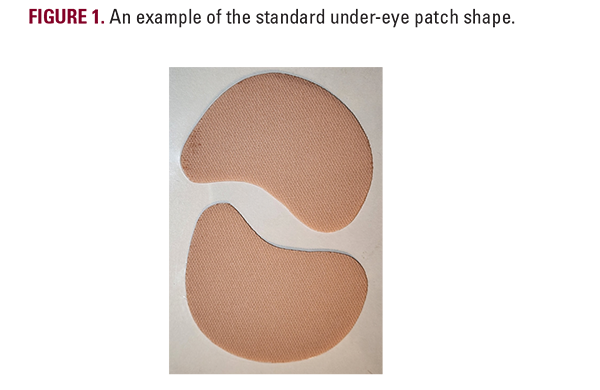
Adhesive patches, popularly referred to as "sun patches," infused with UV-blocking agents, are gaining popularity in the cosmetics market due to their durability and ease of use. The results of a search of the skincare websites Sephora and Ulta Beauty, as well as patches popularized in the media, are summarized in Table 1.2 These patches are currently available as pre-cut sheets shaped to fit the zygoma and malar cheeks in a standard under-eye patch shape, as in Figure 1, or as gels applied in a thin layer to the face and peeled off once no longer needed. With the exception of the gels, patches are generally marketed as waterproof, and some are reusable. While earlier models of these sun patches were only available in opaque colors that were noticeable on the face, newer models include more discreet, thin, clear membrane-like patches that blend into the skin and may even be covered with makeup. This makes for a method of facial sun protection that can last for several hours while remaining cosmetically acceptable.3
Sun Patches
Adhesive patches, popularly referred to as "sun patches," infused with UV-blocking agents, are gaining popularity in the cosmetics market due to their durability and ease of use. The results of a search of the skincare websites Sephora and Ulta Beauty, as well as patches popularized in the media, are summarized in Table 1.2 These patches are currently available as pre-cut sheets shaped to fit the zygoma and malar cheeks in a standard under-eye patch shape, as in Figure 1, or as gels applied in a thin layer to the face and peeled off once no longer needed. With the exception of the gels, patches are generally marketed as waterproof, and some are reusable. While earlier models of these sun patches were only available in opaque colors that were noticeable on the face, newer models include more discreet, thin, clear membrane-like patches that blend into the skin and may even be covered with makeup. This makes for a method of facial sun protection that can last for several hours while remaining cosmetically acceptable.3
Practical applications include situations otherwise requiring frequent sunscreen reapplications during extended outdoor periods or underwater activities. Of note, most patches do not cover the entire face, and if sunscreen is not concomitantly applied to the remaining sun-exposed areas, one would be likely to acquire tan lines or even sunburns. Moreover, as with any other adhesive product, one would risk poor adhesive performance as well as the risk of developing contact dermatitis. Real-world reports on "sweatproof" patches have accounted that some patches do not actually remain well adhered to sweaty skin. Some reports also describe sunburns in the shape of the patches, implying a lack of efficacy in UV protection of the covered skin. While clinical trials or head-todoi