
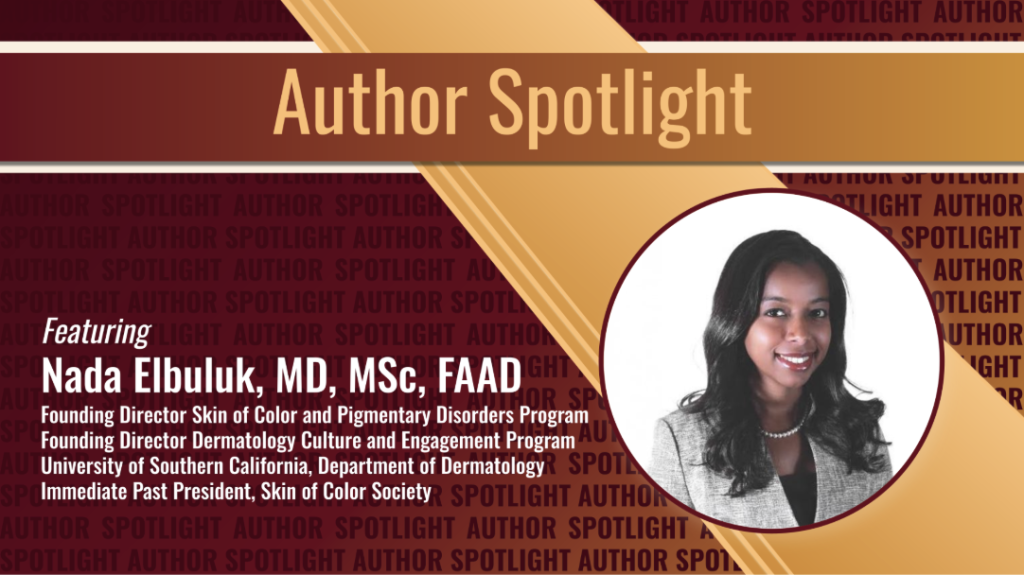
Our current Author Spotlight features Nada Elbuluk, MD, MSc, FAAD, one of the co-authors of Public Interest in Hyperpigmentation: Insights From a Google Trends Analysis, published in our July 2026 issue. In addition to the article, Dr. Elbuluk also provided insight about the current state of dermatology and how the field is adapting to new advances in technology and treatments.
We’re also delighted to welcome Dr. Elbuluk to the Journal of Drugs in Dermatology (JDD) Editorial Board as a Senior Editor, where her expertise and leadership will help shape the future of the journal.
In your experience, what is one commonly overlooked factor in diagnosing or managing hyperpigmentation that deserves more attention?
One of the most commonly overlooked factors with hyperpigmentation disorders is that many attempt to treat dark areas with lightening agents without first confirming the diagnosis. This step is particularly important as knowing the diagnosis affects not only the prognosis, but also appropriate approach to treatment.
Of all your research findings, are there any surprising or unexpected results that changed your perspective on the topic?
I was surprised by the spike in hyperpigmentation searches in early 2025. It’s unclear what caused that spike though one could speculate on various societal happenings which could have triggered it. I was also intrigued by the global results and seeing that certain countries including Trinidad & Tobago, Jamaica, Mauritius, Ghana, and Nigeria were top nations for several search terms related to hyperpigmentation. These countries predominantly consist of individuals of color and many of them also have a history of using skin lightning products.
How do you see artificial intelligence and digital dermatology evolving in clinical practice over the next five years?
I think that artificial intelligence and digital dermatology will continue to become more a part of our clinical practice in the next five years. I think what’s important is that we use these tools to augment and support the work that we do clinically and not to replace the care that we provide as physicians and healthcare providers. There are also many conditions that we diagnose and treat including disorders of pigmentation that could benefit from more objective monitoring which AI and digital dermatology may be able to help provide. Additionally, programs like Google Trends will continue to be able to offer us quick and accessible ways of understanding public concerns about various dermatologic issues. This research can support traditional epidemiology and database studies.
If you could implement one immediate policy change to improve dermatologic care on a broader scale, what would it be and why?
It would be increasing access to dermatologic care both in the US and globally. Access to subspecialties such as dermatology continues to remain a challenge in particular for underserved areas. The results of the study show that in parts of the US, in particular, the Southeast and in many parts of the world, including the Caribbean and Africa, many are actively seeking information about pigmentary disorders. Many of those areas internationally and in rural America also have a low number of dermatologists. This study helps highlight the current public interest in pigmentary disorders and as dermatologists we should try to meet that interest with dermatologic education and access to care.
Are there any misconceptions among dermatologists or patients about a specific treatment or condition you’d like to address?
I think when people are searching for pigmentary disorders and skin brightening/lightening, they are often looking to try to treat their own pigmentary conditions. Currently, the skin lightning industry is a multi-billion dollar industry. Many individuals are trying to treat these conditions without medical guidance, and many don’t know the diagnosis they carry and simply buy products that are targeted towards “dark spots” or “skin lightening.” What consumers need to understand is that they need to have a proper diagnosis of their pigmentary disorder(s) and that dermatologists can help guide them to appropriate treatments so that they aren’t spending time and money for months to years without seeing sufficient and sustained improvement. Consumers can also have multiple concurrent pigmentary disorders and not realize the pathogenesis and treatment of those spots may vary.
The other important thing to understand is that there are treatments that can have adverse effects particularly those available in international countries where there may be less regulation of over-the-counter products sold. Cutaneous and systemic adverse effects have been reported from such products, particularly with long term use of hydroquinone, high potency topical steroids and other ingredients not safe for long term use.
How do you navigate balancing efficacy and accessibility when recommending treatments to patients from diverse backgrounds?
Once a diagnosis is determined, I discuss with the patient the treatment options and the treatment algorithm. We then go through a shared decision-making process that takes into account the efficacy and safety profile of the different treatments, patient preference, their comorbidities, their skin type, and their access to treatments in order to determine next steps and an appropriate treatment plan.
What role do social determinants of health play in dermatologic treatment outcomes, and how can dermatologists better address these challenges?
Social determinants of health can play a significant role in dermatologic treatment outcomes including with pigmentary disorders. Access to care, health literacy, and health disparities all affect individuals knowing when to see a dermatologist and what is considered appropriate and safe treatment for their condition(s). Occupational and social factors may also exacerbate primary dermatologic conditions.
If you could collaborate with any other specialty or field to advance dermatologic research, which would it be and why?
I would collaborate with more basic scientists studying melanocyte biology to better understand the molecular mechanisms and pathogenesis involved in various pigmentary disorders. This would deepen our understanding for these conditions in a way which would allow for more precise immune targeted therapies and ultimately allow for more effective treatment options.
What is a piece of advice you wish you had received earlier in your dermatology career?
To take advantage of more opportunities offered to early career dermatologists. There are many programs and resources available to dermatologists in the early years after training that can be overlooked or not considered because it’s also a time in life where one is often busy starting their careers and families.
Outside of clinical practice and research, what excites you most about the future of dermatology?
I’m most excited to see dermatology continue to gain attention globally as a vital and important part of medicine across the world. The creation of World Skin Health Day (July 8) and the recognition of dermatology as a global health priority by the World Health Organization are two examples of significant strides in the right direction.