
INTRODUCTION
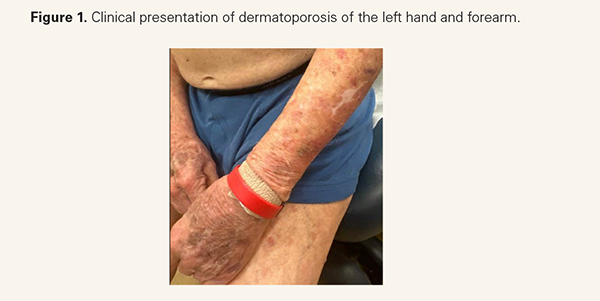
Cellular senescence is a permanent and stable arrest of the cell cycle triggered by endogenous and exogenous stressors, such as DNA damage, oxidative stress, and telomere dysfunction.1,2 In this state, cells are unable to proliferate despite favorable growth conditions and often exhibit increased resistance to apoptosis through upregulation of cell survival pathways.1 Additionally, senescent cells may influence the surrounding environment through the senescence-associated secretory phenotype (SASP), which consists of inflammatory cytokines, chemokines, growth factors, and proteases.3,4 Cellular senescence and SASP play key roles in skin aging and are thought to contribute to dermatoporosis, an age-related condition that primarily affects chronically sun-exposed areas, such as the forearms.5 Dermatoporosis is characterized by skin atrophy and increased skin fragility, susceptibility to skin tears, secondary infection, and delayed wound healing5-7 (Figure 1).
In response to the growing recognition of senescence-driven pathology, emerging research has focused on senotherapeutics, a field focused on targeting cellular senescence.8 Here we review the role of cellular senescence and SASP in skin aging and examine potential senotherapeutic agents. We also discuss commonly used topical treatments, including hyaluronic acid (HA), retinoids, vitamin C, niacinamide, and alpha hydroxy acids (AHAs), to inform clinical strategies for addressing cellular senescence in skin aging.
Cellular Senescence and SASP
Cellular senescence plays a key role in both intrinsic and extrinsic skin aging. Intrinsic aging primarily occurs in sun-protected areas, resulting in epidermal thinning, loss of subcutaneous fat, and reduced dermal thickness.2,9 Extrinsic aging is largely driven by chronic sun exposure, leading to a loss of collagen and dermal extracellular matrix.9 Both intrinsic and extrinsic aging contribute to the accumulation of senescent cells, driving structural and functional changes in the skin.10 Skin biopsies from older individuals reveal increased frequency of senescent cell markers, specifically p16INK4A, a cell cycle checkpoint protein, and senescence-associated β-galactosidase (SA-βgal) expression, a lysosomal enzyme.2,9,11
Senescent cells also influence skin aging and tissue regeneration through paracrine signaling via SASP.1,10 Similar to senescent cells, SASP increases with age and can alter the tissue microenvironment through collagen degradation and chronic inflammation, leading to visible features of aging such as sagging, wrinkles, and skin laxity.8,9 Although senescent cells and SASP contribute to skin aging, they also play beneficial roles in certain physiological contexts, including embryonic development, suppressing cancer cell proliferation, and aiding in wound healing by limiting excessive cell growth, fibrosis, and granulation tissue formation.8,9
Senotherapeutics
Senotherapeutics, including senolytics and senomorphics, have emerged as a promising strategy for treating age-related disease and restoring skin tissue structure and function.2,8 Senolytics are currently under investigation for their potential to induce cell death in senescent cells.8 Several classes of senolytic compounds have been investigated, including tyrosine kinase inhibitors, B-cell lymphoma-2 (BCL-2) inhibitors, and FOXO4-DRI peptide.8 However, many senolytic agents lack cell-type specificity, leading to off-target effects and toxicity in healthy tissues.8 As a result, further research is needed to optimize dosing strategies and enhance tissue-specific targeting.8
Senomorphics modulate senescent cell behavior by suppressing or altering SASP rather than eliminating senescent cells. Examples include mammalian target of rapamycin (mTOR) inhibitors, Janus kinase (JAK) inhibitors, and nuclear factor kappa B (NF-κB) inhibitors.8 Although senotherapeutics have promise, they are not yet approved for clinical use.2 Potential side effects and safety profile of longterm treatment need to be evaluated prior to clinical application in dermatology.2,8
Over-the-Counter Topicals and Retinoids
While senotherapeutics remain experimental, several agents such as HA, retinoids, vitamin C, niacinamide, and AHAs have been studied for their effects on cellular senescence and the clinical manifestations of skin aging and dermatoporosis.
Cellular senescence plays a key role in both intrinsic and extrinsic skin aging. Intrinsic aging primarily occurs in sun-protected areas, resulting in epidermal thinning, loss of subcutaneous fat, and reduced dermal thickness.2,9 Extrinsic aging is largely driven by chronic sun exposure, leading to a loss of collagen and dermal extracellular matrix.9 Both intrinsic and extrinsic aging contribute to the accumulation of senescent cells, driving structural and functional changes in the skin.10 Skin biopsies from older individuals reveal increased frequency of senescent cell markers, specifically p16INK4A, a cell cycle checkpoint protein, and senescence-associated β-galactosidase (SA-βgal) expression, a lysosomal enzyme.2,9,11
Senescent cells also influence skin aging and tissue regeneration through paracrine signaling via SASP.1,10 Similar to senescent cells, SASP increases with age and can alter the tissue microenvironment through collagen degradation and chronic inflammation, leading to visible features of aging such as sagging, wrinkles, and skin laxity.8,9 Although senescent cells and SASP contribute to skin aging, they also play beneficial roles in certain physiological contexts, including embryonic development, suppressing cancer cell proliferation, and aiding in wound healing by limiting excessive cell growth, fibrosis, and granulation tissue formation.8,9
Senotherapeutics
Senotherapeutics, including senolytics and senomorphics, have emerged as a promising strategy for treating age-related disease and restoring skin tissue structure and function.2,8 Senolytics are currently under investigation for their potential to induce cell death in senescent cells.8 Several classes of senolytic compounds have been investigated, including tyrosine kinase inhibitors, B-cell lymphoma-2 (BCL-2) inhibitors, and FOXO4-DRI peptide.8 However, many senolytic agents lack cell-type specificity, leading to off-target effects and toxicity in healthy tissues.8 As a result, further research is needed to optimize dosing strategies and enhance tissue-specific targeting.8
Senomorphics modulate senescent cell behavior by suppressing or altering SASP rather than eliminating senescent cells. Examples include mammalian target of rapamycin (mTOR) inhibitors, Janus kinase (JAK) inhibitors, and nuclear factor kappa B (NF-κB) inhibitors.8 Although senotherapeutics have promise, they are not yet approved for clinical use.2 Potential side effects and safety profile of longterm treatment need to be evaluated prior to clinical application in dermatology.2,8
Over-the-Counter Topicals and Retinoids
While senotherapeutics remain experimental, several agents such as HA, retinoids, vitamin C, niacinamide, and AHAs have been studied for their effects on cellular senescence and the clinical manifestations of skin aging and dermatoporosis.