INTRODUCTION
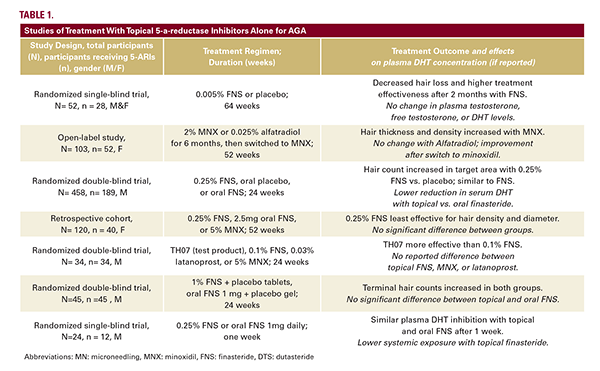
Androgenetic alopecia (AGA) is a non-scarring alopecia triggered by an inherited follicular sensitivity to dihydrotestosterone (DHT) and other environmental factors.1 Current FDA-approved treatments include topical minoxidil (in men and women) and oral finasteride (in men), often with varied efficacy. 5-Alpha-reductase inhibitors (5-ARIs), such as finasteride, inhibit dihydrotestosterone (DHT), but systemic absorption can lead to side effects such as sexual dysfunction and diminished libido. Recent trials have investigated topical 5-ARIs as a promising treatment for AGA, in hopes of obtaining the therapeutic benefit of these medications while limiting systemic exposure. This review investigates the efficacy of topical 5-ARIs in the treatment of AGA.
Articles regarding androgenic alopecia and topical 5-ARIs (including dutasteride, finasteride, and alfatradiol) were retrieved from PubMed, Embase, and Scopus Library databases. Two independent reviewers screened 340 articles, and 19 articles met the criteria for inclusion, available via Mendeley at https://data.mendeley.com/datasets/fdjwx97hwt/1 (Supplementary Figure 1). Quality of Evidence was assessed
Articles regarding androgenic alopecia and topical 5-ARIs (including dutasteride, finasteride, and alfatradiol) were retrieved from PubMed, Embase, and Scopus Library databases. Two independent reviewers screened 340 articles, and 19 articles met the criteria for inclusion, available via Mendeley at https://data.mendeley.com/datasets/fdjwx97hwt/1 (Supplementary Figure 1). Quality of Evidence was assessed