INTRODUCTION
Bis-ethylhexyloxyphenol methoxyphenyl triazine (BEMT) is a UVA/UVB sun filter that has been approved for use in the European Union since 2000. In June 2026, the FDA approved BEMT as a new, safe, and effective UV filter for over-the-counter sunscreens in the US. BEMT was approved in the US at concentrations up to 6% in sunscreen products at maximum use and is used at concentrations of up to 10% in the Southern Common Market (Mercosur), China, and Europe, whereas in Japan BEMT is limited to 3%. We conducted a retrospective analysis of approximately 14,622 subjects who participated in clinical safety studies examining sunscreens formulated with BEMT for countries outside of the US.
MATERIALS AND METHODS
The test subjects included adult volunteers from 18 to 70 years old. These subjects did not have a known history of allergies, skin diseases, or lesions. Exclusion criteria included: pregnancy, currently breastfeeding or planning to become pregnant during the study, having a history of skin cancer within the past 5 years, recent use of corticosteroids or other medications, compromised skin, or existing skin irritations on the test area. Tests were supervised by dermatologists and conducted at an independent laboratory. All clinical safety studies were approved by an Institutional Review Board, and all test subjects signed written informed consent forms.
A total of 108 formulas were assessed, which ranged from 0.1% to 6% BEMT concentration. BEMT formulations in the dataset are also combined with other UV filters, which are not described. Sunscreens in the tested dataset included commercialized and noncommercialized formulations. The categories were further divided into product types (Cream/Lotion, Pump/Spray, Serum, or Stick).
The Human Repeat Insult Patch Test (HRIPT) determines the potential of a product to cause irritation and/or allergic contact dermatitis. The Cumulative Irritation Test (CIT) test assesses the potential of a product to cause cumulative skin irritation. The Photo Toxicity Test (PT) study evaluates an induced photo irritation response to a product. The Photo Allergy Test (PA) study evaluates an induced photosensitization response. One hundred and eight studies were performed in 3 study centers in Latin America, Europe, and Asia. Specific protocols followed for each safety test can be found in Wilson et al 2025.
RESULTS
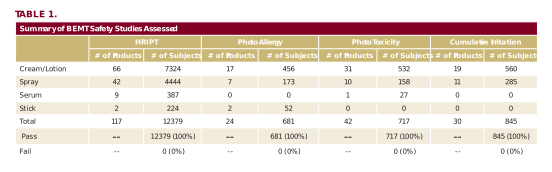
A total of 14,622 subjects were evaluated in HRIPT, CIT, PT, or PA safety studies as summarized in Table 1. For HRIPT, 12,379 subjects evaluated 177 BEMT containing Cream/Lotion, Pump/Spray, Serum, or Stick formulations. These represent a range of commercial formulations that could contain BEMT. Of the 12,379 subjects in the HRIPT studies, there were no cases of sensitization observed from any formulation containing BEMT. For assessments of potential photoallergy, phototoxicity, or cumulative irritation, a total of 2243 subjects tested Cream/Lotion, Pump/Spray, Serum, or Stick formulations containing BEMT.