INTRODUCTION
Medicare Part B spending on skin substitute products rose from $256 million in 2019 to more than $10 billion in 2024.1 A 2025 brief report first documented this trajectory in the dermatologic literature and attributed much of this growth to a 2023 Centers for Medicare & Medicaid Services (CMS) policy that simplified Q-code applications, triggering a rapid proliferation of new and increasingly expensive products.2 By the second quarter of 2025, the median Medicare average sales price (ASP) had tripled to roughly $403/cm2.2 In a parallel modeled cost analysis, management of Mohs surgical defects with placenta-derived skin substitutes ranged from approximately $6,000 to $210,000 per wound, compared with $120 to $480 for second intention healing (ie, clinic-based wound care expenses) despite any demonstrated clinical benefit.3 The authors of both reports called for payment reform linking Q-code eligibility to proven clinical efficacy.
As of January 1, 2026, CMS implemented a major restructuring of skin substitute reimbursement. Given the prominent role wound care plays in our specialty, a brief synthesis is timely for dermatologists.
Who Has Been Driving the Spending?
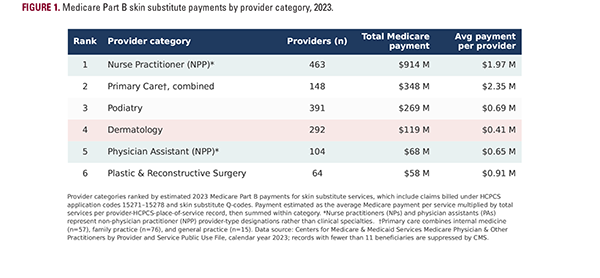
For a closer look at whose practice patterns produced the spiking expenditure for skin substitutes, we reviewed the publicly available 2023 CMS Physician/Other Practitioners Public Use File, which captures practitioner-billed Medicare Part B claims.4 We filtered it to Healthcare Common Procedure Coding System (HCPCS) codes beginning with Q41 or Q42 and current procedural terminology (CPT) codes 15271-15278. Q-codes are temporary HCPCS codes assigned to new products to ensure reimbursement while longer-term coverage is pending. CPT 15271-15278 cover high-cost skin substitute applications. Because this file excludes hospital outpatient and ambulatory surgery center (ASC) settings, where skin substitutes are bundled into ambulatory payment classification (APC) payments rather than separately reimbursed, these office-based claims represent the dominant share of 2023 Medicare skin substitute spending. An important limitation is that this data identifies billing categories but cannot establish wound severity, appropriateness, supervision, or whether care was physician-directed. However, several findings warrant the attention of the dermatologic community.
As of January 1, 2026, CMS implemented a major restructuring of skin substitute reimbursement. Given the prominent role wound care plays in our specialty, a brief synthesis is timely for dermatologists.
Who Has Been Driving the Spending?
For a closer look at whose practice patterns produced the spiking expenditure for skin substitutes, we reviewed the publicly available 2023 CMS Physician/Other Practitioners Public Use File, which captures practitioner-billed Medicare Part B claims.4 We filtered it to Healthcare Common Procedure Coding System (HCPCS) codes beginning with Q41 or Q42 and current procedural terminology (CPT) codes 15271-15278. Q-codes are temporary HCPCS codes assigned to new products to ensure reimbursement while longer-term coverage is pending. CPT 15271-15278 cover high-cost skin substitute applications. Because this file excludes hospital outpatient and ambulatory surgery center (ASC) settings, where skin substitutes are bundled into ambulatory payment classification (APC) payments rather than separately reimbursed, these office-based claims represent the dominant share of 2023 Medicare skin substitute spending. An important limitation is that this data identifies billing categories but cannot establish wound severity, appropriateness, supervision, or whether care was physician-directed. However, several findings warrant the attention of the dermatologic community.