
Dear Editor,
This report highlights that intralesional corticosteroids may serve as adjunctive therapy in alopecia areata patients who were initially steroid non-responders after a period of treatment with Janus kinase inhibitors such as ritlecitinib. While the patient described in this case did not experience eyebrow regrowth while receiving ritlecitinib alone, adjunctive intralesional triamcinolone led to sustained eyebrow hair regrowth in this previous steroid non-responder.
A male patient in his early twenties with treatment-resistant alopecia universalis since age 2 years initially presented to the dermatology clinic in 2019. The patient was enrolled in a clinical trial in which he received ritlecitinib since 2019. At the time of enrollment, his Severity of Alopecia Tool (SALT) score was 100%. Prior to this, the patient had been a non-responder to intralesional corticosteroid injections, clobetasol cream, topical 5% minoxidil, and hydrocortisone 2.5% cream, with minimal response to bimatoprost 0.03% solution to the eyelashes. After initiating ritlecitinib, the patient experienced full scalp hair regrowth at the 24-week primary endpoint of the clinical trial. In early 2024, the patient's SALT score is 0%.
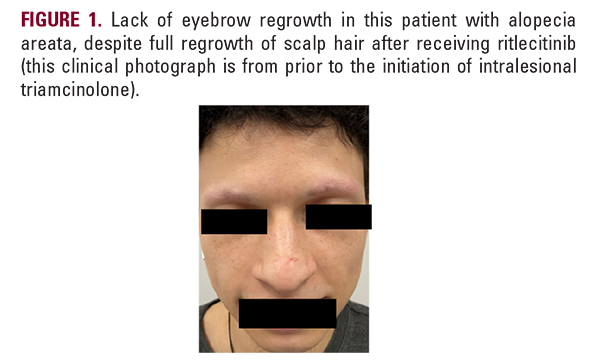
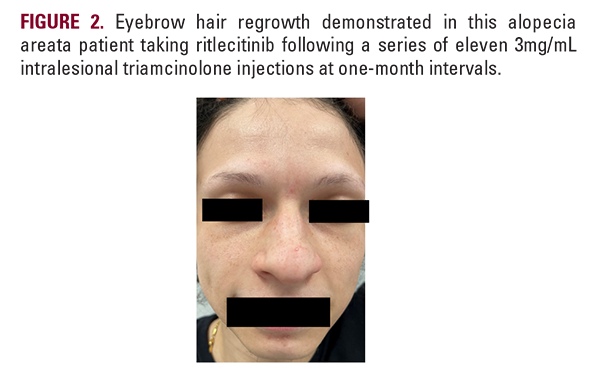
Despite full regrowth of scalp hair while on ritlecitinib 50mg daily, the patient's eyelashes and eyebrows remained without hair (Figure 1). In early 2024, 3 mg/cc triamcinolone acetonide injections were initiated in the eyebrows, as intralesional corticosteroids are the preferred treatment for eyebrow loss in alopecia areata patients. Despite the patient's previous history as a non-responder to intralesional corticosteroid injections, impressive and sustained regrowth of the patient's eyebrows was noted following a series of eleven intralesional triamcinolone treatments (Figure 2). This report highlights the first documented case of a patient who, initially refractory to intralesional corticosteroid injections, became responsive after beginning oral ritlecitinib.
Alopecia areata/universalis represents non-scarring forms of hair loss driven by the dysregulation of various T cell-mediated pathways. The formation of autoantigens in the hair follicle leads to overactivation of proinflammatory cytokines, which
This report highlights that intralesional corticosteroids may serve as adjunctive therapy in alopecia areata patients who were initially steroid non-responders after a period of treatment with Janus kinase inhibitors such as ritlecitinib. While the patient described in this case did not experience eyebrow regrowth while receiving ritlecitinib alone, adjunctive intralesional triamcinolone led to sustained eyebrow hair regrowth in this previous steroid non-responder.
A male patient in his early twenties with treatment-resistant alopecia universalis since age 2 years initially presented to the dermatology clinic in 2019. The patient was enrolled in a clinical trial in which he received ritlecitinib since 2019. At the time of enrollment, his Severity of Alopecia Tool (SALT) score was 100%. Prior to this, the patient had been a non-responder to intralesional corticosteroid injections, clobetasol cream, topical 5% minoxidil, and hydrocortisone 2.5% cream, with minimal response to bimatoprost 0.03% solution to the eyelashes. After initiating ritlecitinib, the patient experienced full scalp hair regrowth at the 24-week primary endpoint of the clinical trial. In early 2024, the patient's SALT score is 0%.
Despite full regrowth of scalp hair while on ritlecitinib 50mg daily, the patient's eyelashes and eyebrows remained without hair (Figure 1). In early 2024, 3 mg/cc triamcinolone acetonide injections were initiated in the eyebrows, as intralesional corticosteroids are the preferred treatment for eyebrow loss in alopecia areata patients. Despite the patient's previous history as a non-responder to intralesional corticosteroid injections, impressive and sustained regrowth of the patient's eyebrows was noted following a series of eleven intralesional triamcinolone treatments (Figure 2). This report highlights the first documented case of a patient who, initially refractory to intralesional corticosteroid injections, became responsive after beginning oral ritlecitinib.
Alopecia areata/universalis represents non-scarring forms of hair loss driven by the dysregulation of various T cell-mediated pathways. The formation of autoantigens in the hair follicle leads to overactivation of proinflammatory cytokines, which
subsequently bind the hair follicle. This binding activates immune-mediated pathways and leads to the production of perforins and granzymes via the JAK-STAT pathway. Eventually, patients experience perforin and granzyme-induced apoptosis of the hair follicle.1 Alopecia areata/universalis is thought to have a genetic predisposition. This patient did not have a family history of hair loss of any type, however. There is no known long-term, absolute cure for alopecia areata, but corticosteroids, squaric acid, minoxidil, calcipotriol, and tacrolimus have been utilized to treat this autoimmune condition.1,2 An emerging realm of treatment for alopecia areata includes Janus kinase