To the Editor,
Wide local excision (WLE) is the current standard of care for treatment of melanoma in situ (MIS).1 Mohs micrographic surgery (MMS) is another surgical treatment used for MIS, offering benefits including circumferential margin control and the ability to operate in cosmetically and functionally sensitive areas.1,2 Prior investigations comparing MMS and WLE for MIS have found similar overall survival.3,4 However, current literature is limited on the comparable risks of postoperative outcomes between the two procedures. To bridge this gap in the literature, our study examined whether MIS patients treated with MMS have similar postoperative outcome risks to those treated with WLE.
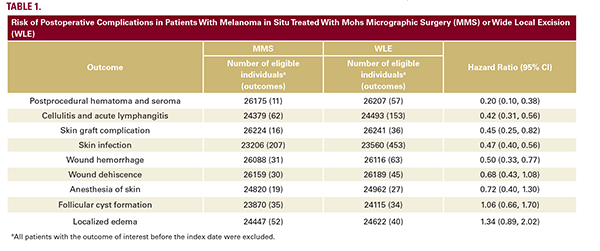
Using the TriNetX Research Network (112 healthcare organizations), we stratified adult patients with ≥1 ICD-10-CM code for MIS (D03) into two cohorts: 1. MMS: ≥1 CPT code (17311-17315); and 2. WLE: ≥1 CPT code (11600-11646). Cohort index dates were defined as the date of the first MMS or WLE procedure, respectively. We 1:1 propensity score-matched cohorts on baseline demographics, MIS site, irradiation history, and potential comorbidities (malignant melanoma, nicotine dependence, alcohol related disorders, diabetes mellitus, overweight/obesity, chronic obstructive pulmonary disease) and medications (anticoagulants, platelet aggregation inhibitors, systemic corticosteroids, immunosuppressants). 30-day Cox proportional hazards models with 95% confidence intervals (CIs) were calculated to determine the risk of postoperative complications following MMS and WLE.
Wide local excision (WLE) is the current standard of care for treatment of melanoma in situ (MIS).1 Mohs micrographic surgery (MMS) is another surgical treatment used for MIS, offering benefits including circumferential margin control and the ability to operate in cosmetically and functionally sensitive areas.1,2 Prior investigations comparing MMS and WLE for MIS have found similar overall survival.3,4 However, current literature is limited on the comparable risks of postoperative outcomes between the two procedures. To bridge this gap in the literature, our study examined whether MIS patients treated with MMS have similar postoperative outcome risks to those treated with WLE.
Using the TriNetX Research Network (112 healthcare organizations), we stratified adult patients with ≥1 ICD-10-CM code for MIS (D03) into two cohorts: 1. MMS: ≥1 CPT code (17311-17315); and 2. WLE: ≥1 CPT code (11600-11646). Cohort index dates were defined as the date of the first MMS or WLE procedure, respectively. We 1:1 propensity score-matched cohorts on baseline demographics, MIS site, irradiation history, and potential comorbidities (malignant melanoma, nicotine dependence, alcohol related disorders, diabetes mellitus, overweight/obesity, chronic obstructive pulmonary disease) and medications (anticoagulants, platelet aggregation inhibitors, systemic corticosteroids, immunosuppressants). 30-day Cox proportional hazards models with 95% confidence intervals (CIs) were calculated to determine the risk of postoperative complications following MMS and WLE.