To the Editor,
While biologic medications are frequently used to treat inflammatory skin diseases, patients have experienced paradoxical skin diseases arising from treatment.1 The onset of new hidradenitis suppurativa (HS) has been reported after psoriatic biologic therapy, inciting characteristic deepseated, inflammatory lesions despite immunosuppression.1 To investigate the scope of this phenomenon and differences in HS risk between therapies, we conducted a retrospective cohort study utilizing the TriNetX database, a global health research network with aggregated data from over 300 million patients worldwide.
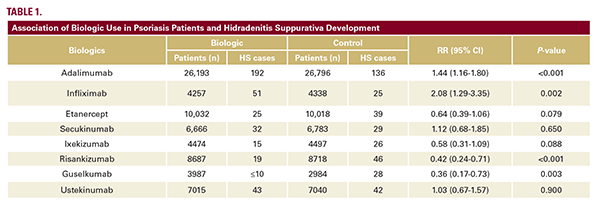
Treatment cohorts included psoriasis or psoriasis vulgaris patients prescribed an approved psoriatic biologic while excluding all other therapies. Certolizumab, brodalumab, tildrakizumab, and bimekizumab were excluded due to low sample size. Controls were patients with psoriasis or psoriasis vulgaris without any biologic use. Groups were propensitymatched for demographics, comorbidities, and comedications. Risk ratios and 95% confidence intervals (CI) were calculated for HS incidence (Table 1). Patients with HS before biologic therapy prescription were excluded.
Psoriasis patients treated with adalimumab (RR: 1.44 |1.16-1.80|) or infliximab (RR: 2.08 |1.29-3.35|) were significantly more likely to be diagnosed with HS compared to controls. Additionally, psoriasis patients on risankizumab (RR: 0.42 |0.24-0.71|) or guselkumab (RR:0.36 |0.17-0.73|) therapy were both associated with significantly decreased risk of HS incidence after treatment. No other biologics demonstrated significantly different rates of HS compared to controls.
The mechanism of biologic-induced HS remains unclear; however, this phenomenon may help explore the complex pathogenesis of HS. Unlike etanercept and certolizumab pegol, adalimumab and infliximab are full monoclonal antibodies to TNF-α.2 The unmodified Fc region of these biologics can activate the complement cascade,2 increasing C5a and NLRP3 inflammasome levels, which stimulate interleukin (IL)-1β, a key HS inflammatory marker.3 On the other hand, unlike IL-17 and IL-12/23 antagonists, IL-23 inhibitors may be protective of HS by avoiding stimulation of compensatory inflammatory markers. IL-23 biologics selectively inhibit the IL-23/Th17 cascade critical in psoriasis while sparing the IL-12/IFN-γ axis, preventing unwanted initiation of other immune responses.4 Secukinumab and ixekizumab both inhibit IL-17A, but induction of a negative feedback loop in the IL-23/IL-17 axis, can upregulate IL-23 and Th17, balancing out HS incidence.5 Furthermore, although ustekinumab is also an IL-23 inhibitor, additional IL-12 downregulation may decrease IFN-γ levels, inducing additional stimulation of IL-1β and subsequent HS.6
While biologic medications are frequently used to treat inflammatory skin diseases, patients have experienced paradoxical skin diseases arising from treatment.1 The onset of new hidradenitis suppurativa (HS) has been reported after psoriatic biologic therapy, inciting characteristic deepseated, inflammatory lesions despite immunosuppression.1 To investigate the scope of this phenomenon and differences in HS risk between therapies, we conducted a retrospective cohort study utilizing the TriNetX database, a global health research network with aggregated data from over 300 million patients worldwide.
Treatment cohorts included psoriasis or psoriasis vulgaris patients prescribed an approved psoriatic biologic while excluding all other therapies. Certolizumab, brodalumab, tildrakizumab, and bimekizumab were excluded due to low sample size. Controls were patients with psoriasis or psoriasis vulgaris without any biologic use. Groups were propensitymatched for demographics, comorbidities, and comedications. Risk ratios and 95% confidence intervals (CI) were calculated for HS incidence (Table 1). Patients with HS before biologic therapy prescription were excluded.
Psoriasis patients treated with adalimumab (RR: 1.44 |1.16-1.80|) or infliximab (RR: 2.08 |1.29-3.35|) were significantly more likely to be diagnosed with HS compared to controls. Additionally, psoriasis patients on risankizumab (RR: 0.42 |0.24-0.71|) or guselkumab (RR:0.36 |0.17-0.73|) therapy were both associated with significantly decreased risk of HS incidence after treatment. No other biologics demonstrated significantly different rates of HS compared to controls.
The mechanism of biologic-induced HS remains unclear; however, this phenomenon may help explore the complex pathogenesis of HS. Unlike etanercept and certolizumab pegol, adalimumab and infliximab are full monoclonal antibodies to TNF-α.2 The unmodified Fc region of these biologics can activate the complement cascade,2 increasing C5a and NLRP3 inflammasome levels, which stimulate interleukin (IL)-1β, a key HS inflammatory marker.3 On the other hand, unlike IL-17 and IL-12/23 antagonists, IL-23 inhibitors may be protective of HS by avoiding stimulation of compensatory inflammatory markers. IL-23 biologics selectively inhibit the IL-23/Th17 cascade critical in psoriasis while sparing the IL-12/IFN-γ axis, preventing unwanted initiation of other immune responses.4 Secukinumab and ixekizumab both inhibit IL-17A, but induction of a negative feedback loop in the IL-23/IL-17 axis, can upregulate IL-23 and Th17, balancing out HS incidence.5 Furthermore, although ustekinumab is also an IL-23 inhibitor, additional IL-12 downregulation may decrease IFN-γ levels, inducing additional stimulation of IL-1β and subsequent HS.6