
INTRODUCTION
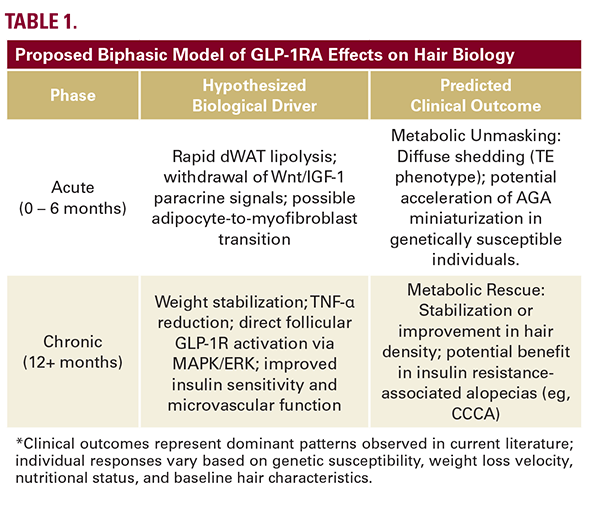
Glucagon-like peptide-1 receptor agonists (GLP-1RAs) have transformed obesity and type 2 diabetes management, yet emerging reports of hair loss represent a potential adherence concern. Pharmacovigilance analyses using the FDA Adverse Event Reporting System (FAERS) demonstrate significantly elevated reporting odds ratios for alopecia with semaglutide (ROR: 2.46, 95% CI: 2.14–2.83) and tirzepatide (ROR: 1.73, 95% CI: 1.42–2.09) compared to other antidiabetic agents.1,2 While hair loss is often attributed to telogen effluvium (TE) secondary to rapid weight loss, a recent real-world cohort study of over 1 million patients found a 64% increased odds of androgenetic alopecia (AGA) diagnoses at 12 months among GLP-1RA users (adjusted OR: 1.64, 95% CI: 1.35–1.99).3 These findings suggest GLP-1RAs may not simply induce transient shedding but could potentially accelerate follicular miniaturization in individuals with subclinical or early-stage AGA. We propose an integrative framework, the GLP-1RA Paradox, governed by the dWAT-follicle adipose axis, which distinguishes between two mechanistically distinct phases: acute Metabolic Unmasking and chronic Metabolic Rescue (Table 1).
MATERIALS AND METHODS
The interplay between GLP-1RA-mediated adipose lipolysis and localized follicular signaling is best understood through the dWAT-follicle adipose axis, which dictates the shift between tissue remodeling and regeneration (Figure 1).