
To the Editor,
Hidradenitis suppurativa (HS) is a chronic inflammatory dermatosis characterized by recurrent nodules and abscesses and is associated with psychosocial burdens and disordered eating behaviors (DEBs).1-3 Prior studies reported a 27.8% prevalence of DEBs among 2,363 HS patients and significant associations between HS, emotional eating, and external eating.1-2 Despite increasing recognition, patient perspectives regarding body image (BI) and DEB related to HS remain unknown and were evaluated in this study.
An anonymous, IRB-approved (NCR256803) survey was distributed to the HS Connect email listserv, a global HS patient organization, of approximately 6,000 individuals. Descriptive statistics summarized cohort characteristics. Chi-squared tests, Fisher’s exact test, and binary logistic regression analyses were performed, with statistical significance defined as P<0.05.
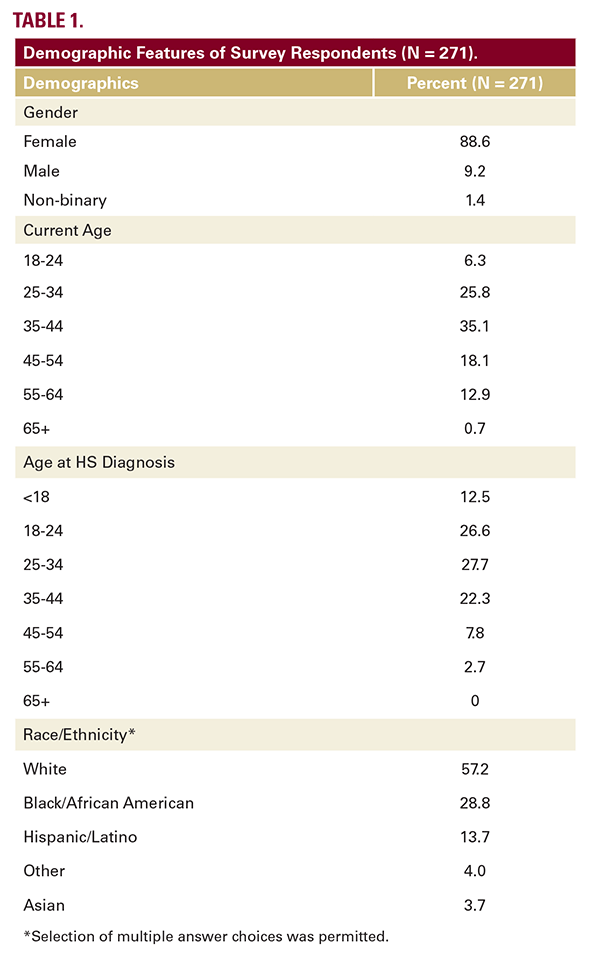
A total of 271 respondents completed the survey (Table 1). When asked how BI was impacted after HS diagnosis, 60% reported worsening, most commonly due to flares (87%) and the appearance of HS-affected body areas (85%), compared to only 5% reporting improvement. Additionally, increasing current age (odds ratio [OR] 0.777, 95% confidence interval (CI) [0.61-0.98], P=0.0366) and age at HS diagnosis (OR = 0.761 [0.61- 0.94], P=0.0131) were associated with 23% and 24% lower odds of worsened BI, respectively.
Participants with worsened BI had greater odds of restrictive eating (OR 2.53 [1.47-4.37], P<0.001). Overall, 75.7% reported ≥1 DEB following HS diagnosis, most commonly restrictive eating (42.1%), guilt after meals (34.7%), and binge eating (25.8%). Stress (74%), HS flares (67%), and BI dissatisfaction (64%) were the most frequently reported DEB triggers (Figure 1).
While dermatologists (61%) were significantly more likely to diagnose HS compared to primary care practitioners (PCPs) (17.2%) (OR 7.85 [5.16, 11.95], P<0.001), a significantly greater proportion of respondents discussed BI or DEB concerns with PCPs (61%) than with dermatologists (24.6%) (OR 3.02 [1.63,5.60], P<0.001). Participants were also significantly more
Hidradenitis suppurativa (HS) is a chronic inflammatory dermatosis characterized by recurrent nodules and abscesses and is associated with psychosocial burdens and disordered eating behaviors (DEBs).1-3 Prior studies reported a 27.8% prevalence of DEBs among 2,363 HS patients and significant associations between HS, emotional eating, and external eating.1-2 Despite increasing recognition, patient perspectives regarding body image (BI) and DEB related to HS remain unknown and were evaluated in this study.
An anonymous, IRB-approved (NCR256803) survey was distributed to the HS Connect email listserv, a global HS patient organization, of approximately 6,000 individuals. Descriptive statistics summarized cohort characteristics. Chi-squared tests, Fisher’s exact test, and binary logistic regression analyses were performed, with statistical significance defined as P<0.05.
A total of 271 respondents completed the survey (Table 1). When asked how BI was impacted after HS diagnosis, 60% reported worsening, most commonly due to flares (87%) and the appearance of HS-affected body areas (85%), compared to only 5% reporting improvement. Additionally, increasing current age (odds ratio [OR] 0.777, 95% confidence interval (CI) [0.61-0.98], P=0.0366) and age at HS diagnosis (OR = 0.761 [0.61- 0.94], P=0.0131) were associated with 23% and 24% lower odds of worsened BI, respectively.
Participants with worsened BI had greater odds of restrictive eating (OR 2.53 [1.47-4.37], P<0.001). Overall, 75.7% reported ≥1 DEB following HS diagnosis, most commonly restrictive eating (42.1%), guilt after meals (34.7%), and binge eating (25.8%). Stress (74%), HS flares (67%), and BI dissatisfaction (64%) were the most frequently reported DEB triggers (Figure 1).
While dermatologists (61%) were significantly more likely to diagnose HS compared to primary care practitioners (PCPs) (17.2%) (OR 7.85 [5.16, 11.95], P<0.001), a significantly greater proportion of respondents discussed BI or DEB concerns with PCPs (61%) than with dermatologists (24.6%) (OR 3.02 [1.63,5.60], P<0.001). Participants were also significantly more
likely to discuss concerns with PCPs compared to nutritionists (36.2%, OR 1.93 [1.07-3.53], P=0.0267), psychiatrist (27.5%, OR 2.66, 95% CI [1.42-5.13], P=0.0015), gynecologists (14.5%, OR 5.37 [2.52-12.55], P<0.001), bariatric surgeons (8.7%, OR 9.19 [3.17-27.40], P<0.001), or weight loss coaches (7.3%, OR 11.10 [4.21-37.10], P<0.001). Approximately half (53.5%) of participants