INTRODUCTION
Plaque psoriasis is a chronic inflammatory condition characterized by keratinocyte hyperproliferation and immune dysregulation that significantly impacts quality of life.1 While conventional therapies, such as topical corticosteroids and biologics, are frequently capable of stabilizing disease progression, their limitations, like adherence challenges and adverse effects,2,3 necessitate alternative treatments. The 308 nm excimer laser utilizes sitespecific UVB to induce DNA damage and apoptosis in treated cells, decreasing the inflammation and hyperproliferation characteristic of psoriasis.4 Although excimer is an established treatment, current literature lacks a comprehensive metaanalysis quantifying the laser's efficacy. This review and metaanalysis seek to address this gap by synthesizing data from studies evaluating excimer laser treatment for plaque psoriasis.
MATERIALS AND METHODS
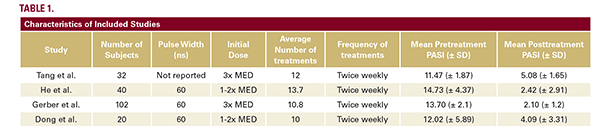
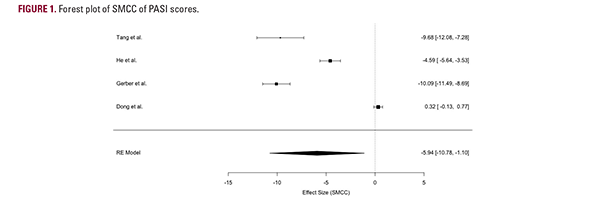
We searched MEDLINE, Embase, CENTRAL, and Web of Science using the search terms "psoriasis" and "laser". We included all clinical trials that utilized a 308 nm excimer laser for plaque psoriasis. Studies must have treated subjects twice weekly for at least 10 sessions. The Psoriasis Area and Severity Index (PASI) must have been the standardized measure used in included studies. A random-effects model was used to estimate standardized mean change with change score standardization (SMCC), which was used as the effect size to estimate the difference between baseline and follow-up PASI. A mixed-effects meta-regression was conducted to pool effect sizes across studies. All statistical analyses were performed in RStudio using the "metafor" package.