To the Editor,
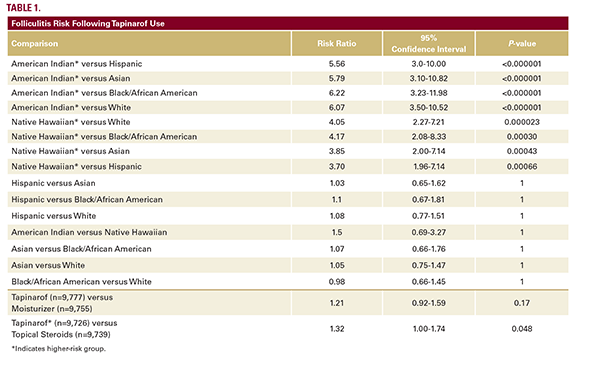
Tapinarof, a topical aryl hydrocarbon receptor (AhR) agonist, is approved for psoriasis and atopic dermatitis (AD).1 Folliculitis and contact dermatitis are the most frequently reported dermatologic adverse events.2 Tapinarof-induced folliculitis may stem from AhR-driven abnormal keratinization and follicular plugging.3 We aimed to quantify folliculitis risk following tapinarof use and assess racial/ethnic disparities.
Using the TriNetX Research Network, we conducted two retrospective cohort analyses of adults (≥18) using tapinarof. We queried codes from the 10th revision of the International Classification of Diseases (ICD-10) and RxNorm from September 1, 2022, to September 1, 2025, as tapinarof received FDA approval in May 2022. For the first analysis, tapinarof users were compared with a matched moisturizer cohort; for the second, tapinarof users were compared with a matched topical corticosteroid cohort. We excluded patients with pre-existing folliculitis, other follicular disorders, active skin infection, immunosuppressive conditions/medication use, concurrent exposure to both tapinarof and a control product, or concurrent exposure to both control products. Propensity score matching was performed for age, demographics, comorbidities, and indications (psoriasis/AD) to minimize confounding. Risk ratios (RR) and absolute risk differences (ARD) were assessed, including subgroup analyses by race/ethnicity (P<0.05).