Dear Editor,
Keloids are a dermatologic condition with high recurrence rates and variable treatment success. Racial disparities can play a crucial role in diagnosis delays and treatment outcomes. Studies have shown a higher incidence of keloids found in non-white patients, with Black patients diagnosed with larger and more advanced keloids compared to other racial groups.1 Although racial disparities in dermatologic care have been documented, treatment trends specific to keloids remain underexplored. We sought to evaluate racial differences in treatment patterns for keloids using a large representative cohort.
This study utilized data collected on May 2, 2025, from the TriNetX Research Network, which provides access to de-identified electronic medical records for approximately 144 million patients across 102 healthcare organizations. We identified patients aged 18 to 89 at the time of keloid diagnosis (ICD-10: L91.0) and stratified them by race (White, Black or African American, Asian, or Other Race). We then screened electronic health records for medical and procedural interventions performed within one year of keloid diagnosis.
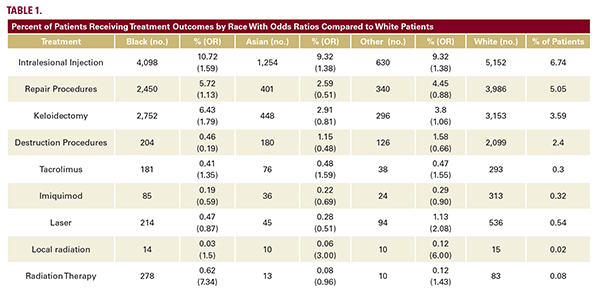
Outcomes of interest included intralesional injections (CPT: 11900, 11901), destruction procedures (CPT: 17110, 17111), radiation treatment (CPT: 77261, 77262, 77401), excision procedures (CPT: 11400-11446), repair procedures (CPT: 12031- 13153, 14000-14302), fractional ablative laser (CPT: 0479T, 0480T), and medications including Tacrolimus and Imiquimod. Patients who received procedures or medications of interest prior to a diagnosis of keloids were excluded from analysis to reduce confounding from individuals receiving treatments for other conditions.
Among keloid patients, 45,191 identified as Black, 16,179 as Asian, 99,076 as White, and 8,334 as Other. Blacks, Asians,
Keloids are a dermatologic condition with high recurrence rates and variable treatment success. Racial disparities can play a crucial role in diagnosis delays and treatment outcomes. Studies have shown a higher incidence of keloids found in non-white patients, with Black patients diagnosed with larger and more advanced keloids compared to other racial groups.1 Although racial disparities in dermatologic care have been documented, treatment trends specific to keloids remain underexplored. We sought to evaluate racial differences in treatment patterns for keloids using a large representative cohort.
This study utilized data collected on May 2, 2025, from the TriNetX Research Network, which provides access to de-identified electronic medical records for approximately 144 million patients across 102 healthcare organizations. We identified patients aged 18 to 89 at the time of keloid diagnosis (ICD-10: L91.0) and stratified them by race (White, Black or African American, Asian, or Other Race). We then screened electronic health records for medical and procedural interventions performed within one year of keloid diagnosis.
Outcomes of interest included intralesional injections (CPT: 11900, 11901), destruction procedures (CPT: 17110, 17111), radiation treatment (CPT: 77261, 77262, 77401), excision procedures (CPT: 11400-11446), repair procedures (CPT: 12031- 13153, 14000-14302), fractional ablative laser (CPT: 0479T, 0480T), and medications including Tacrolimus and Imiquimod. Patients who received procedures or medications of interest prior to a diagnosis of keloids were excluded from analysis to reduce confounding from individuals receiving treatments for other conditions.
Among keloid patients, 45,191 identified as Black, 16,179 as Asian, 99,076 as White, and 8,334 as Other. Blacks, Asians,