To the Editor,
Diabetes mellitus (DM) is associated with an estimated 20 to 30% prevalence of vulvar/anogenital pruritus, with various potential etiologies.1,2 Sodium-glucose cotransporter-2 inhibitors (SGLT2i) are increasingly prescribed for DM and increase urinary glucose excretion, possibly altering vaginal flora, which may contribute to vulvar pruritus (VP). Prior work has demonstrated increased incidence of vulvovaginal candidiasis (VVC) among patients treated with SGLT2i. Still, the overall incidence of VP without VVC in this population is unknown.5 Therefore, we investigated whether SGLT2i use is associated with increased VP.
We performed a retrospective cohort study using the TriNetX US Collaborative Network, which aggregates de-identified electronic health records (EHR). Adult women (≥18 years) with type 2 diabetes mellitus (T2DM) (ICD-10: E11) were stratified by those continuously prescribed SGLT2i (dapagliflozin, empagliflozin, canagliflozin, ertugliflozin) and unexposed controls. Prior diagnosis of VVC (B37.3), general candidiasis (B37), lichen sclerosis (L90.0), psoriasis (L40), lichen simplex chronicus (L28.0), contact dermatitis (L23–L24), lichen planus (L43), unspecified dermatitis (L30.9), or menopausal disorders (N95) was excluded from both cohorts to minimize confounders of VP. The index event was defined as the first SGLT2i prescription (exposed) or T2DM diagnosis (controls). The primary outcome was VP (L29.2) within 1, 3, and 5 years after the index event.
Propensity score matching (1:1) balanced demographics, comorbidities, and medications. Risk estimates and Cox proportional hazards (CPH) models were generated.
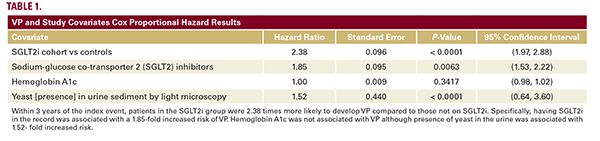
We included 53,025 patients in each cohort; over 1, 3, and 5 years, we observed 46, 71, and 83 cases of VP in the SGLT2i cohort compared with 16, 26, and 34 cases among controls. Absolute risk of VP was 0.087% vs 0.030%, 0.134% vs 0.049%, and 0.157% vs 0.064% in the SGLT2i and control cohorts at 1, 3, and 5 years, respectively. Risk analysis demonstrated a significant association between SGLT2i exposure and VP with risk ratios of 2.88 (95% CI 1.63–5.08), 2.73 (95% CI 1.74–4.28), and 2.44 (95% CI 1.64–3.64) across the respective time points. In the CPH model, the index event remained significantly associated with increased risk (HR 1.85, 95% CI 1.532–2.224, P=0.0063), representing an 85% higher hazard relative to controls. The cumulative incidence of VP increased with a longer duration of SGLT2i exposure.
Candidiasis-related ICD-10 codes were excluded from our model due to insufficient frequency within the matched cohort. Given the well-established association between SGLT2i and VVC and the low number of candidiasis codes observed, we hypothesize that VVC may be under-reported in EHR datasets in patients presenting with VP.3 The 1.5-fold increased risk of developing VP with the presence of yeast in the urine, with concomitantly
Diabetes mellitus (DM) is associated with an estimated 20 to 30% prevalence of vulvar/anogenital pruritus, with various potential etiologies.1,2 Sodium-glucose cotransporter-2 inhibitors (SGLT2i) are increasingly prescribed for DM and increase urinary glucose excretion, possibly altering vaginal flora, which may contribute to vulvar pruritus (VP). Prior work has demonstrated increased incidence of vulvovaginal candidiasis (VVC) among patients treated with SGLT2i. Still, the overall incidence of VP without VVC in this population is unknown.5 Therefore, we investigated whether SGLT2i use is associated with increased VP.
We performed a retrospective cohort study using the TriNetX US Collaborative Network, which aggregates de-identified electronic health records (EHR). Adult women (≥18 years) with type 2 diabetes mellitus (T2DM) (ICD-10: E11) were stratified by those continuously prescribed SGLT2i (dapagliflozin, empagliflozin, canagliflozin, ertugliflozin) and unexposed controls. Prior diagnosis of VVC (B37.3), general candidiasis (B37), lichen sclerosis (L90.0), psoriasis (L40), lichen simplex chronicus (L28.0), contact dermatitis (L23–L24), lichen planus (L43), unspecified dermatitis (L30.9), or menopausal disorders (N95) was excluded from both cohorts to minimize confounders of VP. The index event was defined as the first SGLT2i prescription (exposed) or T2DM diagnosis (controls). The primary outcome was VP (L29.2) within 1, 3, and 5 years after the index event.
Propensity score matching (1:1) balanced demographics, comorbidities, and medications. Risk estimates and Cox proportional hazards (CPH) models were generated.
We included 53,025 patients in each cohort; over 1, 3, and 5 years, we observed 46, 71, and 83 cases of VP in the SGLT2i cohort compared with 16, 26, and 34 cases among controls. Absolute risk of VP was 0.087% vs 0.030%, 0.134% vs 0.049%, and 0.157% vs 0.064% in the SGLT2i and control cohorts at 1, 3, and 5 years, respectively. Risk analysis demonstrated a significant association between SGLT2i exposure and VP with risk ratios of 2.88 (95% CI 1.63–5.08), 2.73 (95% CI 1.74–4.28), and 2.44 (95% CI 1.64–3.64) across the respective time points. In the CPH model, the index event remained significantly associated with increased risk (HR 1.85, 95% CI 1.532–2.224, P=0.0063), representing an 85% higher hazard relative to controls. The cumulative incidence of VP increased with a longer duration of SGLT2i exposure.
Candidiasis-related ICD-10 codes were excluded from our model due to insufficient frequency within the matched cohort. Given the well-established association between SGLT2i and VVC and the low number of candidiasis codes observed, we hypothesize that VVC may be under-reported in EHR datasets in patients presenting with VP.3 The 1.5-fold increased risk of developing VP with the presence of yeast in the urine, with concomitantly