Featured Article
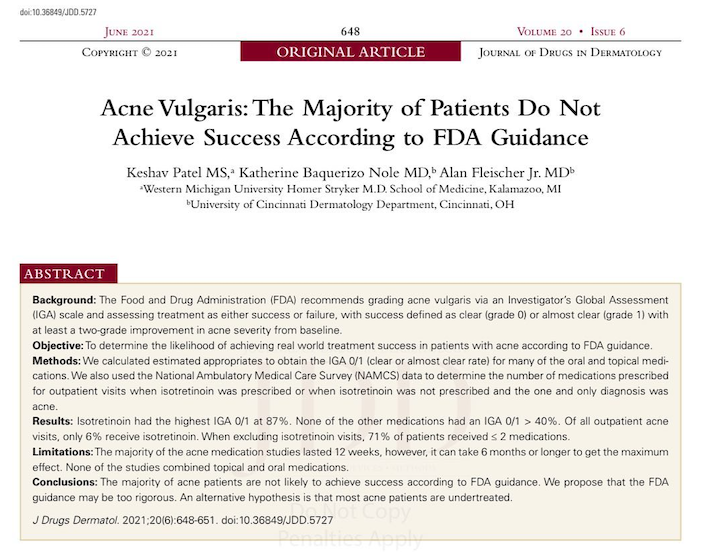
The majority of acne patients are not likely to achieve success according to FDA guidance. Is the FDA guidance too rigorous?
What is the likelihood of treatment success in patients with acne vulgaris?
According the FDA, success is defined as clear or almost clear. The FDA recommends using the IGA grading scale. The different grades include clear (grade 0), almost clear (grade 1), mild severity (grade 2), moderate severity (grade 3), and severe (grade 4). However, there are many different scales for grading acne severity.
Data from the 2012 to 2016 NAMCS was used to determine the number of medications prescribed for outpatient visits when isotretinoin was prescribed or when isotretinoin was not prescribed and the one and only diagnosis was acne. These surveys were developed and implemented by the National Center of Health Statistics, part of the Center for Disease Control and Prevention (CDC). Results from the survey provide nationally representative yearly estimates of non-hospital-based outpatient healthcare utilization.
This study finds the majority of acne patients are not likely to achieve success according to FDA guidance. The study proposes that the FDA guidance may be too rigorous. An alternative hypothesis is that most acne patients are undertreated.
Further studies should be done to demonstrate a clinically meaningful severity difference, or minimum clinically important difference, in acne severity and these studies may help redefine acne treatment success.
How did the oral and topical medications perform? What drugs were the most efficacious at the end of 12 weeks?
The authors compared 19 oral and topical acne treatments and the results may be surprising. Read the article to find out.
- Adapalene and benzoyl peroxide gel 0.1%/2.5%
- Adapalene gel 0.1%
- Adapalene gel 0.3%
- Benzoyl Peroxide gel 2.5%
- Clindamycin gel 1.2%
- Clindamycin phosphate and benzoyl peroxide gel 1.2%/2.5%
- Clindamycin phosphate and tretinoin gel 1.2%/0.025%
- Dapsone gel 5%
- Dapsone gel 7.5%
- Minocycline foam 4%
- Tazarotene cream 0.1%
- Tazarotene foam 0.1%
- Tretinoin lotion 0.05%
- Trifarotene cream
- Doxycycline calcium tablet
- Drospirenone/ethinyl estradiol tablet
- Extended release minocycline
- Isotretinoin capsule
- Sarecycline tablet
Acne Vulgaris: The Majority of Patients Do Not Achieve Success According to FDA Guidance
Keshav Patel MS, Katherine Baquerizo Nole MD, Alan Fleischer Jr. MD
Get More from the JDD
Get the latest news delivered straight to your Inbox – sign up for the JDD Newsletter.
Discover the latest research, exclusive articles from leading dermatology experts, popular Podcast episodes, free CME activities, and more!


You May Also Like