
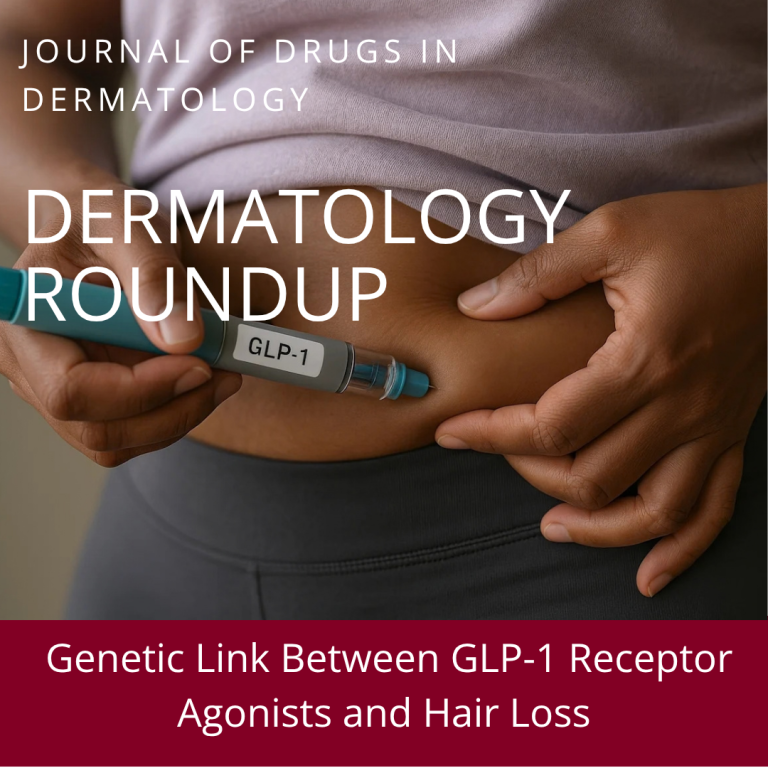
A new study provides the first scientific evidence of a suspected genetic link between the use of GLP-1 receptor agonists and hair loss. The study, led by researchers at NYU Langone Health, found men with androgenetic alopecia are more likely to have GLP1R genes that naturally cause higher levels of GLP-1 receptor proteins. As such, they have a 7% greater likelihood of experiencing hair loss from GLP-1 receptor agonists.
“Our findings suggest that, if future experiments prove successful, some men, and possibly women too, could be screened and benchmarked for their risk of hair loss before being prescribed GLP-1 medications,” says study senior investigator Lynn Petukhova, PhD, assistant professor in the Ronald O. Perelman Department of Dermatology and the Department of Population Health at NYU Grossman School of Medicine. “We could also envision these findings leading to some GLP-1 users being prescribed combination treatments to prevent hair loss, such as minoxidil or some other drug.”
Women who experience androgenetic alopecia were not included in the study due to a lack of research, though Dr. Petukhova plans to investigate whether the genetic link in men also applies to women. The study was published online in the Journal of Investigative Dermatology.
Phase 3 B Results of IL-17 Inhibitor, GLP-1 Agonist in Psoriatic Disease Patients With Obesity
Lilly’s phase 3b data on concomitant use of ixekizumab (Taltz) and tirzepatide (Zepbound) shows “improved and durable efficacy” in adults with both psoriatic disease and obesity. Previously reported results of the TOGETHER-PsO and TOGETHER-PsA studies at the 36- week endpoint showed statistically superior improvements in disease activity and metabolic outcomes compared with ixekizumab alone. Now, at the 52-week endpoint, data show these outcomes were either maintained or improved with no new safety concerns.
“In psoriatic arthritis, the greater improvements in disease activity seen with Taltz and Zepbound in the first month, before clinically meaningful weight loss occurred, continued through one year,” says dermatologist and rheumatologist Joseph F. Merola, MD, MMSc, president of the Psoriasis and Psoriatic Arthritis Clinics Multicenter Advancement Network (PPACMAN), co- president of the Group for Research and Assessment of Psoriasis and Psoriatic Arthritis (GRAPPA), and president of the Rheumatology-Dermatology Society.” In psoriasis, the durability of complete skin clearance at one year represents real, lasting progress for patients. Paired with continued metabolic improvements, these findings show what may be possible when treating psoriatic disease and obesity concurrently.”
Two Dermatologists Named ABMS Scholars
The American Board of Medical Specialties (ABMS) includes two dermatologists in its 2026- 2027 ABMS Scholars Program. Elizabeth Bailey, MD, MPH, of Stanford University School of Medicine, will receive a $15,000 grant for her project, “Development of Entrustable Professional Activities for Dermatology Residency.” In addition, Drew Saylor, MD, MPH, FAAD, FACMS, of the University of California San Francisco, will also receive a grant for her project,“Pathology Concordance as a Competency Milestone: Developing a Concordance Assessment Tool and EPA Framework for Frozen Section Interpretation in Mohs Surgery Fellowship.” Both were co-sponsored by the American Board of Dermatology.