
Beyond Standard Topicals: Evaluating LTN Serum for Melasma and Acne-Induced PIH
Have you caught this compelling clinical update in the recent issue of the JDD?
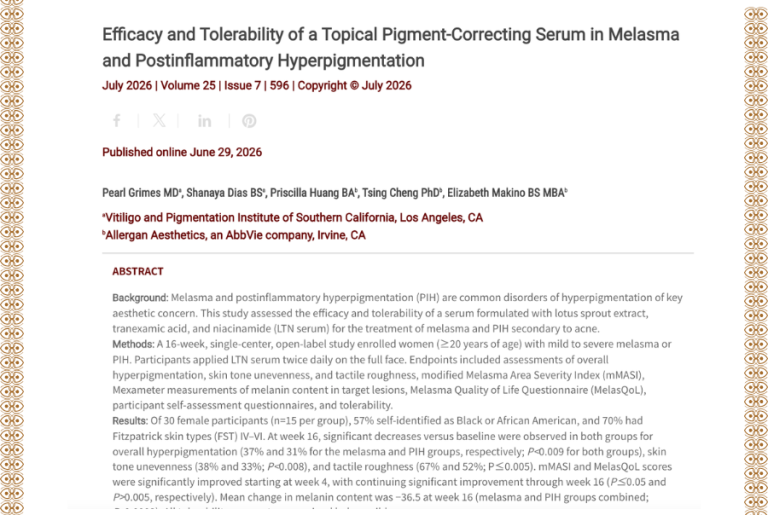
Managing recalcitrant hyperpigmentation disorders such as melasma and postinflammatory hyperpigmentation presents an ongoing clinical challenge, particularly in patients with darker skin phototypes. While traditional options exist, identifying well-tolerated formulations that deliver meaningful clinical improvements without inducing secondary irritation remains a top priority for practicing dermatologists and aesthetic providers. A newly published clinical study evaluates the therapeutic potential of a novel topically applied serum containing lotus sprout extract, tranexamic acid, and niacinamide for full-face management of hyperpigmentation.
The open-label clinical trial examined the real-world impact of twice-daily LTN serum application over a 16-week period in adult female subjects presenting with mild to severe facial melasma or acne-related postinflammatory hyperpigmentation. Notably, the study focused on diverse patient representation, with a significant majority of participants exhibiting Fitzpatrick skin types IV through VI.
Researchers tracked multiple clinical endpoints throughout the trial duration. Objective measures included changes in target lesion melanin index via Mexameter readings, alongside validated clinician scoring tools like the modified Melasma Area Severity Index. In addition to physical metrics, the investigation monitored patient-reported outcomes using the Melasma Quality of Life Questionnaire, overall skin tone uniformity, surface texture changes, and comprehensive cutaneous tolerability parameters.
The published data reveals fascinating insights into how quickly therapeutic benefits manifest, the percentage reduction in overall hyperpigmentation, and how patient quality-of-life scores shifted over the 16-week course. Given the high prevalence of pigmentary disorders in skin of color, these findings offer valuable perspective for refining your daily treatment algorithms.
Read the complete study in the Journal of Drugs in Dermatology to review the full numerical data, explore the detailed methodology, and assess how these clinical outcomes can inform your topical regimen strategies for hyperpigmentation.
Blog write-up assisted by AI