
A JDD retrospective review links generalized disease to higher comorbidity burden and reports favorable response to pentoxifylline
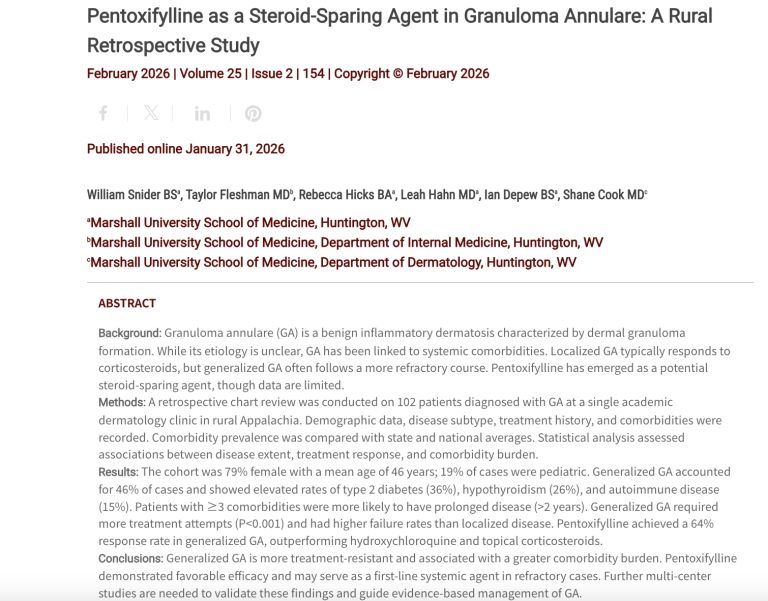
In this article from JDD’s February 2026’s issue, authors present a single center, retrospective chart review of 102 patients with granuloma annulare seen at an academic dermatology clinic in rural Appalachia. The study evaluated disease subtype, treatment history, and medical comorbidities to better define clinical patterns and treatment outcomes.
Key findings include a high proportion of generalized disease, an association between generalized disease and greater comorbidity burden including diabetes and thyroid disease, and a tendency for generalized disease to require more treatment attempts and to be more treatment resistant than localized disease. Pentoxifylline produced a notable response rate in generalized cases and compared favorably with other systemic and topical therapies in this cohort.
The authors conclude that generalized granuloma annulare presents distinct clinical challenges and that pentoxifylline may be a reasonable systemic option in refractory cases. They call for multi center studies to validate these observations and to inform evidence based management.
Read the full JDD article to review methods and outcomes in detail. Consider assessing comorbidity burden when managing patients with generalized granuloma annulare and discuss pentoxifylline as a potential systemic option in cases that do not respond to standard therapies. Share these findings at your next department meeting to help inform local practice and identify opportunities for collaborative research.
J Drugs Dermatol. 2026;25(2):154-158. doi:10.36849/JDD.9304
Blog write-up assisted by AI