
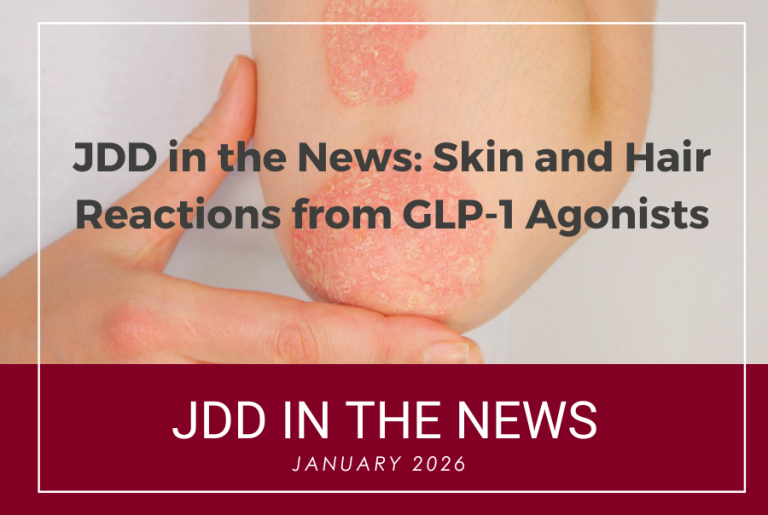
Medscape highlighted a January Journal of Drugs in Dermatology study on the incidence of skin and hair effects from GLP-1 agonists. The study, “Cutaneous Adverse Events Associated With GLP-1 Receptor Agonists: A FAERS Database Analysis From 2018-2024,” looked at data from the FDA Adverse Event Reporting System on the following GLP-1 agonists: semaglutide, liraglutide, exenatide, and dulaglutide. In patients who were prescribed these medications, researchers looked for adverse events involving the skin and hair by looking for the terms
“rash,” “pruritus,” “urticaria,” “alopecia,” “angioedema.” Up to 8.16% of GLP-1 receptor agonists cases reported a cutaneous adverse event, most often in females; the mean patient age was 60. Semaglutide was associated with the highest rate of cutaneous adverse effects while dulaglutide was associated with the lowest rate. Cutaneous effects from GLP-1 agonists were less frequent than in DPP-4 inhibitors. The researchers theorized that adverse effects could be due to dosage, immune modulation, and patient perception of efficacy. The researchers concluded that skin and hair effects are infrequent in patients on GLP-1 agonists, but the frequency does vary depending on the drug.
Adverse events were also the focus of a Healio article about an October 2025 JDD study on the incidence of nodules and lipomas after influenza vaccination. The study, “Increased Risk of Subcutaneous Nodules and Lipomas Following Influenza Vaccination: A Multicenter TriNetX Cohort Study,” used data from the TriNetX platform to confirm the hypothesis that intramuscular influenza vaccination is associated with an increased risk of the development of subcutaneous nodules and lipomas in the upper arm. A deeper dive into the data revealed that patients who
received the quadrivalent formulations – but not the trivalent formulations – were at the increased risk. The highest risk of nodule formation was associated with the preservative-containing quadrivalent influenza vaccine, while the preservative-free version was associated with the highest risk of lipoma development. The researchers acknowledge the many factors involved in the development of nodules and lipomas, including administration technique and needle selection, as well as genetic predispositions. The researchers point out that the benefits of influenza vaccination far outweigh the increased risk of nodules and lipomas.
Healio also wrote about an October JDD brief communication on the dermatologic risks of nail products. The study, “The Dermatologic Hazards of Nail Product Usage,” outlined allergic contact dermatitis from nail product usage. The article details the triggers, including tosylamide/formaldehyde resin, which is the most common allergen. Methyl Methacrylate (MMA) is a monomer used with acrylic nails that has been found to cause severe contact dermatitis. The article points out that, in recent studies, more than 80% of sensitizations to HEMA (methacrylates is 2-hydroxyethyl methacrylate) are due to nail products. Women who were exposed to nail chemicals through their positions as nail technicians were also more likely to have chronic dermatitis and lichenified and psoriasiform dermatitis. Damage to the nail and nail plate were also reported. With regards to UV exposure from gel manicures, the researchers note that data is conflicting and more research is needed to determine the risk of skin cancer from the curing process.