
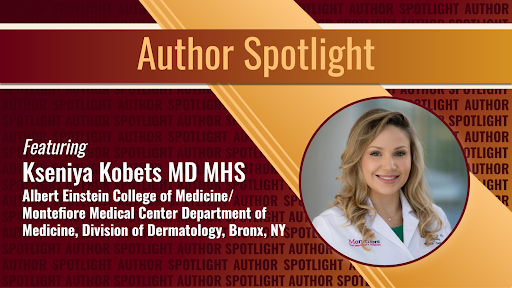
Our current Author Spotlight features Kseniya Kobets MD MHS, one of the co-authors of “Disparities in Hidradentitis Suppurativa Clinical Trials: An Updated Review of ClinicalTrials.gov from 2020 to 2024,” published in JDD’s December 2025 issue. In addition to her article, Dr. Kobets also answered questions around the current state of dermatology and how the field is adapting to new advances in technology and treatments.
- In your experience, what is one commonly overlooked factor in diagnosing or managing a specific skin condition that deserves more attention?
I increasingly believe that a background component of androgenetic alopecia is present in nearly everyone, and it becomes more pronounced with age, perimenopause, and postmenopause. When we see “improvement” in certain scarring alopecias—like LPP—on therapies such as finasteride or minoxidil, part of what we may be treating is the underlying androgenetic component that often goes unrecognized.
This perspective has changed the way I evaluate patients who present with traction alopecia or scarring alopecia. Even when scarring is clinically evident, many patients still have a reservoir of susceptible background hairs affected by androgenetic alopecia. Addressing this component can help them retain what is salvageable, even if we cannot fully reverse scarred areas. There is some hope when scaring is early on and in the younger population.
I always emphasize to patients that alopecia is multifactorial. We may halt the progression of the inflammatory process, but supporting the remaining hairs, using oral or topical minoxidil, oral or topical finasteride, compounded combinations, or PRP injections can preserve hair density if initiated early enough.
Another overlooked issue is that for skin of color, topical or oral minoxidil requires additional counseling. Women with melanin-rich skin already prone to post-inflammatory hyperpigmentation or facial hirsutism can experience distress from unwanted facial hair growth. Addressing this upfront—discussing hair-removal options or pigment-lightening agents—helps patients feel seen, understood, and supported. These conversations build trust and underscore that we are cognizant of both therapeutic benefits and real-world complications.
- Of all your research findings, were there any surprising or unexpected results that changed your perspective?
One of the most interesting preliminary findings from our prospective study using the 1470 nm non-ablative laser for scarring and scarring alopecias is that some patients show improvement in areas previously thought to be permanently scarred. Alopecia research is notoriously challenging, so seeing any regenerative signal is meaningful.
What remains unclear is whether we are improving true scarring pathology, addressing the background androgenetic alopecia, or both. That is why our team hopes to study pre- and post-laser molecular changes using mRNA analysis from hair plucking, supported by an ASLMS grant. We are still in early phases of evaluating how to reliably extract and interpret mRNA this way, but it is an exciting frontier.
Of course, important questions remain, such as whether this could worsen active LPP and whether it is best suited only for stable disease. I firmly believe that combining energy-based devices with regenerative (like PRP and exosomes) science may reshape how we approach complex hair disorders in the future.
- How do you see artificial intelligence and digital dermatology evolving over the next five years?
We already use digital tools like HairMetrix to quantify hair thinning and imaging systems such as VISIA to track pores, wrinkles, texture, and pigment. But these technologies are still in early stages.
Where I see tremendous potential is in objective measurement of facial laxity, fat redistribution, and structural changes, particularly in the era of GLP-1 medications, where patients often experience rapid and visible facial changes. An affordable and user-friendly device that can quantify these shifts and help guide treatment planning would be transformative.
AI will also accelerate pattern recognition exams on an iPhone, streamline follow-ups, enhance patient education, and increasingly integrate into aesthetic and medical dermatology workflows.
- If you could implement one immediate policy change to improve dermatologic care on a broad scale, what would it be and why?
Insurance coverage for several highly impactful procedures needs urgent reconsideration. Platelet-rich plasma (PRP) for alopecia has shown efficacy comparable to FDA-approved therapies in meta-analyses, yet remains uncovered. Similarly, lasers for acne scarring and emerging wavelengths like 1726 nm for acne are life-changing for many patients but remain financially inaccessible.
Expanding fair insurance coverage (since many of these devices are expensive and procedures are time consuming) for these evidence-supported interventions would dramatically improve outcomes and reduce long-term psychosocial burden for patients with alopecia, acne, and acne scarring.
- Are there any misconceptions among dermatologists or patients about a specific treatment or condition that you’d like to address?
When I entered dermatology, I wasn’t sure I would pursue fellowship training—yet completing a cosmetic and procedural dermatology fellowship was one of the best decisions of my career. Cosmetic dermatology often gets an unfair reputation for big lips and botched procedures, but in reality, it can change the lives of many people struggling with issues like acne scarring and acne (those that cannot tolerate accutane), pigmentation, and alopecia. And cosmetic dermatologists should be the leaders of safety, innovation, and evidence-based procedural medicine.
Far too many individuals perform aesthetic procedures without adequate training or an understanding of how to manage complications. Board-certified cosmetic and procedural dermatologists should be the ones setting standards, defining evidence, and driving innovation—not reacting to trends initiated without medical oversight.
I entered cosmetic dermatology to better help my acne, scarring, and alopecia patients—areas where medical therapy alone often falls short. With rapid growth in regenerative medicine, energy-based devices, and new systemic therapies like GLP-1s, academic dermatology should fully embrace cosmetic and aesthetic research, not shy away from it.
- How do you balance efficacy and accessibility when recommending treatments to patients from diverse backgrounds?
I never assume a patient’s resources or priorities. I start by understanding their goals, circumstances, and what they ultimately hope to achieve. Having a diverse academic patient population has taught me that accessibility is not one-size-fits-all.
For conditions like acne scarring and alopecia—especially in pediatric patients—I do my best to make in-office treatments accessible when clinically appropriate. The key is transparent communication, realistic expectations, and a personalized pathway using the tools available in our clinic. Patients appreciate when we meet them where they are, even if it’s just starting sunscreen that fits their skin type on the first visit.
- What role do social determinants of health play in dermatologic outcomes, and how can dermatologists better address these challenges?
Dermatology becomes stronger when we train in and care for diverse skin types and underrepresented populations. Recognizing disease presentations in melanin-rich skin ensures we don’t miss key diagnoses and allows us to refine how we describe and categorize conditions and treat them more appropriately.
Academic dermatology has a responsibility to contribute meaningful research in these areas. Studying disorders like CCCA not only drives therapeutic advances but helps patients feel understood and less alone. The conversation around alopecia—especially in women of color—is becoming more open, destigmatized, and compassionate, and clinicians play a major role in leading that shift.
- If you could collaborate with any other specialty to advance dermatologic research, who would it be and why?
I would love to deepen collaborations with women’s health, gynecology, endocrinology, and weight-loss medicine. Hormonal transitions in perimenopause and postmenopause affect skin, hair, bone, and overall well-being. Similarly, rapid weight loss can lead to changes in skin quality, laxity, and hair density. Interdisciplinary partnerships would help us better understand and treat these interconnected aspects of women’s health.
- What is a piece of advice you wish you had received earlier in your dermatology career?
The strength of our field lies in our colleagues and community. Dermatology is a small world, and staying connected—through alumni groups, professional networks, and even informal chats—can be invaluable. We learn from each other’s successes and complications, and these relationships sustain morale in an increasingly fast-paced and demanding specialty.
- Outside of clinical practice and research, what excites you most about the future of dermatology?
I’m excited about regenerative medicine, including exosomes and other molecular messengers that may one day direct skin and hair rejuvenation, wound healing, and even tissue regeneration. But, as with stem-cell science, great potential requires great responsibility—we need rigorous research to understand safety and long-term effects.
I’m also energized by the promise of AI to help organize information, streamline care, and enhance how we practice medicine. But amidst all technological advancement, we must stay grounded but embracing human imperfection, prioritize well-being beyond aesthetics, and avoid chasing unattainable “glass skin” ideals. Dermatology is at its best when we blend science, artistry, and humanity and use our god given skills and tools to help others as best we can.