
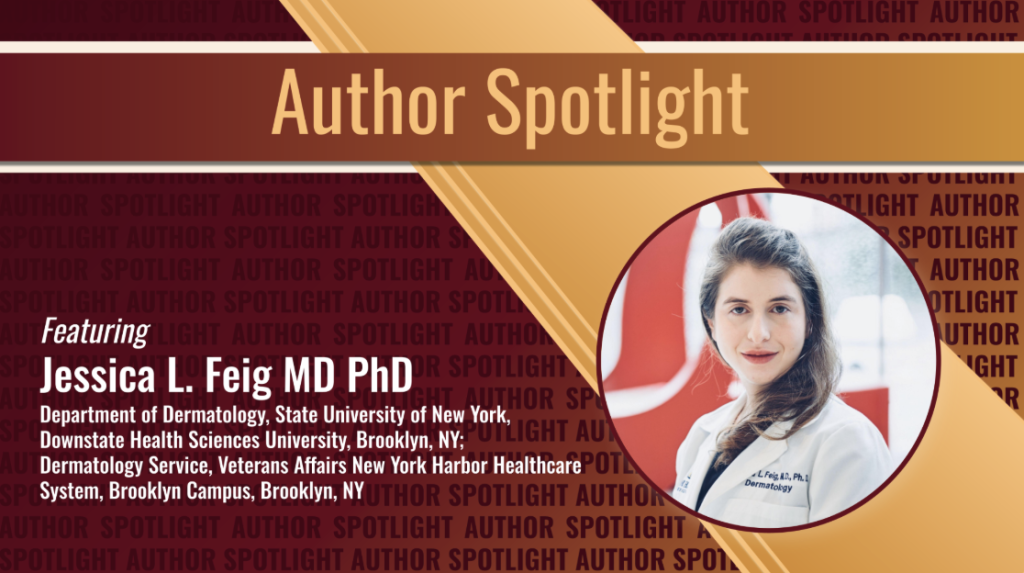
Our current Author Spotlight features Jessica L. Feig MD PhD, one of the co-authors of JAK/STAT Inhibitors Reduce Risk of New-Onset Keloids and Hypertrophic Scars: A Multi-Center Retrospective Cohort Study, published in our September 2026 issue. In addition to the article, Dr. Feig also provided insight about the current state of dermatology and how the field is adapting to new advances in technology and treatments.
In your experience, what is one commonly overlooked factor in diagnosing or managing a specific skin condition that you think deserves more attention?
The psychosocial impact of skin diseases is an area which deserves more attention. This is relevant in the clinic where patients are disturbed by their symptoms. Severe itch or disfiguring scarring can impact one’s quality of life and I have seen therapeutics, which not only affect the skin disease but also greatly impact a patient’s mood and overall psyche. In our database study, we found that initiation of JAK inhibitors was associated with a significantly reduced risk of incident hypertrophic scar and keloid formation. This has implications in the mechanism of action of scarring and keloid development.
Are there any misconceptions among dermatologists or patients about a specific treatment or condition that you’d like to address?
Yes, oftentimes people feel like dermatologists perform mostly cosmetic procedures to enhance aesthetic results. However, dermatologists are uniquely positioned to treat both medical and cosmetic dermatology to change patient outcomes. I was very fortunate to be involved with International Dermatology Outcome Measures (IDEOM), this year. It’s the brainchild of my friend and colleague Dr. Alice Gottlieb. The primary focus of this organization is to develop standardized and validated patient-centered outcome metrics for dermatological diseases, by including dermatologists, patients, and pharmaceutical industry representatives, to ensure that outcomes measured in clinical trials and clinical practice truly reflect patient needs.
What role do you think social determinants of health play in dermatologic treatment outcomes, and how can dermatologists better address these challenges?
Social determinants can certainly play a role but that is why IDEOM was created! It is such a unique organization developed by Dr. Alice Gottlieb to include patients in discussions so that outcomes measured in clinical trials and clinical practice truly reflect patient needs. My mentor and friend Dr. Daniel Siegel introduced me to his workgroup where I was able to get more involved this past year.
If you could collaborate with any other specialty or field to advance dermatologic research, which would it be and why?
Collaboration with the field of immunology would probably be most suited to advance dermatology research. Research and development of novel therapeutic agents heavily rely on immunologists.
What is a piece of advice you wish you had received earlier in your dermatology career?
My most important advice probably came from my late friend and mentor Dr. Haines Ely – he always said, “fast nickels are better than slow dimes” and in practice this is so true. And because yield is a summation of productivity, he would always ensure that generosity should supersede a businessman’s natural instinct to try to get a higher profit margin. Another important piece of advice is seeking out mentorship opportunities early and continuing to cultivate these relationships. I am forever indebted to my mentors, Dr. Buddy Cohen, Dr. Sharon Glick, Dr. Ed Heilman, Dr. Rivkah Isseroff, Dr. Mark Lebwohl, and Dr. Daniel Siegel to name a few.
Outside of clinical practice and research, what excites you most about the future of dermatology?
Dermatology is getting more and more competitive with each passing year and this is exciting because that means we continue to have the best and the brightest join with the potential to become future leaders of dermatology. The sky truly is the limit and I am honored to be a member of a collaborative team of likeminded individuals.