To the Editor,
Analysis of Google search results have previously found underrepresentation of Skin of Color (SOC) compared to the general population in 90.1% of 74 conditions analyzed.1 Some have hypothesized this disparity to be resultant of the paucity of SOC representation in educational materials.2 Since then, Google has attempted to increase the representation of SOC in its search results.3 However, no studies have assessed other search engines. We sought to assess whether there were tangible increases in the representation of SOC in Google results since Kurtti et al, and compare it to representation in other search engines, notably Yahoo, Bing, and DuckDuckGo.1
The first 50 images for 74 search terms, reflecting the conditions studied in Kurtti et al were assessed.1 Terms were queried using Google Chrome "Incognito" window, with location tracking blocked and browsing data, cookies, and cached images cleared. Images were categorized as light (Fitzpatrick I–IV), dark (Fitzpatrick V or VI), or inconclusive, which was reflected when image resolution, lighting, or skin condition made assessing the image skin tone impossible. Black and White images, those that did not have actual photographs of disease, and duplicates were excluded.
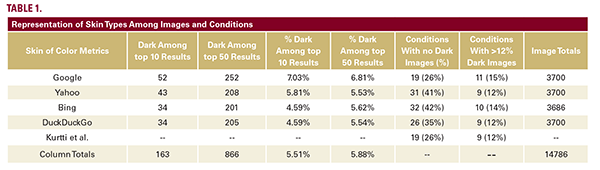
Across four search engines, 5.88% of images displayed dark skin. Google contained the largest proportion of dark skin among the top 50 (6.81%) and 10 (7.03%) images. Comparing the results with Kurtti et al, the same amount of conditions contained no Dark skin Google results (19), though this was still less than Yahoo (31), Bing (32), and DuckDuckGo (26). There were 1.14% more Google image results with Dark skin (P=.04338) in 2024 compared to 2020, though this still falls short of the 12% target representation set out in Kurtti et al. The amount of skin conditions meeting the 12% target was greater for Google in 2024 (11) compared to 2020 (9) and the other search engines (Yahoo 9, Bing 10, DuckDuckGo 9), though the improvement was minimal.
Konisky et al reported a 11.7% prevalence of "melanin-rich" top-100 Google search results among 42 conditions, though the methodology, number of conditions, and prevalence of conditions primarily affecting patients of color could account for differences observed.4 Despite Google's commitment to increasing SOC representation among search engine results, we found the improvement in representation to be minimal. Even with differing search engines and image website sources, under-
Analysis of Google search results have previously found underrepresentation of Skin of Color (SOC) compared to the general population in 90.1% of 74 conditions analyzed.1 Some have hypothesized this disparity to be resultant of the paucity of SOC representation in educational materials.2 Since then, Google has attempted to increase the representation of SOC in its search results.3 However, no studies have assessed other search engines. We sought to assess whether there were tangible increases in the representation of SOC in Google results since Kurtti et al, and compare it to representation in other search engines, notably Yahoo, Bing, and DuckDuckGo.1
The first 50 images for 74 search terms, reflecting the conditions studied in Kurtti et al were assessed.1 Terms were queried using Google Chrome "Incognito" window, with location tracking blocked and browsing data, cookies, and cached images cleared. Images were categorized as light (Fitzpatrick I–IV), dark (Fitzpatrick V or VI), or inconclusive, which was reflected when image resolution, lighting, or skin condition made assessing the image skin tone impossible. Black and White images, those that did not have actual photographs of disease, and duplicates were excluded.
Across four search engines, 5.88% of images displayed dark skin. Google contained the largest proportion of dark skin among the top 50 (6.81%) and 10 (7.03%) images. Comparing the results with Kurtti et al, the same amount of conditions contained no Dark skin Google results (19), though this was still less than Yahoo (31), Bing (32), and DuckDuckGo (26). There were 1.14% more Google image results with Dark skin (P=.04338) in 2024 compared to 2020, though this still falls short of the 12% target representation set out in Kurtti et al. The amount of skin conditions meeting the 12% target was greater for Google in 2024 (11) compared to 2020 (9) and the other search engines (Yahoo 9, Bing 10, DuckDuckGo 9), though the improvement was minimal.
Konisky et al reported a 11.7% prevalence of "melanin-rich" top-100 Google search results among 42 conditions, though the methodology, number of conditions, and prevalence of conditions primarily affecting patients of color could account for differences observed.4 Despite Google's commitment to increasing SOC representation among search engine results, we found the improvement in representation to be minimal. Even with differing search engines and image website sources, under-