To the Editor,
Psoriasis (PsO) is a chronic inflammatory disease associated with significant psychiatric comorbidity.1 Emerging evidence suggests that inflammatory pathways in PsO may contribute to neuroinflammation and mood symptoms, raising the possibility that biologic therapies could differentially influence mental health outcomes.2 However, direct longitudinal comparisons between biologic classes remain limited. Using real-world data from the TriNetX database, we compared incident depression, anxiety, and sleep disorders among PsO patients treated with risankizumab versus adalimumab at 12-,18-, and 24-month follow-up. Cohorts included PsO patients (greater than or equal to 2 ICD-10 L40 codes) with exposure to risankizumab or adalimumab, excluding comparator biologic use and other labeled indications to better reflect psoriasis-specific use.
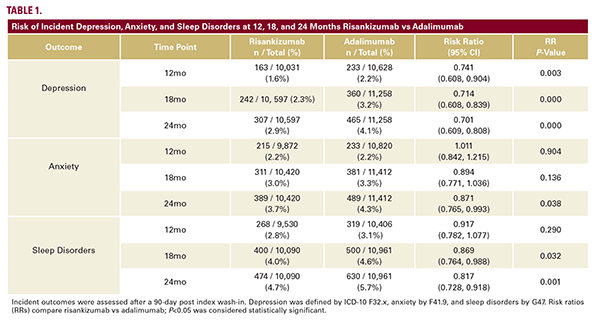
Across all follow-up intervals, risankizumab was associated with lower incident depression compared with adalimumab, with separation evident by 12 months and sustained through 24 months (12 month: RR, 0.741; 95% CI, 0.608-0.904; 18 months: RR, 0.714; 95% CI, 0.608–0.839; 24 months: RR, 0.701; 95% CI, 0.609–0.808; all P less than or equal to 0.003) (Table 1; Figure 1). Sleep disorders similarly favored risankizumab beginning at 18 months (RR, 0.869; 95% CI, 0.764–0.988; P=0.032) and persisted at 24 months (RR 0.817, 95% CI, 0.728–0.918; P=0.001), while the 12-month comparison was not significant. Anxiety outcomes did not differ at 12 or 18 months but favored risankizumab at 24 months (24 months: RR, 0.871; 95% CI, 0.765-0.99; P=0.038).
Psoriasis (PsO) is a chronic inflammatory disease associated with significant psychiatric comorbidity.1 Emerging evidence suggests that inflammatory pathways in PsO may contribute to neuroinflammation and mood symptoms, raising the possibility that biologic therapies could differentially influence mental health outcomes.2 However, direct longitudinal comparisons between biologic classes remain limited. Using real-world data from the TriNetX database, we compared incident depression, anxiety, and sleep disorders among PsO patients treated with risankizumab versus adalimumab at 12-,18-, and 24-month follow-up. Cohorts included PsO patients (greater than or equal to 2 ICD-10 L40 codes) with exposure to risankizumab or adalimumab, excluding comparator biologic use and other labeled indications to better reflect psoriasis-specific use.
Across all follow-up intervals, risankizumab was associated with lower incident depression compared with adalimumab, with separation evident by 12 months and sustained through 24 months (12 month: RR, 0.741; 95% CI, 0.608-0.904; 18 months: RR, 0.714; 95% CI, 0.608–0.839; 24 months: RR, 0.701; 95% CI, 0.609–0.808; all P less than or equal to 0.003) (Table 1; Figure 1). Sleep disorders similarly favored risankizumab beginning at 18 months (RR, 0.869; 95% CI, 0.764–0.988; P=0.032) and persisted at 24 months (RR 0.817, 95% CI, 0.728–0.918; P=0.001), while the 12-month comparison was not significant. Anxiety outcomes did not differ at 12 or 18 months but favored risankizumab at 24 months (24 months: RR, 0.871; 95% CI, 0.765-0.99; P=0.038).