To the Editor,
A direct relationship between hypothyroidism and delayed wound healing has been demonstrated in both in vivo murine and ex vivo human models.1,2 Clinical studies further support this association, with higher postoperative complication rates reported among hypothyroid patients, including those seen in cutaneous and other head and neck surgeries such as rhytidectomy or laryngectomy.3,4 However, the impact of hypothyroidism on outcomes after Mohs micrographic surgery (MMS) remains unclear. This retrospective cohort study evaluates postoperative risks within 30 days of MMS in patients with hypothyroidism.
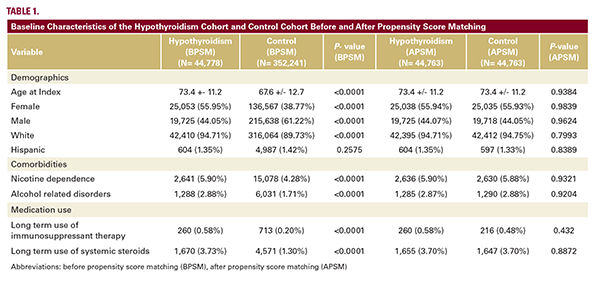
A global retrospective cohort study was conducted utilizing TriNetX, a database containing records from over 120 million patients across 80 health care organizations. Patients who underwent MMS were categorized based on a history of hypothyroidism (n= 50,284) or no diagnosis of hypothyroidism (n= 406,045). Propensity score matching was used to control for demographics, comorbidities, and medication use (Table 1). Post-surgical complications within 30 days were compared between matched cohorts, with significance at P-value <0.05.
A direct relationship between hypothyroidism and delayed wound healing has been demonstrated in both in vivo murine and ex vivo human models.1,2 Clinical studies further support this association, with higher postoperative complication rates reported among hypothyroid patients, including those seen in cutaneous and other head and neck surgeries such as rhytidectomy or laryngectomy.3,4 However, the impact of hypothyroidism on outcomes after Mohs micrographic surgery (MMS) remains unclear. This retrospective cohort study evaluates postoperative risks within 30 days of MMS in patients with hypothyroidism.
A global retrospective cohort study was conducted utilizing TriNetX, a database containing records from over 120 million patients across 80 health care organizations. Patients who underwent MMS were categorized based on a history of hypothyroidism (n= 50,284) or no diagnosis of hypothyroidism (n= 406,045). Propensity score matching was used to control for demographics, comorbidities, and medication use (Table 1). Post-surgical complications within 30 days were compared between matched cohorts, with significance at P-value <0.05.