INTRODUCTION
Central Centrifugal Cicatricial Alopecia (CCCA) is an irreversible primary scarring alopecia impacting up to 5.6% of Black women with significant diagnostic and therapeutic challenges.1 This study aims to review the current clinical trial landscape for CCCA therapeutics.
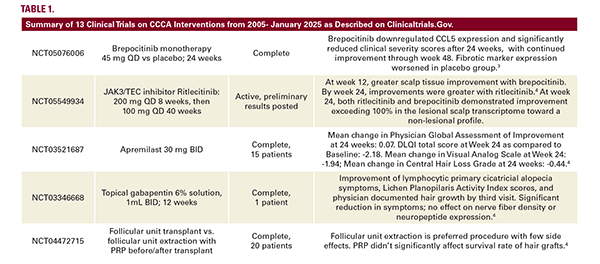
The terms "Central Centrifugal Cicatricial Alopecia", "CCCA", and "scarring alopecia" were searched on ClinicalTrials.gov. Data was extracted for all clinical trials investigating CCCA interventions from 2005 to January 2025. Thirteen clinical trials were found and analyzed, encompassing 12 therapies for CCCA (Table 1). Six studies were marked as "complete" with published results on ClinicalTrials.gov or PubMed. Seven studies marked as "active" or "recruiting" had no results yet available.
Brepocitinib, a tyrosine kinase 2/JAK1 inhibitor significantly reduced clinical severity scores (NCT05076006).3 Ritlecitnib, a JAK3 and tyrosine protein kinase inhibitor, resulted in greater improvement of scalp tissue at 24 weeks when compared to brepocitinib (NCT05549934).3 In clinical trial NCT03346668, topical gabapentin improved physician-documented hair growth.5
Some trials didn't show improvement with the investigated treatment. In NCT03521687, while apremilast resulted in slight quality of life improvement, there wasn't significant hair loss improvement.4 Similarly, microneedling (NCT04342091) and platelet-rich plasma (NCT04472715) didn't significantly improve alopecia severity scores or hair graft survival, respectively.2,4
The increasing number of CCCA clinical trials over the past two decades underscores a growing commitment to advancing targeted therapies and improving outcomes for patients with CCCA (Figure 1).
The terms "Central Centrifugal Cicatricial Alopecia", "CCCA", and "scarring alopecia" were searched on ClinicalTrials.gov. Data was extracted for all clinical trials investigating CCCA interventions from 2005 to January 2025. Thirteen clinical trials were found and analyzed, encompassing 12 therapies for CCCA (Table 1). Six studies were marked as "complete" with published results on ClinicalTrials.gov or PubMed. Seven studies marked as "active" or "recruiting" had no results yet available.
Brepocitinib, a tyrosine kinase 2/JAK1 inhibitor significantly reduced clinical severity scores (NCT05076006).3 Ritlecitnib, a JAK3 and tyrosine protein kinase inhibitor, resulted in greater improvement of scalp tissue at 24 weeks when compared to brepocitinib (NCT05549934).3 In clinical trial NCT03346668, topical gabapentin improved physician-documented hair growth.5
Some trials didn't show improvement with the investigated treatment. In NCT03521687, while apremilast resulted in slight quality of life improvement, there wasn't significant hair loss improvement.4 Similarly, microneedling (NCT04342091) and platelet-rich plasma (NCT04472715) didn't significantly improve alopecia severity scores or hair graft survival, respectively.2,4
The increasing number of CCCA clinical trials over the past two decades underscores a growing commitment to advancing targeted therapies and improving outcomes for patients with CCCA (Figure 1).