To the Editor,
American Indian/Alaskan Native (AI/AN) populations have been historically underrepresented in dermatologic research. Given that the term AI/AN encompasses over 574 federally recognized tribes with cultural, linguistic, genetic, and geographic differences, it is necessary to evaluate whether existing research accounts for this diversity.1,2 There are few studies investigating common skin conditions affecting AI/AN, and the results vary between them. Some conditions that have been cited as prevalent in AI/AN patients are the following: dermatitis, folliculitis, pityriasis alba, skin neoplasms, postinflammatory hyperpigmentation, actinic prurigo, and hypertrophic scar formation.1,3,4
This study investigates whether the AI/AN at a single institution in Southern California follows the trends from previous studies. A retrospective chart review was performed with AI/ AN patient encounters at Loma Linda University Department of Dermatology between 2010 and 2022. Inclusion was determined by the race indicated in the electronic medical record. Diagnoses were determined by ICD-10 codes from each encounter. The following ICD-10 codes were excluded from our results: Z79.899 (encounter for use of high-risk medication) and Z85.828 (history of skin cancer). To reduce inflation from follow-up or medication management, visits were filtered to only include initial consultations and office visits, leaving 3,515 encounters included in this study.
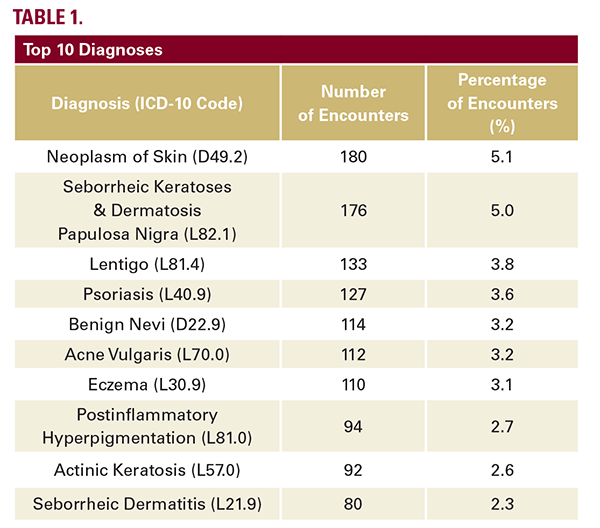
Neoplasm of the skin, seborrheic keratoses, lentigines, psoriasis, and nevi ranked as the top 5 diagnoses, respectively (Table 1). Surprisingly, folliculitis and pityriasis alba were only documented in 23 and 7 encounters, respectively. Hypertrophic scarring was documented in 20 encounters, and actinic prurigo was not seen in any encounter. Psoriasis being among the top 5 encounters was unexpected, as previous research indicates low prevalence in AI/AN.3 This data supports the necessity to reassess the dermatologic needs of AI/AN to better guide management and care of these populations. Given the paucity of research regarding the prevalence of dermatologic diseases within AI/AN populations, these findings suggest additional studies are warranted to better characterize any potential tribal differences or other factors that may affect AI/AN patients
American Indian/Alaskan Native (AI/AN) populations have been historically underrepresented in dermatologic research. Given that the term AI/AN encompasses over 574 federally recognized tribes with cultural, linguistic, genetic, and geographic differences, it is necessary to evaluate whether existing research accounts for this diversity.1,2 There are few studies investigating common skin conditions affecting AI/AN, and the results vary between them. Some conditions that have been cited as prevalent in AI/AN patients are the following: dermatitis, folliculitis, pityriasis alba, skin neoplasms, postinflammatory hyperpigmentation, actinic prurigo, and hypertrophic scar formation.1,3,4
This study investigates whether the AI/AN at a single institution in Southern California follows the trends from previous studies. A retrospective chart review was performed with AI/ AN patient encounters at Loma Linda University Department of Dermatology between 2010 and 2022. Inclusion was determined by the race indicated in the electronic medical record. Diagnoses were determined by ICD-10 codes from each encounter. The following ICD-10 codes were excluded from our results: Z79.899 (encounter for use of high-risk medication) and Z85.828 (history of skin cancer). To reduce inflation from follow-up or medication management, visits were filtered to only include initial consultations and office visits, leaving 3,515 encounters included in this study.
Neoplasm of the skin, seborrheic keratoses, lentigines, psoriasis, and nevi ranked as the top 5 diagnoses, respectively (Table 1). Surprisingly, folliculitis and pityriasis alba were only documented in 23 and 7 encounters, respectively. Hypertrophic scarring was documented in 20 encounters, and actinic prurigo was not seen in any encounter. Psoriasis being among the top 5 encounters was unexpected, as previous research indicates low prevalence in AI/AN.3 This data supports the necessity to reassess the dermatologic needs of AI/AN to better guide management and care of these populations. Given the paucity of research regarding the prevalence of dermatologic diseases within AI/AN populations, these findings suggest additional studies are warranted to better characterize any potential tribal differences or other factors that may affect AI/AN patients
seeking dermatologic care.2 Important next steps are to promote recruitment of AI/AN into dermatologic studies and further assess the generalizability of previous research. The authors recommend future studies consider the complex history and ethical considerations involving research in AI/AN populations and take particular care to maintain trust within these resilient communities.
DISCLOSURES
Jasmine Hawkins and Janiene Luke MD have no conflicts of
interest to disclose.
REFERENCES
- Kryatova MS, Okoye GA. Dermatology in the North American Indian/Alaska native population. Int J Dermatol. 2016;55(2):125-134.
- Mainous AG 3rd, Kelliher A, Warne D. Recruiting Indigenous patients into clinical trials: a circle of trust. Ann Fam Med. 2023;21(1):54-56.
- Cornelison RL. Cutaneous diseases in Native Americans. Dermatol Clin. 2003;21(4):699- 702.
- Fleischer AB Jr, Feldman SR, Bradham D. Office-based physician services provided by dermatologists in the United States in 1990. J Invest Dermatol. 1994;102(1):93-97.
AUTHOR CORRESPONDENCE
Jasmine Hawkins MD jasminerainhawkins@gmail.com