
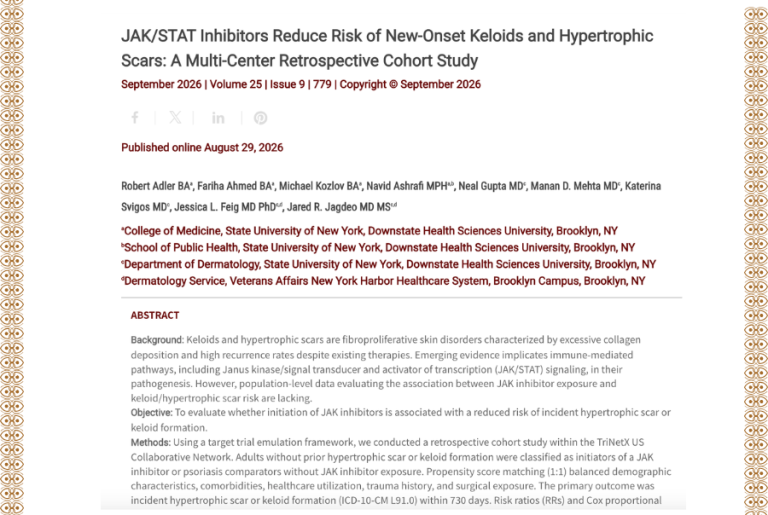
Targeting Fibroproliferative Disorders: Could JAK Inhibitors Lower Keloid and Hypertrophic Scar Risk?
Here is an essential new report from the JDD that could shift how we think about scar prevention. Keloids and hypertrophic scars present ongoing management challenges for clinicians, marked by persistent collagen hyperdeposition and frustratingly high recurrence rates following conventional therapies. While traditional approaches focus heavily on symptomatic control, recent research points toward immune-mediated pathways, specifically the JAK/STAT signaling cascade, as potential drivers of abnormal scar formation.
To explore this systemic connection on a broader scale, researchers leveraged real-world patient data through a large-scale retrospective cohort study. Utilizing a target trial emulation framework across a massive US database, the study analyzed adults with no prior history of excessive scarring. Investigators compared individuals initiating targeted Janus kinase systemic therapy against matched control cohorts to measure the two-year incidence of new keloid or hypertrophic scar diagnoses.
The results reveal a statistically significant reduction in both cumulative risk and overall hazard ratios for incident scar formation among patients receiving JAK inhibitor therapy. By controlling for critical confounding variables such as prior surgical exposure, localized trauma history, comorbidities, and baseline healthcare utilization, the trial provides compelling real-world evidence for the protective effects of immunomodulation.
As systemic therapies expand across dermatologic indications, understanding their secondary benefits on tissue remodeling offers valuable foresight for practice. Dive into the complete Journal of Drugs in Dermatology publication to explore the methodology, exact hazard ratios, and potential clinical applications for future scar prevention strategies.
Blog write-up assisted by AI