
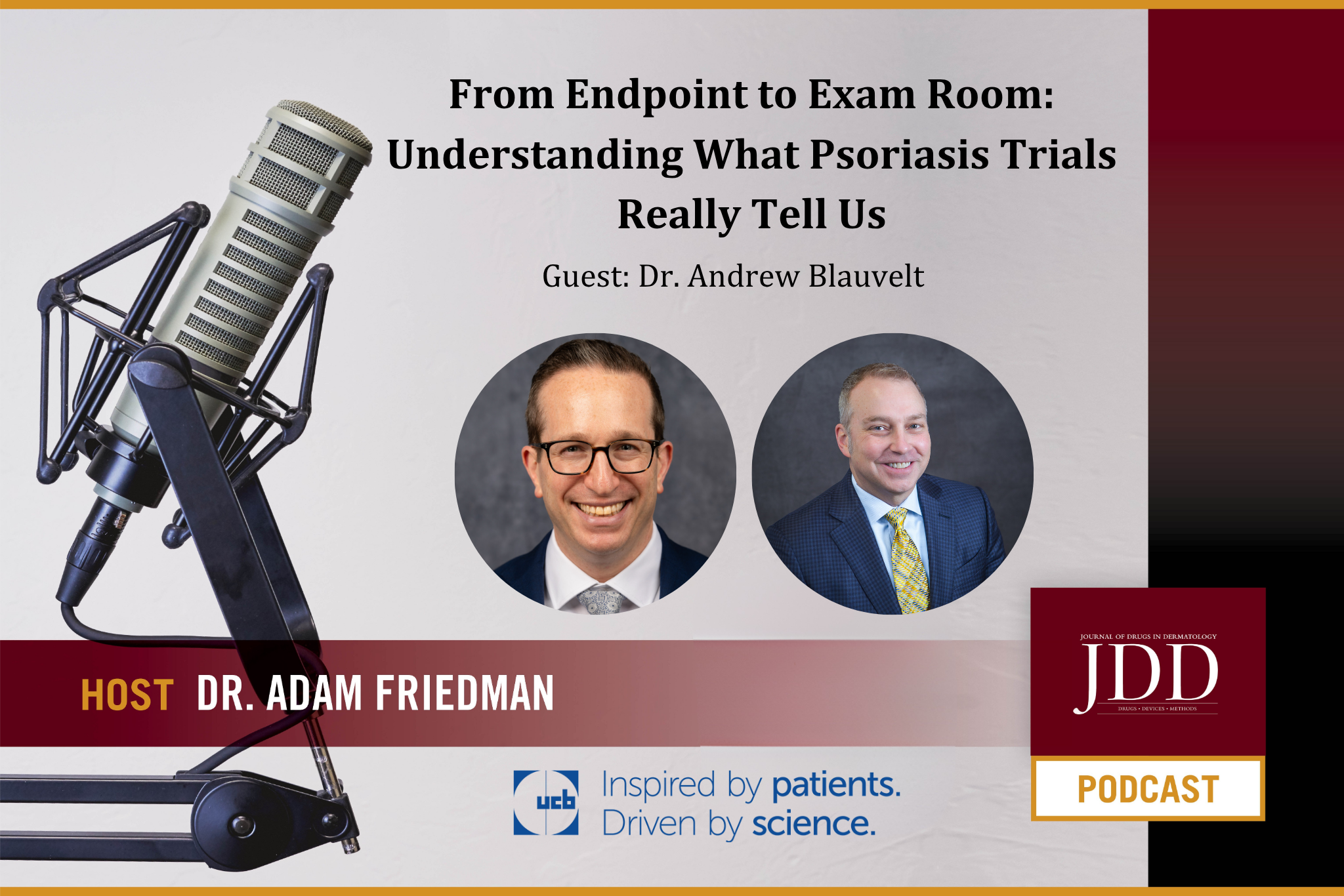
From Endpoint to Exam Room: Understanding What Psoriasis Trials Really Tell Us
Guest: Dr. Andrew Blauvelt
Not all psoriasis data tell the same story, and sometimes the loudest signal isn’t the most important one. In this episode of the JDD Podcast, host Dr. Adam Friedman sits down with internationally recognized psoriasis expert and clinical trial titan Dr. Andrew Blauvelt to unpack the critical nuances of clinical trial design, data interpretation, and how evidence can shape, or distort, clinical perception.
Before diving into any one therapy, Drs. Friedman and Blauvelt explore the foundations of data literacy, discussing how study design, endpoint selection, duration of follow-up, and safety reporting can dramatically influence how clinicians interpret efficacy and risk. They examine common pitfalls that lead to apples to oranges comparisons and discuss how early narratives can sometimes outpace the totality of evidence. Applying this framework to bimekizumab (Bimzelx), the conversation tackles persistent questions surrounding its safety profile, including the often-discussed candidiasis signal, while reviewing key lessons from the BE READY, BE VIVID, BE SURE, and BE RADIANT clinical programs. The discussion also highlights the growing importance of long-term disease control, including four year “no flare” data that may challenge traditional treatment expectations in psoriasis.
Whether you are evaluating a new therapy, comparing clinical trials, or simply trying to separate signal from noise, this episode offers practical insights into translating data into confidence, and ultimately into better patient management. You are welcome.
Episode Transcription
Introduction and Clinical Trial Foundations
Timestamp: 00:01
Dr. Adam Friedman: Welcome to the podcast, Dr. Blauvelt.
Dr. Andrew Blauvelt: Thank you, Adam. I am happy to be here.
Dr. Adam Friedman: Honestly, it is funny, Andy, I was thinking about how it is crazy that you have not been on this podcast before, especially given everything you have done in the world of clinical research, drug development, moving the needle, and getting our hands on so many very impactful medications. And this is all on this side of the table—this is my fault. So I am glad you are finally here so we can get into some of the very practical elements of clinical trial design so that those listening can actually make sense of it all. And I got to say, this is a throwback. I remember probably now almost 10 years ago, you were here at GW and you gave a talk as part of a psoriasis forum on just clinical research methodology. I still remember that talk because what you so uniquely do is distill these complex methods and analytical tools in such an approachable manner. So what I am really doing here is just setting you up for failure because everyone is going to expect this incredible review of clinical trial methodology. So, you are welcome.
Dr. Andrew Blauvelt: Well, it is something that I did solely for 13 years. I did not do anything else. I was a 100% clinical trialist for 13 years, ran a private center where we would average 35 to 40 trials at any one time. So I was the PI on, at any moment, 35 trials. And so that is a lot of balls in the air, a lot of experience. I do like to talk about it, and I did develop an expertise because of that.
Dr. Adam Friedman: So you say you dabble—you dabble a little bit, yeah.
Dr. Andrew Blauvelt: Not dabble, yeah. The opposite of dabbling.
Understanding Endpoints and Placebo Effects
Timestamp: 04:00
Dr. Adam Friedman: So with that in mind, and before we get into any specific drugs and the data supporting said drug, I want to level set. Psoriasis is a very crowded space, a lot of very good therapies, probably even more coming. Maybe to start off, what are some of the key elements of trial design that clinicians need to understand to actually interpret these studies correctly and translate them to the real world?
Dr. Andrew Blauvelt: Yeah, so it is a good question. We used to see many years ago week 12 as a primary endpoint time, and that is gone away. Almost everything has been week 16. So week 16 primary endpoint is very typical for psoriasis. It is also kind of emerged as the primary endpoint for most eczema trials. We do have a couple of the recent eczema trials with a week 24 endpoint. And this compares to, let’s say, like alopecia areata, where you need more time; there you have an endpoint usually of week 36. So for psoriasis, the first thing is the endpoint timing: week 16.
You always see a placebo group in the pivotal trials or the Phase 3 trials. That is required still by the FDA. We always look at the placebo response, right? And then look at the drug response, and the difference in those two we call the treatment effect. Normally in psoriasis trials, we have very low placebo rates, usually less than 10%, in the 5% range or so. And so the treatment effect is usually just what the drug is, because there is not much to subtract out.
On the other hand, in eczema trials, you see much more significant placebo effects. It is because moisturization is occurring as part of eczema trials, and moisturization by itself can lead to improvement of eczema. It is also because eczema can be more episodic, right? Going up and down with the weather, with the season, whereas psoriasis tends to be pretty stable. So we do not really worry about placebo responses being high in psoriasis trials; they are usually low. That is more in the AD realm. Then many trials will have a crossover where the placebo patients will then go on to active drug at week 16, and we see what their response is.
It is very easy, I would say, to compare trial to trial—even though they are not head-to-head normally—in psoriasis trials because the populations are normally very, very similar in terms of the inclusion/exclusion criteria and the demographics of the patients. We always say you can not compare study to study, la la la, but in psoriasis, everybody does it because the designs and the types of patients are so similar. So that is why you see many meta-analyses now comparing psoriasis biologics. I rely on them; I look to them. I think they are accurate to do those cross-study comparisons, again, because of the similarity in the designs and in the patients.
Evaluating Long-Term Efficacy Data (NRI vs. As-Observed)
Timestamp: 08:00
Dr. Andrew Blauvelt: I think the other kind of point here is when you get beyond week 16, everything changes. And what I mean by that is every company tends to look at their data differently—their long-term data—because now you do not have the placebo group, right? So you do not have the control group. People use observed data, they use non-responder imputation (NRI); some are strict, some are loose. It is much tougher to compare drug to drug, study to study, when you look at long-term efficacy. So always take the long-term efficacy with a grain of salt.
When you are looking at, for example, week 52 data, year two data, year three data, what kind of patients are we talking about? Which ones are they looking at? Did they select out, for example, the responders? Or is this what we say “tip to tail”—is it from week zero all the way to year two or year three? Or is it taking a subset of patients at week 16 that are responders and then only looking at them in the long run? Long-term data is much more precarious in terms of needing much more care in evaluating.
Dr. Adam Friedman: You totally got to what my second question was going to be, which was all about timing. You hit on this 16-week readout, which no doubt could look very different from a week 48, 52, or even four-year dataset. I think you hit on how we should be looking at that data and those differences with a grain of salt. It is so important, to what you said, knowing what is actually being evaluated. Who is the cohort, right? This is not your placebo-controlled cohort of very similar demographics. So I guess maybe take that a little further. What should we be looking at? You mentioned how the data is being analyzed—so NRI versus as-observed, last observation carried forward. Obviously, knowing that is important, as is knowing who is being studied. Is there anything else you want those looking at that OLE (open-label extension) or LTE (long-term extension) type data to really look at to make sense of it?
Dr. Andrew Blauvelt: Yeah, so the best long-term analysis, I would tell your listeners, is NRI: non-responder imputation. What does that mean? Those words mean that anyone who is stopping the study for any reason—and it could be due to poor efficacy, it could be due to a side effect, it could be because they moved away, or it could be because they just decided they did not want to come in anymore—is called a non-responder in an NRI analysis.
Dr. Adam Friedman: Correct.
Dr. Andrew Blauvelt: And so that is considered the most strict and, frankly, it is probably not the most accurate because it records patients who move away—who may be doing terrific on the drug—as non-responders. And so, but if drugs have the chops, is what I say, if drugs are great and they show great NRI data, I always say to the companies, “If you show NRI data, if you have great NRI data, you show it.” Not everybody can show NRI data. They do not want to because their efficacy does not look good when they do it by NRI. So if you want your data to look the best, you do not use NRI. But if you have a drug that is terrific, that is amazing, and your NRI data looks good, then you use it. Those companies really should be touting that it is NRI and it still looks terrific.
NRI is the toughest. The easiest is as-observed. As-observed means they only count the people who are still left in the trial. So let us say 100 people start, 50 people are left, and out of those 50, let us say half of them are responders; they will say a 25 out of 50, or 50% response rate, because that’s all that is left. The NRI would say 25 out of 100, a 25% response rate. So you can see how different it is between NRI and as-observed.
Then the intermediate one is what we call mNRI, and the “m” stands for modified. That’s maybe, in my opinion, the most accurate, if you will, because in a modified NRI, you’re counting patients who don’t respond and those who have a side effect as a non-responder, which is probably appropriate. But then the people who leave and get married or move away, dropping out of the study for just random reasons, those people are not called non-responders. So the mNRI is probably the closest to reality.
Dr. Adam Friedman: Just one clarification for the audience: “got chops” is a good thing, versus the Gen Z terminology “chopped,” which is bad. So I just want to make sure there’s no confusion here for anyone who’s Gen Z listening to this whatsoever. I had to. You put it out there—it was a layup for me. Thank you so much, Andy.
Deconstructing Safety Data and Background Rates
Timestamp: 13:40
Dr. Adam Friedman: But let’s switch gears to safety, because I think safety data can be especially tricky. I know I get a couple of beads of sweat when I have to go over the safety slides on those branded decks because there are so many different ways of portraying it—exposure-adjusted event rates, pooled analyses, differing follow-up durations. So many pitfalls, so little time. They can lead to overestimation or underestimation of risk. How do you approach those?
Dr. Andrew Blauvelt: Yeah, well, I teach about this all the time, Adam, as you know, because I spend a lot of time thinking about safety and a lot of time over the years looking at safety events, writing about them, and talking about them. So the first thing is easy: it’s the first 16 weeks. In the first 16 weeks, you have a placebo control. I always teach that it’s a simple percentage. What is the percent of people that have a URI (upper respiratory infection) in the placebo group versus the percentage of people that have a URI in the drug group, or whatever you’re looking at, right? That’s easy. I tell people to scan the placebo numbers and then scan the drug numbers side by side. Look at those percentages, and you’re looking for something that’s out of whack from the placebo numbers, right? You’re using the placebo there as your base.
So let’s say 10% of people get colds or URIs in the placebo group. In the drug group, if it’s 10%, there’s no effect. If it’s more like 12% or 13%, it’s probably nothing. But if it’s 20% colds versus 10%, then you’re thinking that’s a side effect and calling it a side effect. I don’t call things that happen on the drug side effects when it’s just random. If the numbers are 10 and 10 in the drug and placebo groups for colds, I would not say, “Oh look, the drug causes colds in 10% of people.” No, that’s not the way to interpret it. You compare it to the placebo, and if it’s the same, then you say the drug does not cause colds. Does that make sense?
Dr. Adam Friedman: Oh, absolutely.
Dr. Andrew Blauvelt: Okay, so that’s the easy part, right?
Dr. Adam Friedman: Yeah, it’s the next part where I’m like, “What is this patient-year nonsense?”
Dr. Andrew Blauvelt: Yeah. The next part is hard because you lose the placebo group after week 16. So now you have people on the drug, stuff is happening, and you’re collecting it. Let’s talk about famous things; let’s talk about heart attacks and cancer. Heart attacks and cancers occur in trials. If you’ve done enough trials like me—and there are others like me—stuff happens, right? Life happens during, especially during, a five-year trial. You are going to see people getting cancer, you are going to see people getting heart attacks, and you’re going to see people ending up in the hospital in a five-year trial of thousands of people. It does not mean those drugs cause heart attacks, cancers, or hospitalizations. So the first rule is don’t freak out when you see it while doing the trial, number one, and don’t freak out when you’re reading about it—like, “Dang, there’s a heart attack, there were three heart attacks, there are seven cancers.” Don’t freak out.
What you need to do is do the same sort of comparisons to see, quote-unquote, whether there’s a signal or not. How do you do that? What do you look at? You rely upon databases that are well-established that give you the rate of heart attacks or cancers in a given population over time, over a five-year period. Those are known, right? We know what the rate of heart attack is in the US population for certain ages. We know what the rate of cancer is. So there, you have to take the clinical trial numbers—the rate of those things, not the percentage, but the rate, which accounts for the time factor. You compare the rate of cancer or heart attacks on the drug in the study to the rate of those things in the community.
That’s what you do. That’s what we do. We look to see if those are out of whack. If they’re in line with the community rate, then we don’t say the drug causes cancer or causes heart attacks, even though there are cases of cancer and heart attacks in the trial.
Now, the only exception to this is you do have to look at each individual case looking for something weird. Take that one example I gave you of cancer, comparing the cancer rate in the community—what if the seven cancers are all the same one? A B-cell lymphoma, let’s say, or pancreatic cancer. There are seven cases of pancreatic cancer and nothing else. You do have to look at the individual cases to see if there’s something weird about the types of cancer or the types of heart attack, let’s say. This has come up recently with an AD (atopic dermatitis) drug: two cases of Kaposi sarcoma. Right? That is unusual. It doesn’t matter if it’s consistent with the background rate of Kaposi sarcoma; you just don’t see Kaposi sarcoma in a clinical trial for eczema. So sometimes there can be a rare signal, right? First you look at the background to make sure you’re consistent, and then you look at the types of these things happening, looking for weirdness is what I would say.
Dr. Adam Friedman: “Looking for weirdness”—that should be on a t-shirt, honestly. I would wear it. Who doesn’t like a graphic tee, right?
Dr. Andrew Blauvelt: Well, it’s funny, Adam, because a lot of companies will want to dismiss their cancer data and they’ll say, “Oh, the rate of cancer is low and there are seven cases.” And I’m always like, “Well, probably, but tell me what the seven are. Tell me actually what the seven cancers are.” Because, you know, you’ve got the low rate, which is good, but then do you have anything weird in those seven cases?
Dr. Adam Friedman: Right, if all seven cases are super weird cancers that wouldn’t typically happen, exactly. That’s when you’ve got to, I agree, keep scratching or pulling the thread a little bit to really understand: is this a real thing or is it just on par with patients of the same demographic and disease state, untreated, developing these? I love things like when you make those—I mean, it’s not a true comparison—but when you use a Kaiser cohort or large datasets to say, “All right, same exact patient, not on treatment, these are the rates of these things too.” I think that can be helpful. It’s not head-to-head, but it’s probably the closest thing we have.
Real-World Evidence vs. Claims-Based Databases
Timestamp: 21:00
Dr. Adam Friedman: Given all that, given all the different pieces that you just mentioned, are there any specific elements of clinical trial design—whether it be the various analytical tools where some are more stringent than others, or the issues with safety, especially when you don’t have a placebo—which you find lend themselves to the greatest opportunity for misinterpretation or creating misperceptions about a medication?
Dr. Andrew Blauvelt: Well, there’s a famous thing happening right now, and I really don’t like it, and it’s the TriNetX database. Have you heard of it?
Dr. Adam Friedman: I’m a little guilty on this one, but I’ve dabbled like you. I’ve dabbled in it a little bit.
Dr. Andrew Blauvelt: No, I have not dabbled in it; I’ve criticized it.
Dr. Adam Friedman: I’ve dabbled in clinical trials. No, I know you have.
Dr. Andrew Blauvelt: I’ve criticized it. TriNetX is a claims-based database. And so things are categorized by doctors who are putting in the code. Doctors put in codes, as you know, for various reasons. A recent example that was bad: TB rates of patients on IL-23 and IL-17 inhibitors were reported as being high. At the same time, I was publishing a paper saying you don’t have any TB with IL-17 and IL-23 inhibitors.
What happened in that paper where they were saying there’s a TB incidence is they were looking at TB codes and not active cases. Probably many people were putting in the TB code simply for doing a TB test. They were simply doing the TB test, putting in the TB code, and so those were not active cases of TB. The other part about that is they were rounding up, so that like one case and two cases were rounded up to 10. You can’t do that with rare diseases. You can’t round up to 10. So that paper was just wrong. It’s just wrong.
Dr. Adam Friedman: I think it speaks to garbage in, garbage out, right? I think that like any tool, you can use it well. I can see how utilizing large data like TriNetX is an awesome responsibility, because you can manipulate the data and be blind to the issues of the data and still put it out and create issues like you’re describing. Which, by the way, as an aside on behalf of all dermatology, thank you to you and your colleagues for that wonderful position statement about TB testing with IL-23s and IL-17s, where we hopefully are not arbitrarily testing. This probably played a role in the loss of that requirement in some new therapies, and maybe there’ll be some backtracking on that as well to really limit any hurdles for patients getting on advanced therapies for psoriasis. I think you’re right; something as stupid as the study you’re describing could possibly undermine that great work. I do believe, and I am a toxic optimist, things like TriNetX could be used for good, but there’s so much opportunity for it to be misconstrued and misinterpreted.
Case Study: Bimekizumab Safety Labeling and Misperceptions
Timestamp: 24:38
Dr. Adam Friedman: Along those lines, I think this is a great opportunity to segue into maybe a more translational discussion about how everything we’re talking about applies to some of the medications out there. I think bimekizumab is probably a good example. With some of those opportunities for things to be misinterpreted or misconstrued, what do you think some of the biggest misperceptions around the safety profile related to bimekizumab are, and where did those originate in the context of misinterpretation or misrepresentation of data?
Dr. Andrew Blauvelt: It’s a great example, Adam, and thank you for giving me the opportunity. Thanks for the comments about the TB paper. It actually has gotten a lot of press and a lot of traction, and we’re happy with that because we do not think it should be done; it’s unnecessary testing, unnecessary cost, and so forth. So thanks for that.
Very interestingly, it’s the fourth IL-17 blocker, right? We have secukinumab, brodalumab, and ixekizumab, and then along comes bimekizumab. Yes, it’s a little bit different in that it blocks IL-17A and IL-17F, but not really much different, right? It’s basically the same. I think it is more potent than the others because of the dual blockade of the two IL-17 isoforms that are most important. But I think it’s predominantly more similar than different compared to the other IL-17s. We knew from those IL-17s that there are two side effects: oral candidiasis and rare incidences of inflammatory bowel disease. Those are the side effects with IL-17 blockers.
We do have brodalumab with possible suicide, and it has that label. But then we have bimekizumab come along, and there was one suicide in the clinical trial program. In addition, patients were filling out forms asking about suicidal ideation. On one particular question, there were more common positive answers to suicidal ideation compared to the placebo group. But none of those patients went on to commit suicide, and none of them had the same answer at the next visit. So it was kind of like a spurious questionnaire issue. Then the FDA decides to give it a warning for suicide. No expert that I know believed that that should have been done.
We actually published a paper, and I’m the first author on it, where we looked at suicide across biologic trials. Guess what? There are suicides with all the biologics—one or two cases here and there. Brodalumab had four; brodalumab had the most, and thus the boxed warning. But the other drugs had one or two, just like bimekizumab had one. And so they don’t have the label, but bimekizumab got the label. The FDA is commenting on this questionnaire data as well as evidence, but it’s really weak. It’s very weak. I think that wording shouldn’t be on the label. I just think it is unnecessary; I don’t think it’s accurate. I think the suicide seen is consistent with background levels of suicide and actually lower than the rate of suicide in psoriatics, right? Because having psoriasis by itself predisposes to suicide. So anyway, that one I feel pretty strongly is a misinterpretation of the data by the FDA.
Dr. Adam Friedman: And it behooves me to bring up—we did publish with one of my faculty, Leandra Johnio, using TriNetX, mind you, showing in the real world the rates of suicide are on par or even lower than with IL-23s. And those are obviously not anything that we raise our eyebrows about. So maybe a good utilization of an “evil” tool, perhaps. But no, I agree, and this is the conversation I have with my patients. The fact that I have to have that conversation really brings up the concept of the “hassle effect,” where the fact that people might have to have this conversation because it’s in there as a warning might actually shift someone away from considering this as an option, given the super busy nature or the rapid pace of dermatology practice today. So I think it does actually hurt patients when this type of data is misinterpreted.
Dr. Andrew Blauvelt: It does.
Managing Oral Candidiasis and Evaluating High PASI Responses
Timestamp: 29:39
Dr. Adam Friedman: You mentioned candida, and I think that risk has been a focal point. How much of that concern is rooted in a true signal versus how the data was initially communicated?
Dr. Andrew Blauvelt: I’ve used so many IL-17s in my career. It’s a true signal, and it’s a higher signal with bimekizumab. That’s what I would say on the numbers. My feeling and my experience, again, with treating hundreds of patients—I would say for ixekizumab and secukinumab, it’s 2% to 3%. It’s pretty low; you see it here and there occasionally. But in bimekizumab, in my view, it’s more in the 10% to 15% range; you see it more commonly. You’ve got risk factors, right? Age, dentures, diabetes, smoking—all of those things are going to increase the risk of oral candidiasis. Even though it’s a higher rate, though, I didn’t really have any patients stop bimekizumab due to it. We were easily managing them with oral Diflucan, or fluconazole. So it is, I think, a true signal. It is more with bimekizumab. I think it’s because the F component, IL-17F, is more involved in the control of candida inside the mouth. Because we have bimekizumab blocking IL-17F, you see more oral candidiasis.
Dr. Adam Friedman: I’m totally with you. I don’t think it’s a deal-breaker. I talk to patients about it. I’ve definitely had a handful of patients develop some flavor of candidiasis, and it is really easy to manage. I think we all as dermatologists should be comfortable managing it. What’s the alternative, right? Managing candidiasis versus having a patient with uncontrolled disease, whether it be plaque plus or minus arthritic disease? I think that has to really win the day when it comes to the decision. But yeah, I agree. I think it’s real, but it’s not a deal-breaker—that’s the way I talk about it as well.
With any of this, it’s helpful also having so much data to predict what is a potential real signal versus, to your point, probably misleading. I mean, of course, and I can’t even imagine how much money went into naming all these studies—BE READY, BE VIVID, BE SURE, BE RADIANT. It sounds like a shampoo commercial, not a clinical trial program for psoriasis. But all these add an extra layer. How do you keep it straight? How do you synthesize all this data without falling into apple-to-orange comparisons? What really stands out to you?
Dr. Andrew Blauvelt: Well, I don’t always use the names of the trials, but I will remember the comparators—what it was compared against. One thing we haven’t said about bimekizumab yet is that it’s the highest PASI 100 drug. If you’re looking for the best chance of clearance, I think it’s the best drug we have right now available for three diseases, actually: for PSO (psoriasis), for PSA (psoriatic arthritis), and for HS (hidradenitis suppurativa).
To me, it’s been a wonderful new development, sort of building on the theme, building on the years of advancement, getting better and better and better. It has the edge. It doesn’t mean the other drugs aren’t wonderful, but when you look at PASI 100, that’s where the wheat separates from the chaff, right? PASI 100 is a way to look at drugs that are comparable because really, the highest-performing drugs will do the best in PASI 100. If you look at PASI 90, they might look similar, but you go to PASI 100, that’s when they separate. And that’s where bimekizumab has the top perch right now.
Clinical Significance of Complete Clearance and Long-Term Durability
Timestamp: 33:38
Dr. Adam Friedman: Yeah, agreed. I think also, for me, one of the most compelling aspects of the story is the four-year data, especially the no-flare data. I find it’s interesting—I think every disease state has its own personality in terms of what patients are willing to tolerate. AD patients set the bar so low; you get them a little bit better and they’re like, “Oh, it’s amazing, don’t mess with it.” Psoriasis patients are like, “Do you see that? Do you see that little white speck? Oh my God, my psoriasis is back.” That’s a generalization, but they know—and many thanks to the NPF (National Psoriasis Foundation) for this call to complete clearance—they should demand complete clearance. And so I think this durability, because these patients have been burned by older medications that maybe do well initially and burn out, this four years of no-flare data is actually very meaningful. What to you does that mean clinically in terms of that four-year story?
Dr. Andrew Blauvelt: Yeah, so I really became a fan of PASI 100 early on in my trial career. I say that because in trials, you see patients every month, or often every month, and you get to know them. When they’re doing well, you’re searching for, “Do they have one spot?” When you walk in and they say, “I’ve got nothing,” and you confirm it, we’re in that realm over and over again. If you’re doing trials with good drugs, you’re focusing really on PASI 100. You’re looking for traces every month. It is true that we’ve gotten spoiled with it, but it also is true that if you look at the quality-of-life data, patients take quite a big hit on their quality of life when they have even a single lesion.
I always teach dermatologists: don’t minimize the effect of one lesion. When you walk in the door and they have a single plaque, don’t say, “Oh, you’re doing fine, see you later, we’re going to keep things the same.” Don’t assume that they are okay with that one plaque, because a lot of patients are not. Of course, depending on where it’s at—if it’s on the shin of a woman, it’s not going to be a good thing for dresses and shorts. If it’s in the scalp, it’s not going to be a good thing; it’s going to be creating scales onto the shoulders. So even a little bit of psoriasis can have a pretty big impact on quality of life. Don’t assume.
What I always say to clinicians is ask them about that. Maybe 90% of people will be okay with a single plaque and you’re not going to change anything, but there are going to be patients who say, “Yeah, I want to do something else because I want to get to zero.”
Moving from Caution to Confidence with New Biologics
Timestamp: 36:34
Dr. Adam Friedman: I think that easily could be one of many answers to my final question for you, which is really about the clinician who’s still hesitant to make that leap or maybe to welcome newer therapeutics into their armamentarium in terms of an IL-17A and F inhibitor. I think that is a good answer: recognizing that a small BSA (body surface area) can have a huge impact. As you said, it’s so important to never assume just because you think they’re doing better doesn’t mean they think they’re doing better, and that could easily erode the relationship you’ve worked so hard to develop. Is there maybe one piece of data or way of thinking about data that you think can help move someone from caution to confidence when it comes to, for example, bimekizumab?
Dr. Andrew Blauvelt: Well, I teach that IL-23 and IL-17 blockers are safer than apremilast. And that shocks a lot of people.
Dr. Adam Friedman: Yeah, that is a bold statement. I like that statement.
Dr. Andrew Blauvelt: They think with apremilast, well, there are no labs. Well, there are no labs with IL-23s and IL-17s either. They don’t cause liver issues or blood test issues, and now you don’t have to test for TB issues. I think apremilast causes some issues, right? It causes some GI intolerability. It has a little bit of a depression/suicide signal around 1%. It has some weight loss, which is not necessarily bad, but can be bad. So there are some things there.
Just the assumption, kind of like a knee-jerk reaction: “Well, biologics cause infections, biologics cause cancers.” Well, it’s just not true for IL-17s and IL-23s. That’s TNF inhibitors, right? That’s rooted in sort of the original thinking of biologics. It depends on what biologic you’re talking about, and the newer ones are terrific and super safe.
Dr. Adam Friedman: Well, Andy, thank you. First of all, it’s an engaging interaction, and I always learn something when we get together. I hope everyone who joined us did as well. Keep it up, man. Psoriasis—it’s funny, I say psoriasis has become really easy to treat because we have such great medications. And very much thanks to folks like you who have taken them from concept to actually the at-home delivery pharmacy. So we thank you, and we’re excited to see what comes next.
Dr. Andrew Blauvelt: Good. Thanks, Adam.
Dr. Adam Friedman: And thank you all for joining us for this edition of the JDD Podcast.
Podcast: Play in new window | Download
Subscribe: RSS