
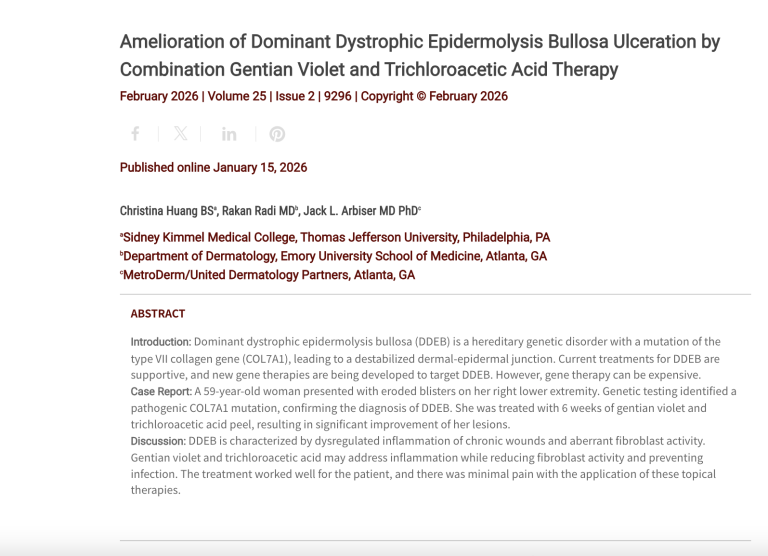
Case report: six weeks of gentian violet and trichloroacetic acid peel produced marked healing in dominant dystrophic epidermolysis bullosa with minimal discomfort
The February 2026 JDD issue features a case report about a 59‑year‑old woman with genetically confirmed dominant dystrophic epidermolysis bullosa (COL7A1 mutation) and chronic eroded blisters of the lower leg. She experienced significant lesion improvement after a six‑week course of topical gentian violet combined with trichloroacetic acid (TCA) peeling. The authors propose the benefit reflects a combination of antiseptic/anti‑inflammatory effects, modulation of fibroblast activity, and improved wound hygiene rather than curative repair of the underlying collagen defect. The treatment was well tolerated with minimal pain reported, offering a low‑cost, pragmatic option in a condition where definitive gene therapies remain investigational and costly.
What’s the clinical takeaway? This is a hypothesis‑generating, single‑patient observation: consider gentian violet ± focal TCA in select, recalcitrant DDEB wounds as a potential adjunct when conventional measures fail, but proceed cautiously given fragile skin, risks of irritation or deeper injury with chemical peeling, and the lack of controlled data.
Read the full report for clinical images, application context and safety notes before adapting this approach in your clinic—and consider reporting outcomes to build evidence.
J Drugs Dermatol. 2026;25(2). doi:10.36849/JDD.9296
Blog write-up assisted by AI